Colons to introduce a list worksheet for Year 6: Colons for lists
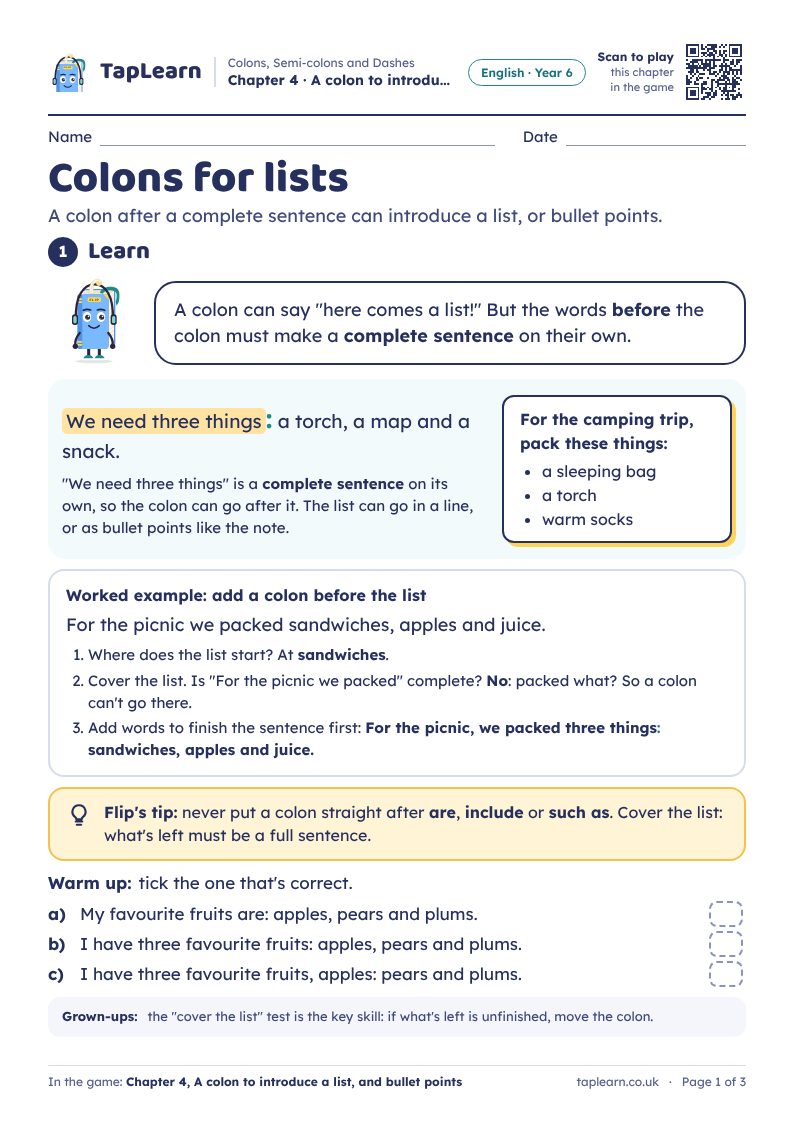
Colons for Lists is a printable colons to introduce a list worksheet for Year 6 (ages 10 to 11) that teaches children to put a colon after a complete sentence to start a list, checking with the cover-the-list test. It covers the Year 6 English statements on using a colon to introduce a list, and the term bullet points.
This worksheet is for members
Membership opens every chapter of every game and every worksheet, for all your children.
See the plansAlready a member? Log in to print it.
Start with the free one: Clause islands (chapter 1).
Print it on A4, in colour or black and white. Do it after the chapter, or before it to see what your child already knows.
What's on the worksheet
Your child puts a colon after a complete sentence to introduce a list or bullet points, and fixes colons after are, include and such as. Includes a pack-the-bag list for a day out and an answers sheet.
- Page 1 · Learn
- A colon saying here comes a list, in a line or as bullet points, a worked example with a picnic list, Flip's never-after-are-or-such-as tip, and a tick-the-correct-one warm-up.
- Page 2 · Try it together
- Pack the bag: choose a day out, write a complete sentence ending with a colon, add each item as a bullet point, then pack the bag together and tick each item as it goes in.
- Page 3 · Practise
- Add colons, tick or cross colons in sentences, rewrite a wrong one, turn a den-building sentence into bullet points, write your own list sentence, and a challenge.
- Answers sheet
- Every answer, mix-ups like a colon straight after include, and a say-the-colon idea.
3 A4 pages and an answers sheet · about 25 minutes
Using it at home
- Teach the cover-the-list test: cover the list with a finger, and if what's left is unfinished, move the colon.
- In pack the bag, keep the bullet points the same style: all short phrases, with no full stops.
- Say "I can see three things in this room, colon…" and the list, then try a wrong one to hear why it sounds odd.
Watch out for
- Putting a colon straight after are, include or such as.
- Cover the list: if what's left is unfinished, move or remove the colon.
- Putting the colon in the middle of the list.
- It goes once, just before the first item.
- Using a comma instead of a colon after a complete sentence that introduces a list.
- Swap it for a colon.
Questions from the worksheet
- Add a colon in the right place: Leo collects three things stamps, shells and badges. The recipe needs these ingredients flour, eggs and milk.
- Tick the sentences where the colon is correct. Cross the others: The colours of the flag are: red, white and blue. The flag has three colours: red, white and blue.
- Turn this sentence into a bullet-point list. Keep the colon: To build a den, you will want these things: a big sheet, some cushions, four chairs and a torch.
- Write your own sentence about your favourite foods, with a colon to introduce the list.
- Sam wrote: My hobbies include: football, chess and drawing. Is the colon right? Explain, and fix it in two different ways.
The answers are on the answers sheet, for grown-ups.
National curriculum in England
This worksheet practises these statements from the Year 6 english programme of study:
- Terminology: subject, object, active, passive, synonym, antonym, ellipsis, hyphen, colon, semi-colon, bullet points
- Indicate grammatical and other features by: using a colon to introduce a list (Years 5–6 english)
- Punctuation: use of the colon to introduce a list and use of semi-colons within lists
In the classroom
- Use Practise B as a quick true or false starter with the cover-the-list test.
- Pairs write a bullet-point list for a class trip, starting with a complete sentence and a colon.
Questions and answers
How do you use a colon to introduce a list?
Put the colon after a complete sentence, just before the first item: I have three favourite fruits: apples, pears and plums.
Can you put a colon after are or such as?
No. The words before the colon must make a complete sentence, so My favourite fruits are: apples… is wrong. Take the colon out, or finish the sentence first.
How do bullet points work with a colon?
Write a complete sentence ending with a colon, then put each item on its own line with a bullet point, keeping them all in the same style.
 TapLearn