Semi-colons in lists worksheet for Year 6
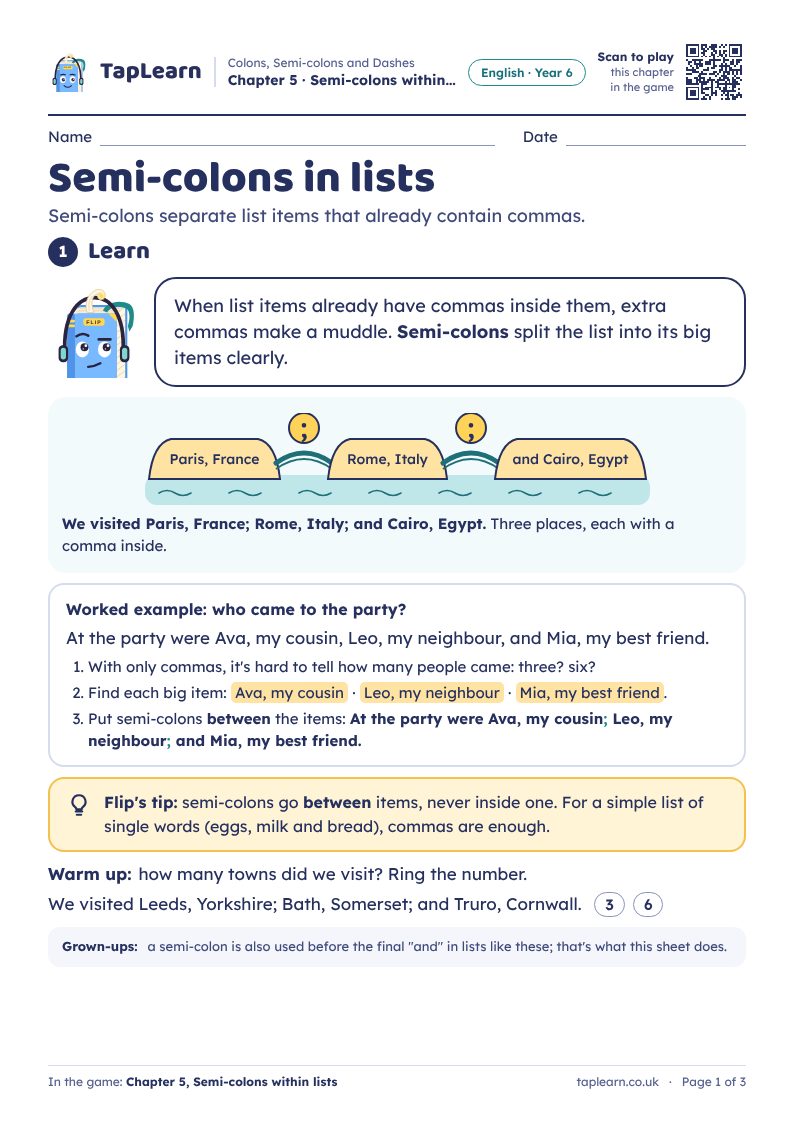
Semi-colons in Lists is a printable semi-colons in lists worksheet for Year 6 (ages 10 to 11) that teaches children to use semi-colons between list items that already contain commas, as in Paris, France; Rome, Italy; and Cairo, Egypt. It covers the Year 6 English statement on using semi-colons within lists.
This worksheet is for members
Membership opens every chapter of every game and every worksheet, for all your children.
See the plansAlready a member? Log in to print it.
Start with the free one: Clause islands (chapter 1).
Print it on A4, in colour or black and white. Do it after the chapter, or before it to see what your child already knows.
What's on the worksheet
Your child uses semi-colons to separate list items that already contain commas, like Paris, France; Rome, Italy, and knows when commas are enough. Includes a dream trip list and an answers sheet.
- Page 1 · Learn
- Why extra commas make a muddle, a worked example making a party guest list clear with semi-colons, Flip's between-items-never-inside tip, and a how-many-towns warm-up.
- Page 2 · Try it together
- Dream trip list: each choose three places to visit, written as town, country, then the child writes them as one sentence and explains where the semi-colons go and why.
- Page 3 · Practise
- Decide whether lists need semi-colons, add them to long lists, correct mistakes, write a list of three people with descriptions, explain when to use them, and a challenge.
- Answers sheet
- Every answer, mix-ups like a semi-colon inside an item, and a family-list idea.
3 A4 pages and an answers sheet · about 25 minutes
Using it at home
- Point out that the commas stay inside each place (Rome, Italy) and the semi-colons go between places.
- Read the dream trip sentence aloud with a longer pause at each semi-colon.
- Say three relatives with a description each, and your child says where the semi-colons would go.
Watch out for
- Using only commas in a long list, so the items run together.
- Ask, "How many things are in this list?"
- Putting a semi-colon inside an item, like Cardiff; Wales.
- The comma stays inside the item; the semi-colon goes between items.
- Using semi-colons in a simple list of single words.
- Commas are enough there.
Questions from the worksheet
- Does the list need semi-colons? Ring Yes or No: I bought apples, pears and plums. I met Leo, the captain, Ava, the goalkeeper, and Sam, the coach.
- Add semi-colons between the list items: The winners were Sam, Year 5, Mia, Year 6, and Ava, Year 4.
- Each list has a mistake. Write it correctly: We visited Cardiff; Wales, Glasgow; Scotland, and Belfast; Northern Ireland. My pets are cats; dogs; and rabbits.
- Explain in your own words when a list needs semi-colons instead of commas.
- I invited Mia, my cousin, Sam and Ava. How many people might be invited? Rewrite it with semi-colons to show that Mia is my cousin.
The answers are on the answers sheet, for grown-ups.
National curriculum in England
This worksheet practises these statements from the Year 6 english programme of study:
- Terminology: subject, object, active, passive, synonym, antonym, ellipsis, hyphen, colon, semi-colon, bullet points
- Punctuation: use of the colon to introduce a list and use of semi-colons within lists
In the classroom
- Use the challenge sentence as a class discussion: how many people were invited?
- Pupils write a list of three class jobs with a description each, using semi-colons.
Questions and answers
When do you use semi-colons in a list?
Use semi-colons to separate list items that already contain commas, so each big item is clear: Ava, my cousin; Leo, my neighbour; and Sam, the coach.
Do simple lists need semi-colons?
No. For a list of single words or short items, like eggs, milk and bread, commas are enough.
Is there a semi-colon before the last and?
In lists like these, yes: this sheet puts a semi-colon before the final and, as in Bath, Somerset; and Truro, Cornwall.
More worksheets from Colons, Semi-colons and Dashes: Bridge the Clause Islands
- Chapter 1: Independent clauses worksheet: Clause islands Free
- Chapter 2: Semi-colons worksheet: Semi-colon bridges Members
- Chapter 3: Colons and dashes worksheet Members
- Chapter 4: Colons to introduce a list worksheet: Colons for lists Members
- Chapter 6: Punctuation terminology worksheet: Punctuation names Members
 TapLearn