Independent clauses worksheet for Year 6: Clause islands
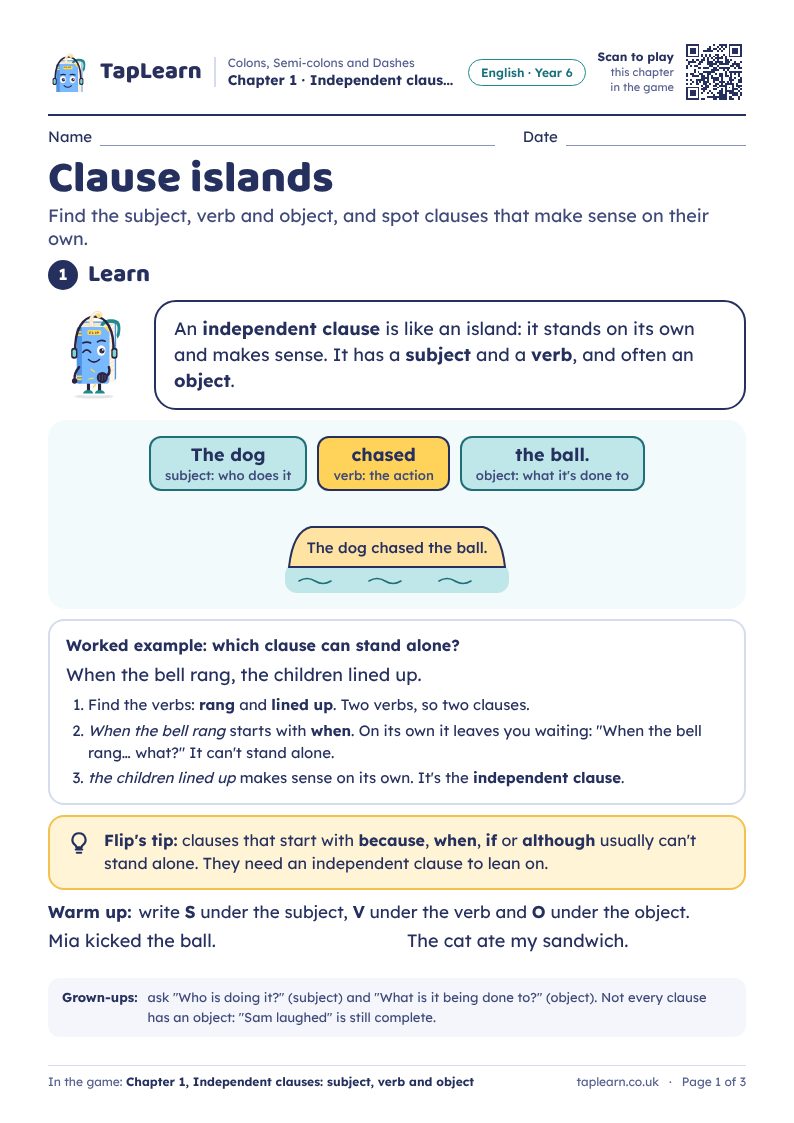
Clause Islands is a printable independent clauses worksheet for Year 6 (ages 10 to 11) that teaches children to find the subject, verb and object and to tell a clause that stands alone from one starting with because, when or if. It covers the Year 6 terms subject and object, ready for the Year 6 English statement on using a semi-colon, colon or dash to mark the boundary between independent clauses.
Free to print, no account needed.
Print it on A4, in colour or black and white. Do it after the chapter, or before it to see what your child already knows.
What's on the worksheet
Your child finds the subject, verb and object in a clause, tells whether a clause can stand on its own, and spots where one clause ends. Includes an act-it-out activity with toys and an answers sheet.
- Page 1 · Learn
- An independent clause as an island, with subject, verb and object labelled in The dog chased the ball, a worked example finding the clause that stands alone, Flip's because-when-if tip, and an S-V-O warm-up.
- Page 2 · Try it together
- Act it out: the grown-up acts out a sentence with soft toys, like Teddy pushes the cushion, and the child names the subject, verb and object. Swap roles and fill in the table.
- Page 3 · Practise
- Mark the subject, verb and object, tick clauses that stand alone, split two clauses run together, swap subject and object, and a challenge about Because the shop was closed.
- Answers sheet
- Every answer, mix-ups like because clauses written as sentences, and a finish-my-clause idea.
3 A4 pages and an answers sheet · about 25 minutes
Using it at home
- Ask "Who is doing it?" for the subject and "What is it being done to?" for the object. Not every clause has an object: "Sam laughed" is still complete.
- In act it out, swap the subject and object ("The cushion pushes Teddy!") to show how the meaning changes.
- Say "Because it was snowing…" and your child adds an independent clause to finish it.
Watch out for
- Writing because, when or if clauses as sentences.
- Read it aloud and ask, "Does it leave you waiting for more?"
- Swapping the subject and the object.
- Ask "Who's doing it?" for the subject and "What's it done to?" for the object.
- Missing the boundary between two clauses.
- Find each verb, then ask who is doing it: each new subject and verb is a new clause.
Questions from the worksheet
- Underline the subject, ring the verb and draw a box round the object: The wind shook the windows. Our class planted three trees.
- Tick the clauses that can stand on their own: because it was raining, The river flooded., when we got home, Sam laughed.
- Each line has two independent clauses run together. Draw a line / where the first clause ends: The sun came out we went to the beach.
- Swap the subject and the object. Write the new sentence, then say how the meaning changes: The goalkeeper caught the ball.
- Sam says, "Because the shop was closed. is a full sentence. It has a subject and a verb." Is he right? Explain, and make it into a full sentence.
The answers are on the answers sheet, for grown-ups.
National curriculum in England
This worksheet practises these statements from the Year 6 english programme of study:
- Punctuation: use of the semi-colon, colon and dash to mark the boundary between independent clauses
- Terminology: subject, object, active, passive, synonym, antonym, ellipsis, hyphen, colon, semi-colon, bullet points
In the classroom
- Use Practise C as a mini-whiteboard task: pupils write the word where the first clause ends.
- Act out subject-verb-object sentences with props at the front of the class.
Questions and answers
What is an independent clause?
An independent clause is a group of words with a subject and a verb that makes sense on its own, like The dog chased the ball. It could be a sentence by itself.
What is the difference between the subject and the object?
The subject is who or what does the action; the object is what the action is done to. In Leo painted the fence, Leo is the subject and the fence is the object.
Why can't a because clause stand alone?
Because makes the clause depend on another one, so on its own it leaves you waiting. Add an independent clause: We went home because the shop was closed.
More worksheets from Colons, Semi-colons and Dashes: Bridge the Clause Islands
- Chapter 2: Semi-colons worksheet: Semi-colon bridges Members
- Chapter 3: Colons and dashes worksheet Members
- Chapter 4: Colons to introduce a list worksheet: Colons for lists Members
- Chapter 5: Semi-colons in lists worksheet Members
- Chapter 6: Punctuation terminology worksheet: Punctuation names Members
 TapLearn