Semi-colons worksheet for Year 6: Semi-colon bridges
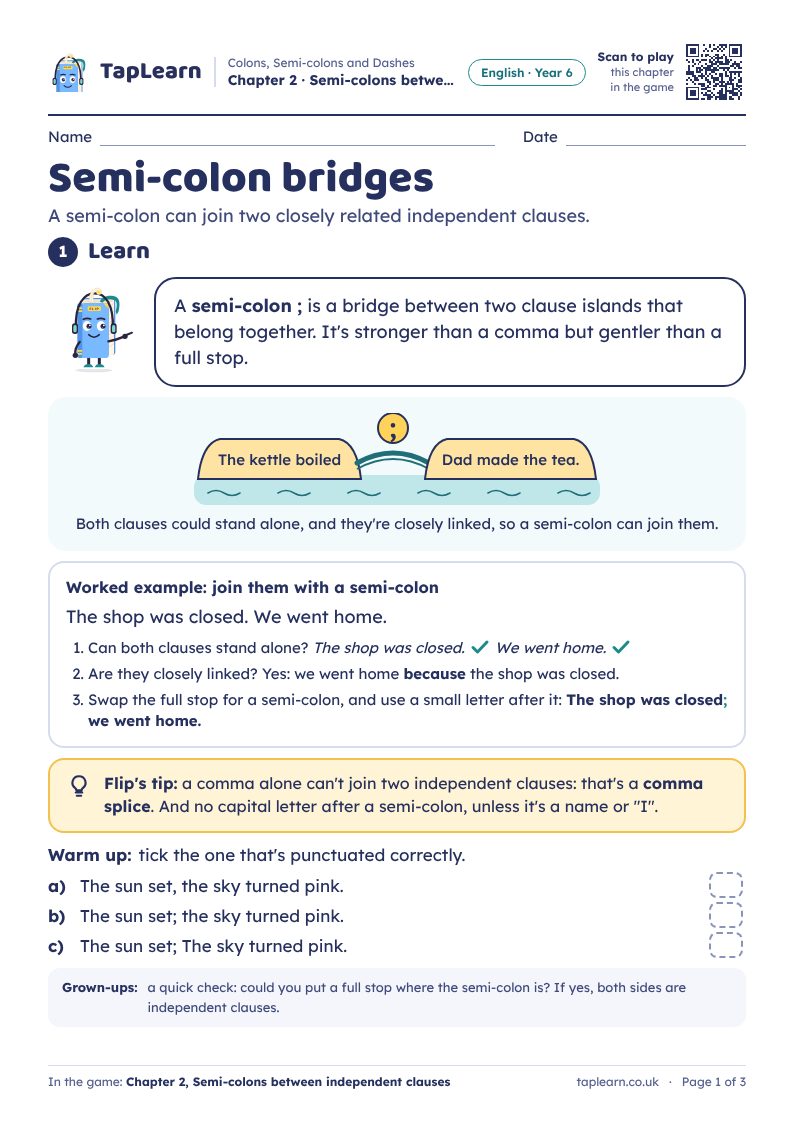
Semi-colon Bridges is a printable semi-colons worksheet for Year 6 (ages 10 to 11) that teaches children to join two closely linked independent clauses with a semi-colon, as in The shop was closed; we went home. It covers the Year 6 English statement on using a semi-colon, colon or dash to mark the boundary between independent clauses.
This worksheet is for members
Membership opens every chapter of every game and every worksheet, for all your children.
See the plansAlready a member? Log in to print it.
Start with the free one: Clause islands (chapter 1).
Print it on A4, in colour or black and white. Do it after the chapter, or before it to see what your child already knows.
What's on the worksheet
Your child joins two closely linked independent clauses with a semi-colon, fixes comma splices and uses a small letter after the semi-colon. Includes a clause matching game with paper scraps and an answers sheet.
- Page 1 · Learn
- The semi-colon as a bridge between two clause islands, a worked example joining The shop was closed and We went home, Flip's comma-splice tip, and a tick-the-correct-one warm-up.
- Page 2 · Try it together
- Clause matching: the grown-up writes three pairs of linked clauses on scraps of paper, the child matches each pair and puts a big semi-colon between them, then tries a mismatched pair.
- Page 3 · Practise
- Add semi-colons, rewrite comma splices, tick closely linked pairs, write a linked clause on the empty island, write your own sentence, and a challenge about a capital letter.
- Answers sheet
- Every answer, mix-ups like comma splices, and a say-it-with-a-semi-colon idea.
3 A4 pages and an answers sheet · about 25 minutes
Using it at home
- A quick check: could you put a full stop where the semi-colon is? If yes, both sides are independent clauses.
- In clause matching, remind your child the second clause starts with a small letter.
- Take turns: one of you says a clause ("The dog was muddy") and the other adds a linked one ("he'd been in the pond").
Watch out for
- Joining two sentences with just a comma (a comma splice).
- Ask, "Could each part be a sentence on its own?" If yes, a comma isn't enough.
- Putting a capital letter after the semi-colon.
- The sentence carries on, so it's a small letter, except for names and I.
- Joining unrelated ideas.
- A semi-colon says these two belong together. If they don't, use a full stop.
Questions from the worksheet
- Add a semi-colon where the first clause ends: Mia loves swimming she goes every Saturday. Leo forgot his lunch his friend shared hers.
- These are comma splices. Rewrite each one with a semi-colon: It was freezing, we wore our hats. The phone rang, nobody answered it.
- A semi-colon joins clauses that are closely linked. Tick the good ones; cross the others: The oven was too hot; the cake burnt. I like pasta; the bus is red.
- Write your own sentence: two linked clauses joined by a semi-colon.
- Leo wrote: The rain stopped; We went outside to play. Is it right? Explain and correct it.
The answers are on the answers sheet, for grown-ups.
National curriculum in England
This worksheet practises these statements from the Year 6 english programme of study:
- Punctuation: use of the semi-colon, colon and dash to mark the boundary between independent clauses
- Terminology: subject, object, active, passive, synonym, antonym, ellipsis, hyphen, colon, semi-colon, bullet points
- Indicate grammatical and other features by: using semicolons, colons or dashes to mark boundaries between independent clauses (Years 5–6 english)
In the classroom
- Use Practise C as a thumbs up, thumbs down check on whether each pair is closely linked.
- Give pairs a set of clause cards to match and join with a semi-colon card.
Questions and answers
How do you use a semi-colon in Year 6?
A semi-colon joins two independent clauses that are closely linked, like The kettle boiled; Dad made the tea. Both sides must make sense on their own.
What is a comma splice?
A comma splice is two complete sentences joined with just a comma, like It was freezing, we wore our hats. Use a semi-colon or a full stop instead.
Do you use a capital letter after a semi-colon?
No. The sentence carries on after a semi-colon, so the next word has a small letter unless it's a name or I.
More worksheets from Colons, Semi-colons and Dashes: Bridge the Clause Islands
- Chapter 1: Independent clauses worksheet: Clause islands Free
- Chapter 3: Colons and dashes worksheet Members
- Chapter 4: Colons to introduce a list worksheet: Colons for lists Members
- Chapter 5: Semi-colons in lists worksheet Members
- Chapter 6: Punctuation terminology worksheet: Punctuation names Members
 TapLearn