Colons and dashes worksheet for Year 6
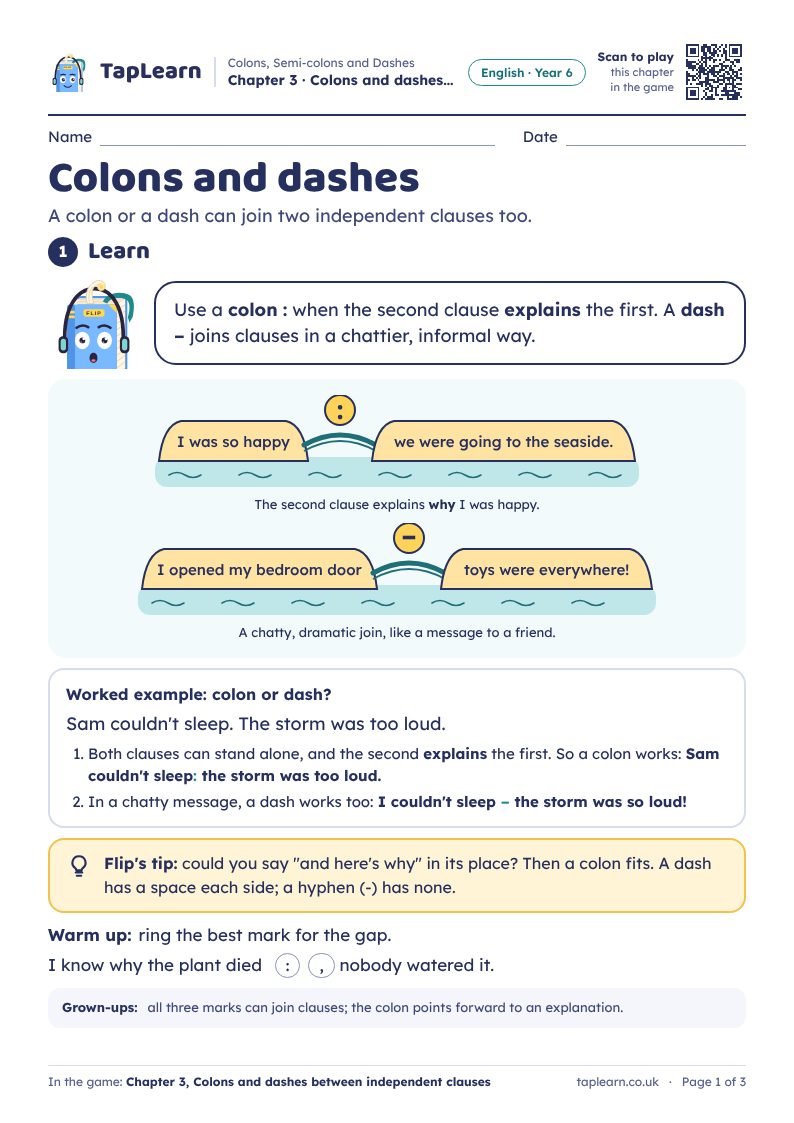
Colons and Dashes is a printable colons and dashes worksheet for Year 6 (ages 10 to 11) that teaches children to use a colon when the second clause explains the first, and a dash to join clauses in chattier writing. It covers the Year 6 English statement on using a semi-colon, colon or dash to mark the boundary between independent clauses.
This worksheet is for members
Membership opens every chapter of every game and every worksheet, for all your children.
See the plansAlready a member? Log in to print it.
Start with the free one: Clause islands (chapter 1).
Print it on A4, in colour or black and white. Do it after the chapter, or before it to see what your child already knows.
What's on the worksheet
Your child joins two clauses with a colon when the second explains the first, or with a dash in chattier writing, and tells a dash from a hyphen. Includes a here's-why sentence game and an answers sheet.
- Page 1 · Learn
- Colons and dashes joining clauses, with I was so happy: we were going to the seaside, a worked example choosing colon or dash, Flip's and-here's-why tip, and a ring-the-best-mark warm-up.
- Page 2 · Try it together
- So happy, here's why: take turns starting a sentence like Dad was cross… and finishing it with a colon and a reason, then hunt for dashes in a comic, magazine or text messages.
- Page 3 · Practise
- Add colons, choose colon or semi-colon, rewrite messages with a dash, fix comma splices, finish sentences with an explanation, and a challenge about I like apples.
- Answers sheet
- Every answer, mix-ups like a hyphen instead of a dash, and a here's-why idea.
3 A4 pages and an answers sheet · about 25 minutes
Using it at home
- Try saying "and here's why" in place of the colon: if it sounds right, the colon fits.
- If the second part doesn't explain the first ("I was so happy: it is Tuesday"), talk about why the colon doesn't fit.
- Say a short clause and your child says "colon" aloud and adds an explanation.
Watch out for
- Joining two clauses with just a comma.
- A comma can't join two independent clauses: use a colon, semi-colon, dash or full stop.
- Using a colon when the second part doesn't explain the first.
- Try saying "and here's why" in its place. If that sounds wrong, use a semi-colon or full stop.
- Writing a hyphen instead of a dash.
- A dash is longer, with a space each side; a hyphen joins words, as in well-known.
Questions from the worksheet
- Add a colon to each sentence: Ava had one wish she wanted a puppy of her own. Leo was nervous it was his first match for the team.
- Does the second clause explain the first? Write : if it does, or ; if it doesn't: The cake was ruined the oven had been far too hot. Mia likes maths her brother likes art.
- Rewrite the message with a dash between the two clauses: We missed the bus. Mum's driving us instead.
- Fix each comma splice. Use a colon if the second part explains the first: Sam was soaked, he had fallen in the stream.
- Mia wrote: I like apples: it is Tuesday. Is the colon right? Explain, and suggest a better second clause.
The answers are on the answers sheet, for grown-ups.
National curriculum in England
This worksheet practises these statements from the Year 6 english programme of study:
- Punctuation: use of the semi-colon, colon and dash to mark the boundary between independent clauses
- Terminology: subject, object, active, passive, synonym, antonym, ellipsis, hyphen, colon, semi-colon, bullet points
- Indicate grammatical and other features by: using semicolons, colons or dashes to mark boundaries between independent clauses (Years 5–6 english)
In the classroom
- Use Practise B on mini-whiteboards: pupils hold up a colon or a semi-colon.
- Collect dashes from class readers and sort them into joining clauses or adding extra information.
Questions and answers
When do you use a colon between two clauses?
Use a colon when the second clause explains the first, as in Sam couldn't sleep: the storm was too loud. Both clauses must make sense on their own.
When can you use a dash to join clauses?
A dash joins two clauses in a chattier, informal way, like a message to a friend: I opened my bedroom door – toys were everywhere!
What is the difference between a dash and a hyphen?
A dash is longer, with a space each side, and separates clauses. A hyphen is short, with no spaces, and joins words, like well-known.
More worksheets from Colons, Semi-colons and Dashes: Bridge the Clause Islands
- Chapter 1: Independent clauses worksheet: Clause islands Free
- Chapter 2: Semi-colons worksheet: Semi-colon bridges Members
- Chapter 4: Colons to introduce a list worksheet: Colons for lists Members
- Chapter 5: Semi-colons in lists worksheet Members
- Chapter 6: Punctuation terminology worksheet: Punctuation names Members
 TapLearn