What you'll learn
- Start a sentence with a capital letter and end it with a full stop
- Choose a question mark for asking and an exclamation mark for big feelings
- Use capital letters for names, places, days of the week and I
- Leave finger spaces so readers can see where each word ends
- Know that singular means one and plural means more than one
- Use the words letter, word, sentence and punctuation to discuss writing
Chapter by chapter
- Letters, words and spaces Free to try
Year 1 english · 1 Year 1 english · 2 Year 1 english · 3
- Sentences: a capital letter to start, a full stop to end
Year 1 english · 4 Year 1 english · 1 Year 1 english · 2
- Question marks and exclamation marks
Year 1 english · 4 Year 1 english · 1 Year 1 english · 2
- Capital letters for names, places, days of the week and I
Year 1 english · 5 Year 1 english · 1
- Singular and plural: one or more than one
Year 1 english · 2 Year 1 english · 3
- Grammar words: talking about my writing
Year 1 english · 3 Year 1 english · 2 Year 1 english · 4 Year 1 english · 5
- The Big Punctuation Challenge (10 questions)
What the chapters cover in the national curriculum in England:
- Year 1 english: Punctuation: separation of words with spaces; introduction to capital letters, full stops, question marks and exclamation marks to demarcate sentences; capital letters for names and for the personal pronoun I
- Year 1 english: Terminology: letter, capital letter, word, singular, plural, sentence, punctuation, full stop, question mark, exclamation mark
- Year 1 english: Use the grammatical terminology in English appendix 2 in discussing their writing
- Year 1 english: Develop their understanding of the concepts set out in English appendix 2 by: beginning to punctuate sentences using a capital letter and a full stop, question mark or exclamation mark
- Year 1 english: Develop their understanding of the concepts set out in English appendix 2 by: using a capital letter for names of people, places, the days of the week, and the personal pronoun 'I'
About this adventure
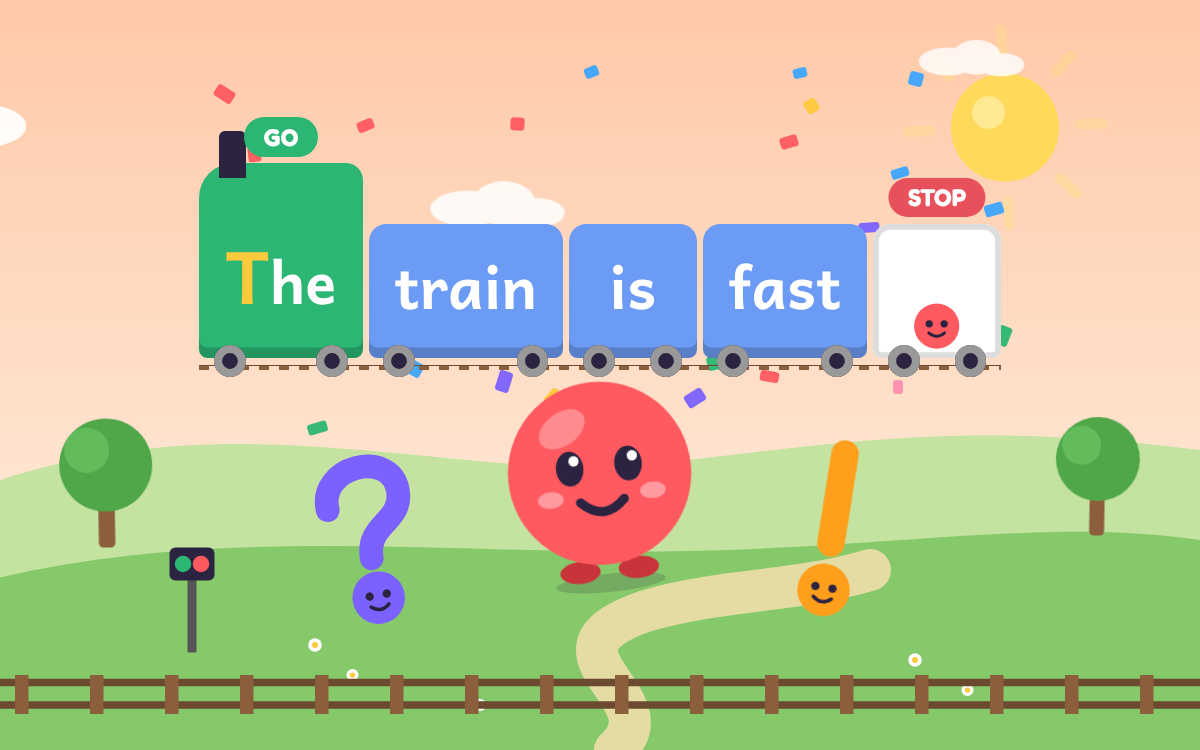
Punctuation Park is an interactive Year 1 punctuation game that teaches children aged 5–7 to use capital letters, full stops, question marks and exclamation marks, following the Year 1 English curriculum in England. Dot, a friendly full stop, guides players around the park and talks them through each activity.
Children split squashed sentences with finger spaces, put the capital letter at the start and the full stop at the end, and listen to decide whether a sentence is telling, asking or showing a big feeling. They give capital letters to names of people and places, the days of the week and the word I, and learn that ordinary words such as park and school do not need one.
Along the way they meet the grammar words letter, word, sentence, punctuation, singular (one) and plural (more than one), then use them to check Pip the pencil's writing before a ten-question final challenge.
Questions and answers
When do you use a capital letter in Year 1?
In Year 1, children use a capital letter at the start of every sentence, for names of people and places, for the days of the week and for the word I. Ordinary words like park, school or dog do not need one in the middle of a sentence.
What is the difference between a question mark and an exclamation mark?
A question mark ends a sentence that asks something and wants an answer, such as 'Where is my hat?'. An exclamation mark ends a sentence that shows a big feeling, like surprise, excitement or someone shouting, such as 'Look out!'.
What do singular and plural mean, in simple words?
Singular means just one thing, like cat, and plural means more than one, like cats. Many words become plural by adding the letter s, which is how Year 1 children first meet these two grammar words.
What age is Punctuation Park for?
Punctuation Park is designed for children aged 5 to 7 and matches the Year 1 English curriculum in England. It also works well as a recap for Year 2 children who want more practice punctuating sentences.
What does the punctuation game include and how long does it take?
The game has six chapters, an optional warm-up on small and capital letters, and a ten-question final challenge, taking about 40 minutes in all. Every instruction is spoken aloud, so children who are still learning to read can play independently.
 TapLearn