The difference between grains and crystals in a rock
Using a scratch test to group rocks as hard or soft
What permeable and impermeable mean, and which rocks are which
Sorting the same rocks in different ways using one property
Chapter by chapter
Rock appearance: natural rocks, colour, texture and shineFree to try
Year 3 science · 1
Looking closely: grains, crystals, layers and fossils
Year 3 science · 1
Hard or soft rocks: the scratch test
Year 3 science · 1
Permeable or impermeable rocks: the water test
Year 3 science · 1
Compare and group rocks in different ways
Year 3 science · 1
Rock Detective Challenge: compare and group rocks (10 questions)
What the chapters cover in the national curriculum in England:
Year 3 science: Compare and group together different kinds of rocks on the basis of their appearance and simple physical properties
About this adventure
Properties of Rocks is an interactive science game that teaches children aged 7–9 to compare and group different kinds of rocks by their appearance and simple physical properties, matching the Year 3 rocks objective in England's national curriculum.
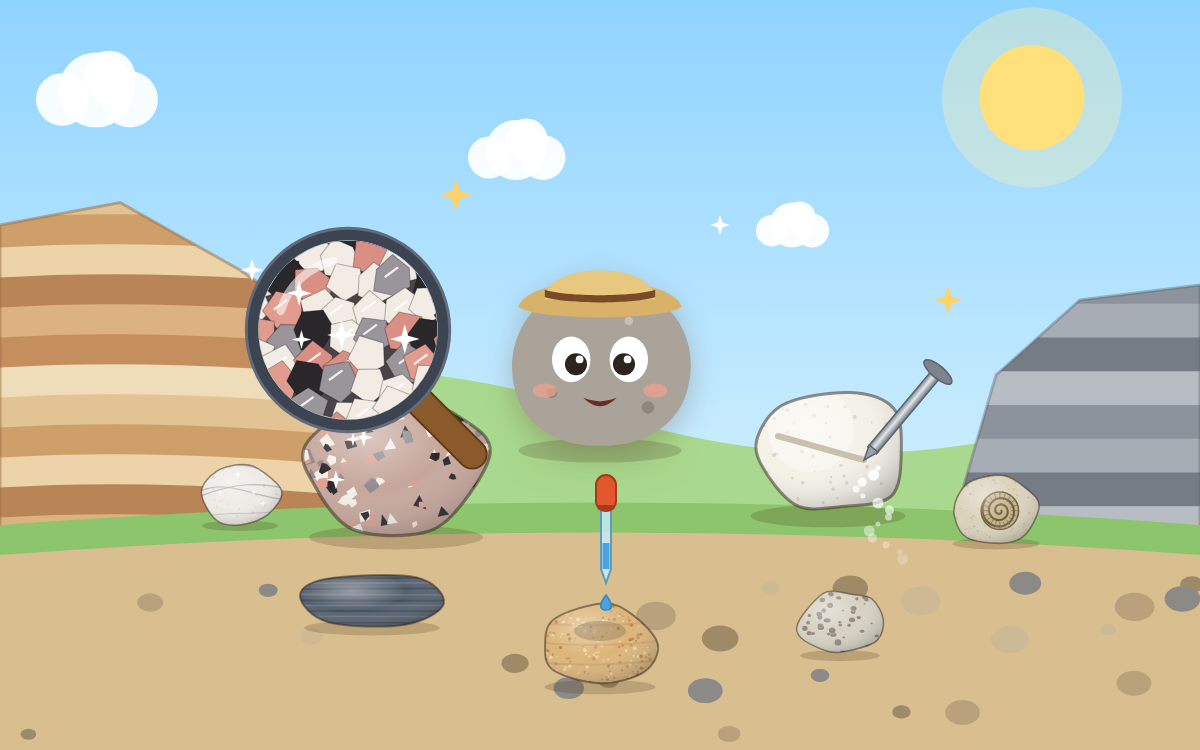
Guided by Pebble, a friendly talking stone, players explore eight rock types: granite, sandstone, chalk, slate, marble, pumice, limestone and flint. They drag a magnifying glass to spot grains and crystals, scratch rocks with a nail to find out which are hard or soft, and use a dropper to see whether water soaks in.
Along the way they learn key words like permeable (lets water in) and impermeable (keeps water out), tackle common mix-ups such as thinking brick is a natural rock, and finish with a ten-question Rock Detective Challenge.
Questions and answers
What are the properties of rocks, in simple words?
The properties of rocks are the things you can notice or test about them, such as colour, texture, shine, hardness and whether water soaks in. Scientists use these properties to compare rocks and sort them into groups.
What is the difference between permeable and impermeable rocks?
Permeable rocks let water soak into them, while impermeable rocks keep water out. Chalk and sandstone are permeable, but granite, slate and marble are impermeable, which is why slate is used for roof tiles.
Are all rocks hard?
No, not all rocks are hard. Chalk is soft enough to scratch with a fingernail, sandstone can be scratched with a nail, and granite and flint are hard enough that a nail leaves no mark.
What age is this rocks game for?
This rocks game is designed for children aged 7 to 9, especially Year 3 pupils in England. It follows the Year 3 science objective on comparing and grouping rocks, and is also useful for older children who want a refresher.
What does the rocks game include and how long does it take?
The game has five hands-on chapters and a ten-question final challenge, and takes around 35 minutes to play through. Children can start with any chapter, and there is a short warm-up on property words for those who need it.
Can we count your visit? We'd like to use one cookie, only on this site, to see how families find and use TapLearn, so we can make it better. No adverts, and nothing is shared. How we measure
Create a free family account and your child can play every chapter of every game for 7 days, with no card needed. Their progress is kept. After that, the free plan is free for ever, and membership is £6.99 a month if you'd like to keep every chapter.


 TapLearn