Commas in a List: A Market Adventure with Kit the Comma
Learn how to use commas in a list, with 'and' before the last item. Fill baskets, fix market signs and write your own list sentences.
- Ages 5–8
- About 35 min
- Easy start
- Grammar & Punctuation
Learn how to use commas in a list, with 'and' before the last item. Fill baskets, fix market signs and write your own list sentences.
Year 2 english · 1
Year 2 english · 2 Year 2 english · 1
Year 2 english · 2
Year 2 english · 1 Year 2 english · 2
What the chapters cover in the national curriculum in England:
Commas in a List is an interactive game that teaches children aged 5–8 how to use commas to separate items in a list, matching the Year 2 English curriculum in England.
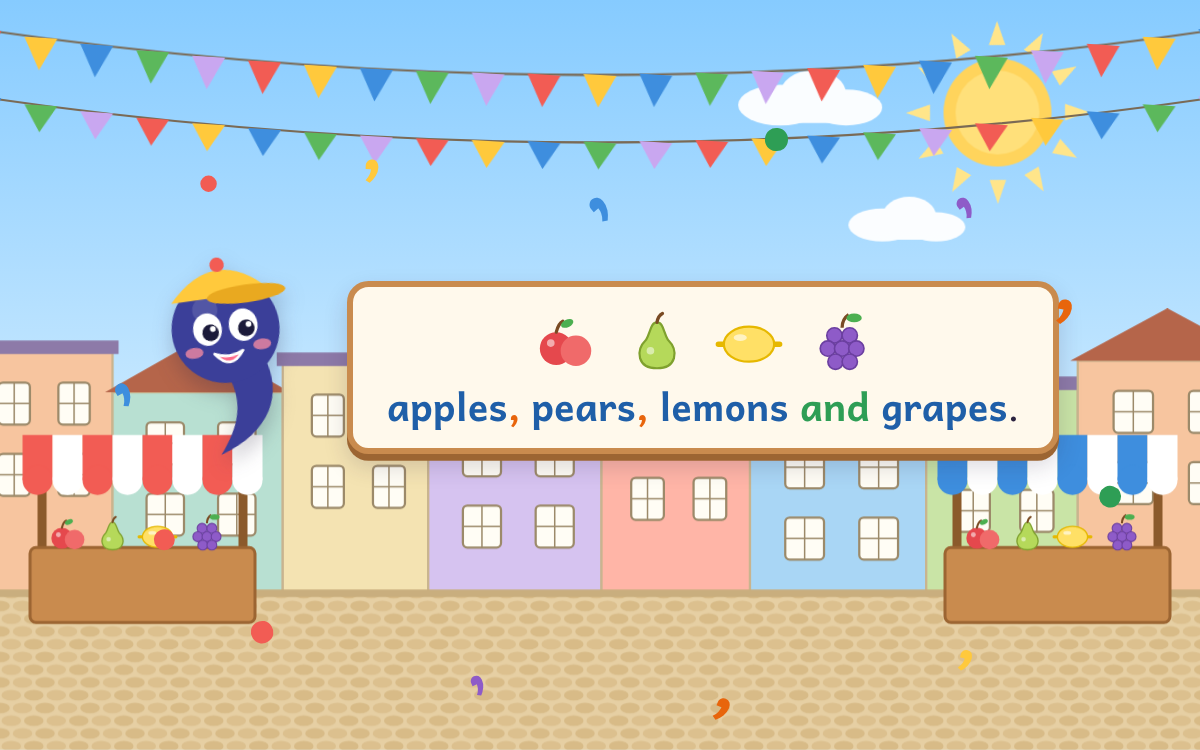
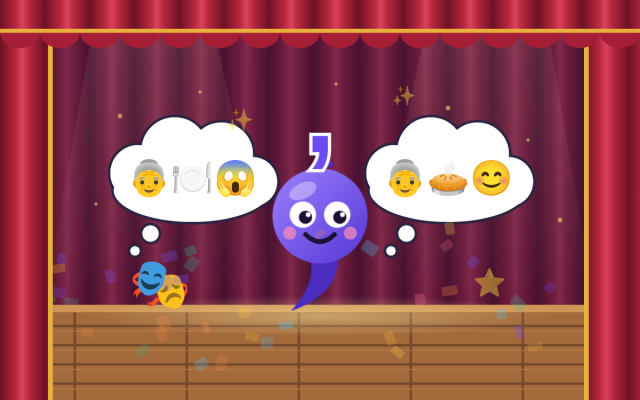
Kit, a talking comma, guides players around a street market. They find out that a comma is a dot with a tail that sits on the line, and learn to tell it apart from a full stop and an apostrophe. Next they put commas between the items in shopping lists and see that 'and' takes the place of the last comma. They then check signs for slips such as a comma after 'and', and build whole list sentences with a capital letter, commas and a full stop.
Every line is read aloud with captions on screen, and an eight-question challenge at the end checks what has stuck.
Put a comma between each item in the list, and use 'and' instead of a comma before the last item, as in 'I bought apples, pears, plums and grapes.' The sentence still starts with a capital letter and ends with a full stop.
In UK primary schools, children are usually taught not to put a comma before 'and' in a simple list, because 'and' already separates the last two items. Some writers add one, called the Oxford comma, but Year 2 pupils learn the version without it.
No, a list of two things just needs 'and', as in 'Tom has a cat and a dog.' Commas are needed when a list has three or more items, to keep each item separate.
It is made for children aged 5 to 8 and follows the Year 2 English curriculum in England, where commas for lists are first taught. Older children who still mix up their commas can use it as a quick refresher.
It has four chapters and a final eight-question Comma Challenge, and takes about 35 minutes to play through. Each chapter opens and closes with a short animation, and children can choose any chapter from the market at any time.
 TapLearn
Getting it ready…
Great work on chapter 1! To open the next chapters, ask a grown-up to take a look.
To play this game, ask a grown-up to take a look. There are lots of free games you can play right now too!
Create a free family account and your child can play every chapter of every game for 7 days, with no card needed. Their progress is kept. After that, the free plan is free for ever, and membership is £6.99 a month if you'd like to keep every chapter.
That's all the learning time for today. Great work! Flip will be ready to play again tomorrow.