Homophones and homonyms worksheet for Year 3: Sound-alike words
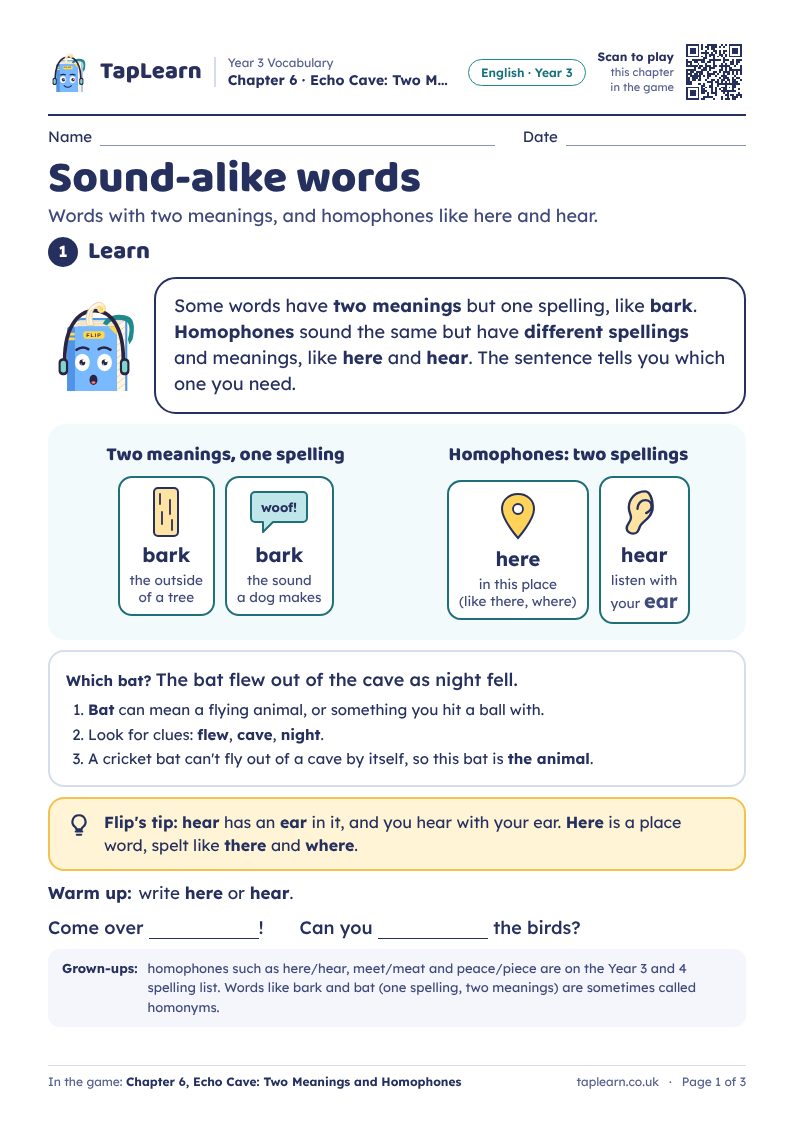
Sound-alike Words is a printable homophones and homonyms worksheet for Year 3 (ages 7 to 8) that teaches children to use clues in the sentence to pick the right meaning of a word like bat, and to choose between homophones like here and hear. On the sheet, children ring meanings, choose homophones and write sentences for each meaning.
Free to print, no account needed.
Print it on A4, in colour or black and white. Do it after the chapter, or before it to see what your child already knows.
What's on the worksheet
Your child uses the sentence to pick the right meaning of words like bat and bark, and chooses between homophones like here and hear. Includes a double-mime game and an answers sheet.
- Page 1 · Learn
- Bark with two meanings and here and hear compared, a worked example deciding which bat flew out of a cave, Flip's ear-in-hear tip, and a here-or-hear warm-up.
- Page 2 · Try it together
- Double-mime: the grown-up says a two-meaning word like wave, ring or light, the child mimes one meaning and then the other, then you make a silly sentence using both.
- Page 3 · Practise
- Ring which meaning is used, ring the right homophone, write sentences for here and hear, write two sentences for park, and a challenge about "I can here the rain".
- Answers sheet
- Every answer, mix-ups like here for hear, and silly-sentence and two-meaning-spotting ideas.
3 A4 pages and an answers sheet · about 25 minutes
In the classroom
- Play double-mime as a class starter with two-meaning words.
- Use Practise B as a mini-whiteboard homophone check.
Questions from the worksheet
- Which meaning is used? The boat rocked on a big wave. (a: moving your hand to say hello, b: water rising in the sea)
- Ring the right homophone: We will ( meet / meat ) at the school gate. Can I have a ( peace / piece ) of cake? The lion shook its shaggy ( main / mane ).
- Write a sentence for each word to show its meaning: here, hear.
- Park has two meanings. Write one sentence for each.
- Sam wrote: "I can here the rain on the roof." Is he right? How could Flip's tip help him?
The answers are on the answers sheet, for grown-ups.
Using it at home
- Homophones like here and hear, meet and meat, and peace and piece are on the Year 3 and 4 spelling list. Words like bat and bark are sometimes called homonyms.
- For a homophone round of double-mime, try "Let's meet for meat pie" and ask which spelling goes with which meaning.
- Listen out for two-meaning words like bat, light and ring when you read or chat.
Watch out for
- Swapping homophones, like here for hear.
- Use memory tricks: hear has an ear; a piece of pie; you meet your friend (two e's).
- Picking the other meaning of a two-meaning word, like a dog's bark for tree bark.
- Ask, "What else is in the sentence? Is there a tree or a dog?"
Questions and answers
What is a homophone?
A homophone sounds the same as another word but has a different spelling and meaning, like here and hear.
What is a homonym?
A homonym is a word with one spelling and two meanings, like bark (on a tree, or the sound a dog makes).
How can children remember here and hear?
Hear has an ear in it, and you hear with your ear. Here is a place word, spelt like there and where.
 TapLearn