Prefixes worksheet for Year 3: Prefix power
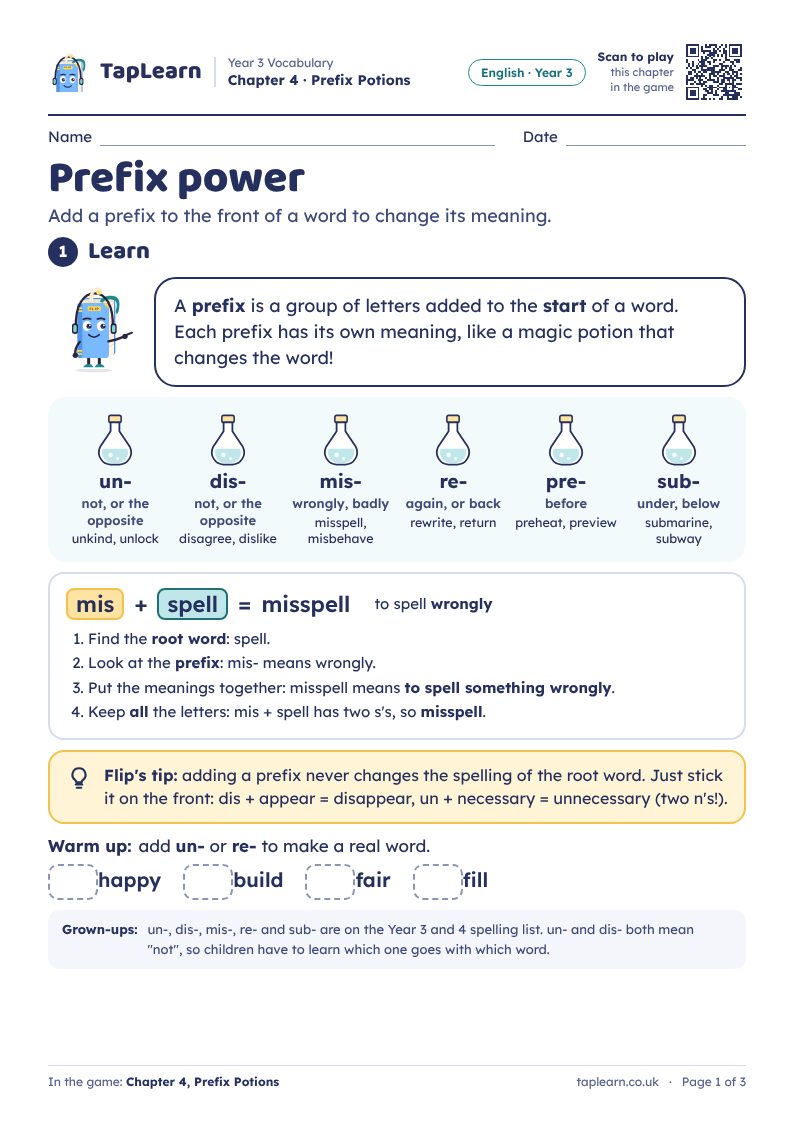
Prefix Power is a printable prefixes worksheet for Year 3 (ages 7 to 8) that teaches what un-, dis-, mis-, re-, pre- and sub- mean, and that adding a prefix never changes the spelling of the root word. On the sheet, children match prefixes to meanings, make real words and explain words like rewrite and submarine.
Free to print, no account needed.
Print it on A4, in colour or black and white. Do it after the chapter, or before it to see what your child already knows.
What's on the worksheet
Your child adds the prefixes un-, dis-, mis-, re-, pre- and sub- and works out what the new words mean. Includes a kitchen prefix hunt on packets and an answers sheet.
- Page 1 · Learn
- The six prefixes with meanings and examples, a worked example working out misspell, Flip's tip that the root word keeps all its letters, and an un-or-re warm-up.
- Page 2 · Try it together
- Kitchen prefix hunt: look on packets, tins and leaflets for words starting with un-, dis-, mis-, re-, pre- or sub-, cover the prefix to check the root, and say what the word means.
- Page 3 · Practise
- Match prefixes to meanings, add un-, dis- or mis- to make real words, write what words like preview mean, write sentences with dis- and re- words, and a challenge about unagree.
- Answers sheet
- Every answer, mix-ups like unagree, and spot-it and opposite-game ideas.
3 A4 pages and an answers sheet · about 25 minutes
In the classroom
- Play the opposite game as a starter on mini whiteboards.
- Use Practise C to discuss how each prefix changes meaning.
Questions from the worksheet
- Draw lines to match each prefix to its meaning: re-, pre-, sub-, mis-.
- Add un-, dis- or mis- to make a real word: agree, lucky, behave, appear, spell, well.
- Use the prefix to write what each word means: rewrite, preview, submarine, misplace.
- Mia says: "I unagree with you!" Is that right? What should she say, and how could she remember?
The answers are on the answers sheet, for grown-ups.
Using it at home
- Un- and dis- both mean "not", so children have to learn which one goes with which word.
- In the hunt, common finds are preheat, recycle, reseal, unwrap and reuse. Uncle and rest don't have prefixes: no root word is left.
- Say a word (kind, like, tidy) and your child adds un- or dis- to make its opposite.
Watch out for
- Using un- where dis- belongs, like unagree or unappear.
- Make a short list of dis- words to learn: disagree, disappear, dislike, disobey, dishonest.
- Mixing up prefix meanings, like thinking re- means "not".
- Link each to a known word: re- as in replay, pre- as in preview, sub- as in submarine.
- Dropping a letter, like mispell.
- Mis + spell keeps both s's (misspell); dis + satisfied keeps both s's (dissatisfied).
Questions and answers
What does the prefix pre- mean?
Pre- means before, as in preheat (heat before) and preview (see before).
What does the prefix sub- mean?
Sub- means under or below, as in submarine (under the sea) and subway.
Why is it disagree and not unagree?
Both un- and dis- mean not, so you have to remember which one each word uses. Disagree is the one you've heard before.
 TapLearn