Vocabulary worksheet for Year 3: Story words
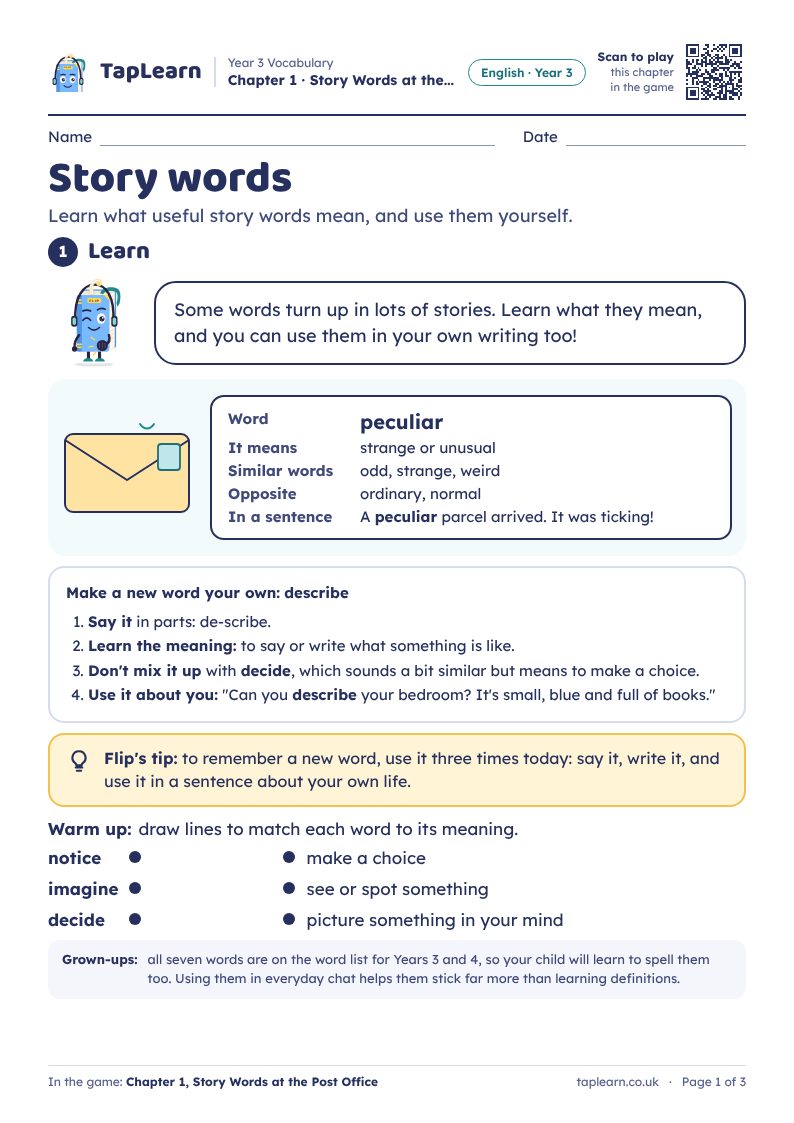
Story Words is a printable vocabulary worksheet for Year 3 (ages 7 to 8) that teaches seven useful story words, notice, peculiar, imagine, decide, surprise, describe and promise, with their meanings, similar words and opposites. On the sheet, children fill gaps, match words to meanings and write sentences about their own lives.
Free to print, no account needed.
Print it on A4, in colour or black and white. Do it after the chapter, or before it to see what your child already knows.
What's on the worksheet
Your child learns and uses seven must-know story words: notice, peculiar, imagine, decide, surprise, describe and promise. Includes a word charades game and an answers sheet.
- Page 1 · Learn
- A word card for peculiar with meaning, similar words, opposite and a sentence, a worked example learning describe, Flip's use-it-three-times tip, and a match-the-meaning warm-up.
- Page 2 · Try it together
- Word charades: write the seven story words on scraps, take turns to act one out or explain it without saying it, then each make up a sentence with it about your day.
- Page 3 · Practise
- Fill gaps with the story words, ring the word that means the same, write sentences about your own life, describe something peculiar in a parcel, and a challenge.
- Answers sheet
- All seven meanings, every answer, mix-ups like describe and decide, and bedtime-word and story-spotting ideas.
3 A4 pages and an answers sheet · about 20 minutes
In the classroom
- Make a word card like the peculiar example for each of the seven words and display them.
- Play word charades in small groups.
Questions from the worksheet
- Fill each gap with a word from the box (notice, peculiar, imagine, decide, surprise, describe, promise): Can you ___ what the monster looked like?
- Ring the word that means the same: peculiar (ordinary, odd, tiny); notice (spot, forget, hide); decide (describe, choose, wait).
- Write a sentence about your own life using each word: surprise, promise.
- Describe something peculiar you could find in a parcel. Use at least two story words.
- Ava says "peculiar means ordinary". Is she right? What would you tell her?
The answers are on the answers sheet, for grown-ups.
Using it at home
- All seven words are on the word list for Years 3 and 4. Using them in everyday chat helps them stick far more than learning definitions.
- In word charades, peculiar can be a funny walk and surprise a big gasp. Model your own sentences first.
- At bedtime, pick one story word and take turns using it in a sentence about your day.
Watch out for
- Picking the opposite meaning, like ordinary for peculiar.
- Ask, "Would you be surprised to see it? Then it's peculiar."
- Mixing up words that sound alike, like describe and decide.
- Say them slowly together and link each to an action: describe = talk about it, decide = choose.
Questions and answers
What does peculiar mean?
Peculiar means strange or unusual. Similar words are odd and weird; its opposite is ordinary.
What is the difference between describe and decide?
Describe means to say or write what something is like. Decide means to make a choice.
How can children remember new words?
Use each new word three times in a day: say it, write it, and use it in a sentence about their own life.
 TapLearn