Context clues worksheet for Year 3: Word detectives
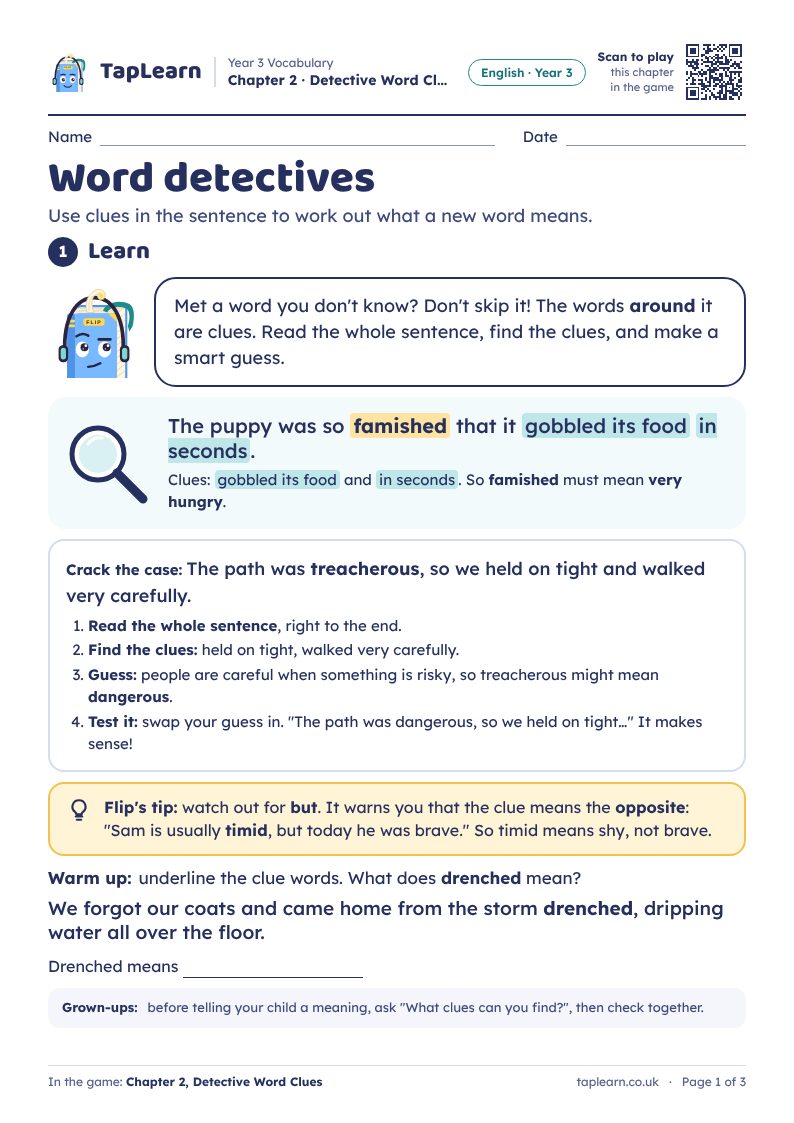
Word Detectives is a printable context clues worksheet for Year 3 (ages 7 to 8) that teaches children to read the whole sentence, find clue words and test a guess for a new word, like famished or treacherous. On the sheet, children ring meanings, underline clues, explain how but helps, and write their own clue sentence.
Free to print, no account needed.
Print it on A4, in colour or black and white. Do it after the chapter, or before it to see what your child already knows.
What's on the worksheet
Your child works out what a new word means from clue words in the sentence, and learns that but can point to an opposite. Includes a book detectives activity with a storybook and an answers sheet.
- Page 1 · Learn
- Famished worked out from its clues, a worked example cracking treacherous by guessing and testing, Flip's tip on but, and an underline-the-clues warm-up about drenched.
- Page 2 · Try it together
- Book detectives: read a page of a storybook, stop at a new word, hunt for clues nearby, guess and test the meaning, then check it in a dictionary or with the grown-up.
- Page 3 · Practise
- Ring what words like weary and minuscule mean, underline clues and write meanings, explain baffling and how but helped, write a clue sentence for gigantic, and a challenge.
- Answers sheet
- Every answer with the clue words, mix-ups like guessing without clues, and pause-and-ask and nonsense-words ideas.
3 A4 pages and an answers sheet · about 25 minutes
In the classroom
- Use nonsense-word sentences as a starter: pupils work out the meaning from clues.
- Run book detectives in pairs with class reading books and dictionaries.
Questions from the worksheet
- Use the clues to ring what the word in bold means: After the long walk, Leo was weary and wanted to lie down. (tired, excited, hungry)
- Underline the clue words. Then write what the word in bold means: The soup was scalding, so we waited for it to cool down.
- The first puzzle was simple, but the second one was baffling. What does baffling mean? How did the word but help you?
- Make your own clue sentence for the word gigantic (very, very big). Put clues in it for a reader.
- Sam reads: "The giant was enormous, but his house was tiny." He says enormous means tiny, because tiny is the clue. Is he right?
The answers are on the answers sheet, for grown-ups.
Using it at home
- Before telling your child a meaning, ask "What clues can you find?", then check together.
- In book detectives, a close guess counts as a win: "large" for "enormous" shows good detective work. Sometimes the clues are in the next sentence.
- Say a sentence with a made-up word ("I put on my wellies and splodged through the mud") and ask what it could mean.
Watch out for
- Guessing without reading the clues.
- Cover the word with a finger and ask, "What word would fit here?" The clues give the answer.
- Picking the opposite meaning, especially with but.
- Point to "but" and say, "This means things are about to change direction."
Questions and answers
What are context clues?
Context clues are the words around a new word that help you work out what it means, like gobbled and in seconds for famished.
How do you work out a new word from clues?
Read the whole sentence, find the clue words, make a guess, then test it by swapping your guess into the sentence.
How does but help with word meanings?
But warns you the clue means the opposite: in "usually timid, but today he was brave", timid means shy.
 TapLearn