Suffix spelling worksheet for Year 2: Spelling suffixes
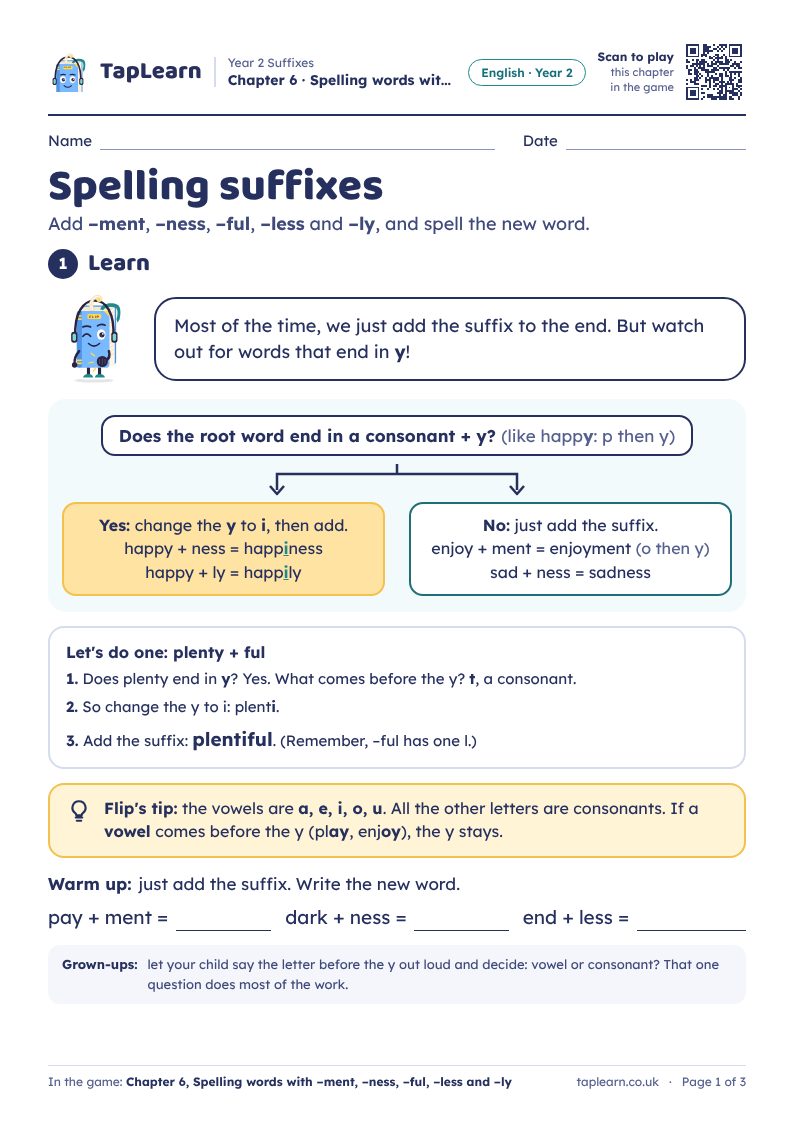
Spelling Suffixes is a printable suffix spelling worksheet for Year 2 (ages 6 to 7) that teaches children to just add the suffix most of the time, but change y to i when a consonant comes before it, as in happiness, and keep it after a vowel, as in enjoyment. It covers the Year 2 statement on adding suffixes to spell longer words, including -ment, -ness, -ful, -less and -ly.
This worksheet is for members
Membership opens every chapter of every game and every worksheet, for all your children.
See the plansAlready a member? Log in to print it.
Start with the free one: Making new nouns (chapter 1).
Print it on A4, in colour or black and white. Do it after the chapter, or before it to see what your child already knows.
What's on the worksheet
Your child spells longer words with -ment, -ness, -ful, -less and -ly, including when y changes to i (happy, happiness) and when it stays (enjoy, enjoyment). Includes a word builder card game and an answers sheet.
- Page 1 · Learn
- The y-to-i rule as a question, examples like happiness and enjoyment, a worked example spelling plentiful, Flip's vowel tip, and a just-add warm-up.
- Page 2 · Try it together
- Word builder: write root words like happy, enjoy and care and the suffixes ment, ness, ful, less and ly on scraps, pair them to make real words, and decide if the y changes.
- Page 3 · Practise
- Add suffixes with no change, change y to i then add, ring the right spelling, join words to fill gaps, and a challenge about enjoiment.
- Answers sheet
- Every answer, mix-ups like happyness and plaiful, and y-or-i and suffix-hunt ideas.
3 A4 pages and an answers sheet · about 25 minutes
Using it at home
- Let your child say the letter before the y out loud and decide: vowel or consonant? That one question does most of the work.
- In word builder, some pairs aren't real words ("sadment"): say them and decide together.
- Say a root word ending in y (funny, play) and a suffix; your child says "y stays" or "y to i" and spells it aloud.
Watch out for
- Keeping the y, like happyness.
- Ask, "What's the letter before the y? Vowel or consonant?"
- Changing the y after a vowel, like enjoiment or plaiful.
- If it's ay, ey, oy or uy, the y stays.
- Spelling -ful with two l's, like carefull.
- The suffix -ful always has one l. Carefully has two because it is careful + ly.
Questions from the worksheet
- No change needed: just add the suffix. enjoy + ment, kind + ness, hope + less, play + ful, move + ment, bad + ly.
- Change the y to i, then add the suffix: happy + ness, easy + ly, merry + ment, penny + less, plenty + ful, lazy + ness.
- Draw a ring round the right spelling: happyness / happiness, enjoyment / enjoiment, carefull / careful, plaiful / playful.
- Leo wrote enjoiment. He says, "You always change y to i." Is he right? How should he spell it?
The answers are on the answers sheet, for grown-ups.
National curriculum in England
This worksheet practises this statement from the Year 2 english programme of study:
- Add suffixes to spell longer words including –ment, –ness, –ful, –less, –ly
In the classroom
- Sort suffix words from a class book by suffix as a group task.
- Use Practise C as a mini-whiteboard spelling check.
Questions and answers
When does y change to i before a suffix?
When a consonant comes before the y: happy becomes happiness and happily.
When does the y stay?
When a vowel comes before it: enjoy becomes enjoyment and play becomes playful.
Why does carefully have two l's?
It's careful + ly. The suffix -ful has one l, and -ly adds another.
More worksheets from Year 2 Suffixes: Build New Words with Toots the Train
- Chapter 1: Suffixes er and ness worksheet: Making new nouns Free
- Chapter 2: Compound words worksheet: Compound nouns Members
- Chapter 3: Suffixes ful and less worksheet: Full of or without? Members
- Chapter 4: Comparing with er and est worksheet: Taller and tallest Members
- Chapter 5: Adding ly worksheet: Adding –ly Members
 TapLearn