Suffixes er and ness worksheet for Year 2: Making new nouns
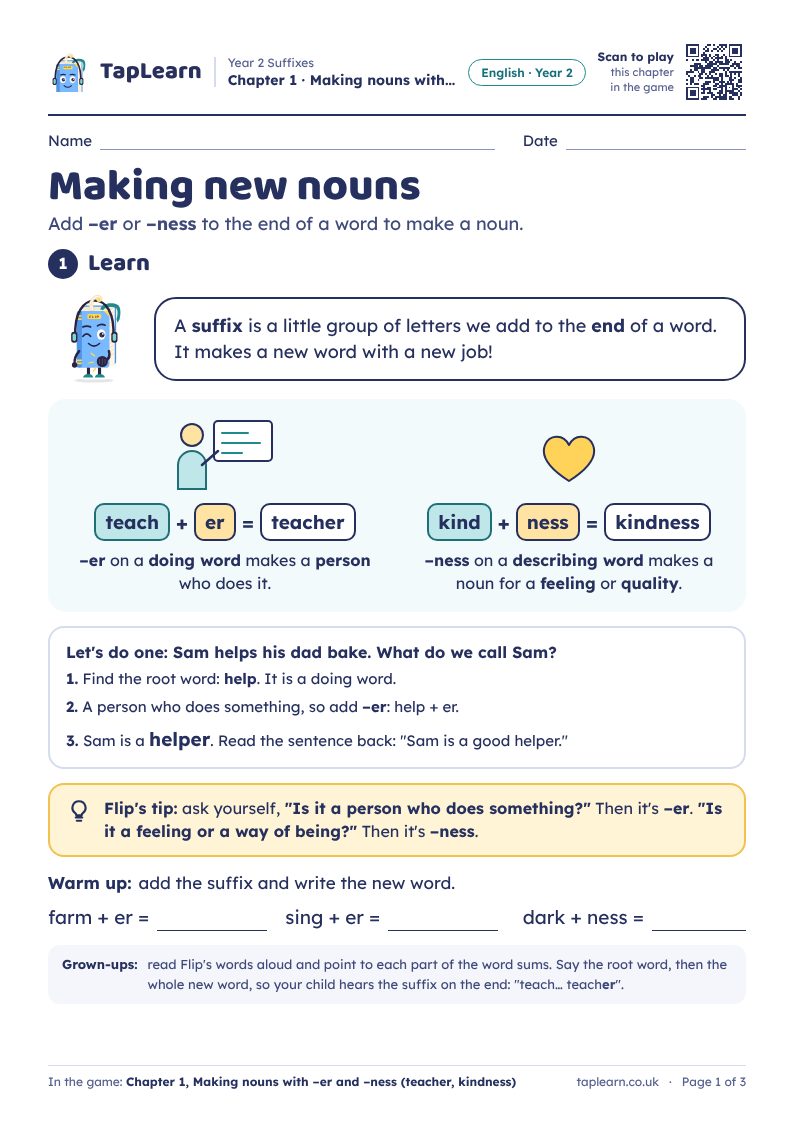
Making New Nouns is a printable suffixes er and ness worksheet for Year 2 (ages 6 to 7) that teaches children that -er on a doing word makes a person who does it, like teacher, and -ness on a describing word makes a feeling or quality, like kindness. It covers the Year 2 statement on forming nouns using suffixes such as -ness and -er.
Free to print, no account needed.
Print it on A4, in colour or black and white. Do it after the chapter, or before it to see what your child already knows.
What's on the worksheet
Your child adds -er to a doing word to name a person (teach, teacher) and -ness to a describing word to name a feeling or quality (kind, kindness). Includes an act-it-out game and an answers sheet.
- Page 1 · Learn
- Teach + er and kind + ness as word sums, a worked example finding helper, Flip's person-or-feeling tip, and an add-the-suffix warm-up.
- Page 2 · Try it together
- Act it out!: the grown-up acts out a doing word like paint and the child taps -er ("You're a painter!"), then acts a feeling like sad and the child taps -ness, then swap.
- Page 3 · Practise
- Ring the suffix and colour -er and -ness words, match root words to suffixes, make nouns to fill gaps, draw a person doing a job, and a challenge about sadder.
- Answers sheet
- Every answer, mix-ups like mixing up -er and -ness, and job-spotting and feelings-faces ideas.
3 A4 pages and an answers sheet · about 20 minutes
Using it at home
- Say the root word, then the whole new word, so your child hears the suffix on the end: "teach… teacher".
- In act it out, if your child says "a sadder", ask "Is sadness a person?" Sadder is a real word, but it compares two things.
- On a walk or in a book, spot people who do jobs and name them with -er: driver, builder, gardener.
Watch out for
- Mixing up -er and -ness.
- Ask, "Is it a person who does something?" (-er) or "Is it a feeling or a way of being?" (-ness).
- Thinking every -er word is a person.
- Some are things that do a job (a toaster) and some compare (taller). Today we're looking at people.
Questions from the worksheet
- Draw a ring round the suffix in each word: teacher, darkness, singer, kindness, painter, softness.
- Draw a line from each root word to the suffix it needs. Write the new word: farm, ill, read, fair.
- Make a noun from the word in brackets to fill the gap: Mia's ___ made Leo smile. (kind) Ava plays football. She is a fast ___. (play)
- Sam wrote: "Mia felt a lot of sadder when her balloon popped." Is he right? What word should he use?
The answers are on the answers sheet, for grown-ups.
National curriculum in England
This worksheet practises these statements from the Year 2 english programme of study:
- Word: formation of nouns using suffixes such as –ness, –er and by compounding
- Add suffixes to spell longer words including –ment, –ness, –ful, –less, –ly
In the classroom
- Play act it out as a class starter with -er and -ness cards.
- Use Practise C as a mini-whiteboard check.
Questions and answers
What does the suffix -er do?
Added to a doing word, -er makes a noun for a person who does it: teach becomes teacher, sing becomes singer.
What does the suffix -ness do?
Added to a describing word, -ness makes a noun for a feeling or quality: kind becomes kindness, dark becomes darkness.
Is sadder the same as sadness?
No. Sadness is a feeling. Sadder compares two things: "Mia was sadder than Leo."
More worksheets from Year 2 Suffixes: Build New Words with Toots the Train
- Chapter 2: Compound words worksheet: Compound nouns Members
- Chapter 3: Suffixes ful and less worksheet: Full of or without? Members
- Chapter 4: Comparing with er and est worksheet: Taller and tallest Members
- Chapter 5: Adding ly worksheet: Adding –ly Members
- Chapter 6: Suffix spelling worksheet: Spelling suffixes Members
 TapLearn