Adding ly worksheet for Year 2: Adding –ly
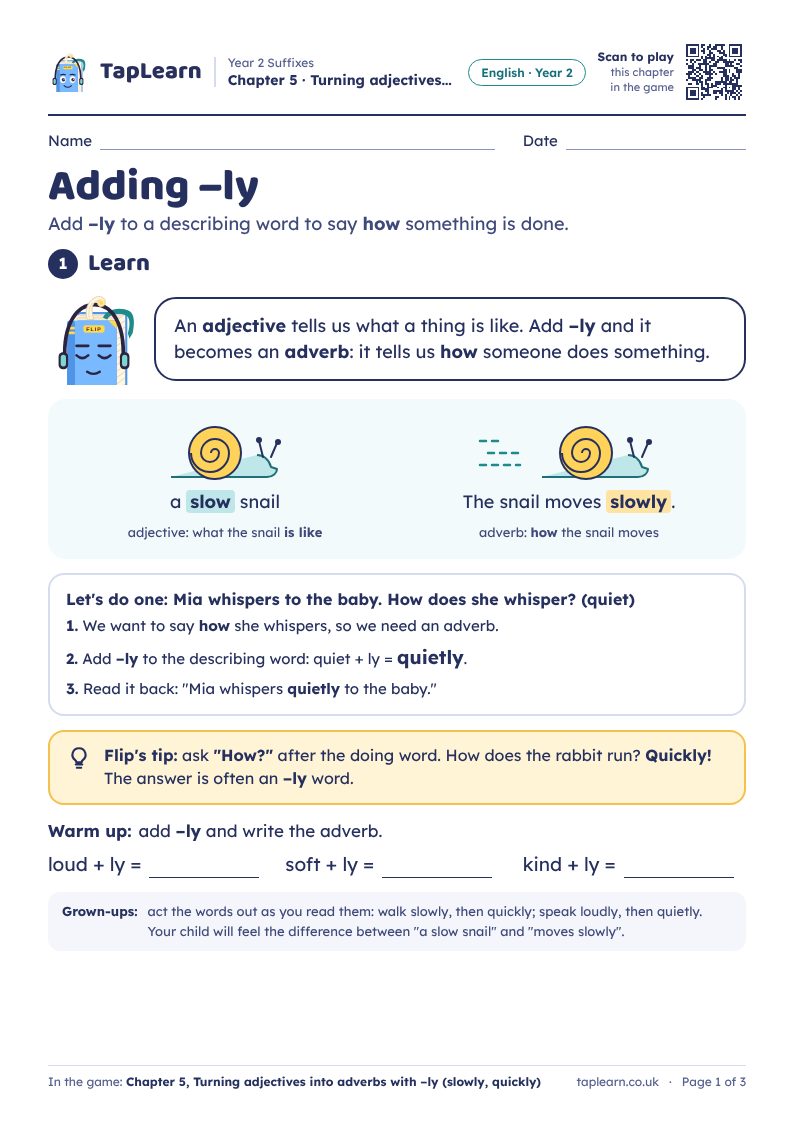
Adding -ly is a printable adding ly worksheet for Year 2 (ages 6 to 7) that teaches children that an adjective says what a thing is like and adding -ly makes an adverb that says how something is done, like "The snail moves slowly." It covers the Year 2 statement on using -ly in Standard English to turn adjectives into adverbs.
This worksheet is for members
Membership opens every chapter of every game and every worksheet, for all your children.
See the plansAlready a member? Log in to print it.
Start with the free one: Making new nouns (chapter 1).
Print it on A4, in colour or black and white. Do it after the chapter, or before it to see what your child already knows.
What's on the worksheet
Your child adds -ly to a describing word to say how something is done: slow becomes slowly, quick becomes quickly. Includes a move-like-this game and an answers sheet.
- Page 1 · Learn
- A slow snail and "The snail moves slowly" compared, a worked example making quietly, Flip's ask-how tip, and an add-ly warm-up.
- Page 2 · Try it together
- Move like this!: write doing words like walk and clap and -ly words like slowly and quietly on scraps, take one from each pile and do it together, then invent your own -ly word.
- Page 3 · Practise
- Add -ly to make adverbs, ring slow or slowly in sentences, choose adverbs to fill gaps, and a challenge about "The slowly snail".
- Answers sheet
- Every answer, mix-ups like "ran quick", and walk-like-this and adverb-guess ideas.
3 A4 pages and an answers sheet · about 20 minutes
Using it at home
- Act the words out as you read them: walk slowly, then quickly; speak loudly, then quietly.
- After each turn in move like this, ask "How did we clap?" and let your child answer with the adverb: "quietly".
- Do an everyday job in a certain way (fold neatly, stamp loudly) and your child guesses the -ly word.
Watch out for
- Using a describing word where an adverb is needed, like "ran quick".
- We often hear this in speech, but in Standard English we write "ran quickly". Ask, "How did she run?"
- Using an -ly word to describe a thing, like "a slowly snail".
- Ask, "Is it telling us what the snail is like, or how it does something?"
- Keeping the y in words like happy.
- Words ending in a consonant and y change y to i: happily, easily.
Questions from the worksheet
- Add -ly to make an adverb: slow, sad, brave, quick, warm, proud.
- Draw a ring round the right word: The snail moved slow / slowly up the wall. Mia has a soft / softly blanket.
- Choose an adverb from the box (quickly, softly, neatly, loudly) to fill each gap: The big dog barked ___ at the cat. Leo stroked the kitten ___.
- Sam wrote: "The slowly snail went home." Is he right? Write it the right way. Can you find two ways?
The answers are on the answers sheet, for grown-ups.
National curriculum in England
This worksheet practises these statements from the Year 2 english programme of study:
- Add suffixes to spell longer words including –ment, –ness, –ful, –less, –ly
- Word: use of the suffixes –er, –est in adjectives and the use of –ly in Standard English to turn adjectives into adverbs
In the classroom
- Play walk like this: call out an -ly word and the class moves that way.
- Use Practise B as a slow-or-slowly vote.
Questions and answers
What is an adverb in Year 2?
An adverb tells us how something is done. Many are made by adding -ly to an adjective: slow becomes slowly.
What is the difference between slow and slowly?
Slow describes a thing (a slow snail). Slowly describes how something is done (the snail moves slowly).
Is it "ran quick" or "ran quickly"?
In Standard English it's "ran quickly", because the word says how she ran.
More worksheets from Year 2 Suffixes: Build New Words with Toots the Train
- Chapter 1: Suffixes er and ness worksheet: Making new nouns Free
- Chapter 2: Compound words worksheet: Compound nouns Members
- Chapter 3: Suffixes ful and less worksheet: Full of or without? Members
- Chapter 4: Comparing with er and est worksheet: Taller and tallest Members
- Chapter 6: Suffix spelling worksheet: Spelling suffixes Members
 TapLearn