Comparing with er and est worksheet for Year 2: Taller and tallest
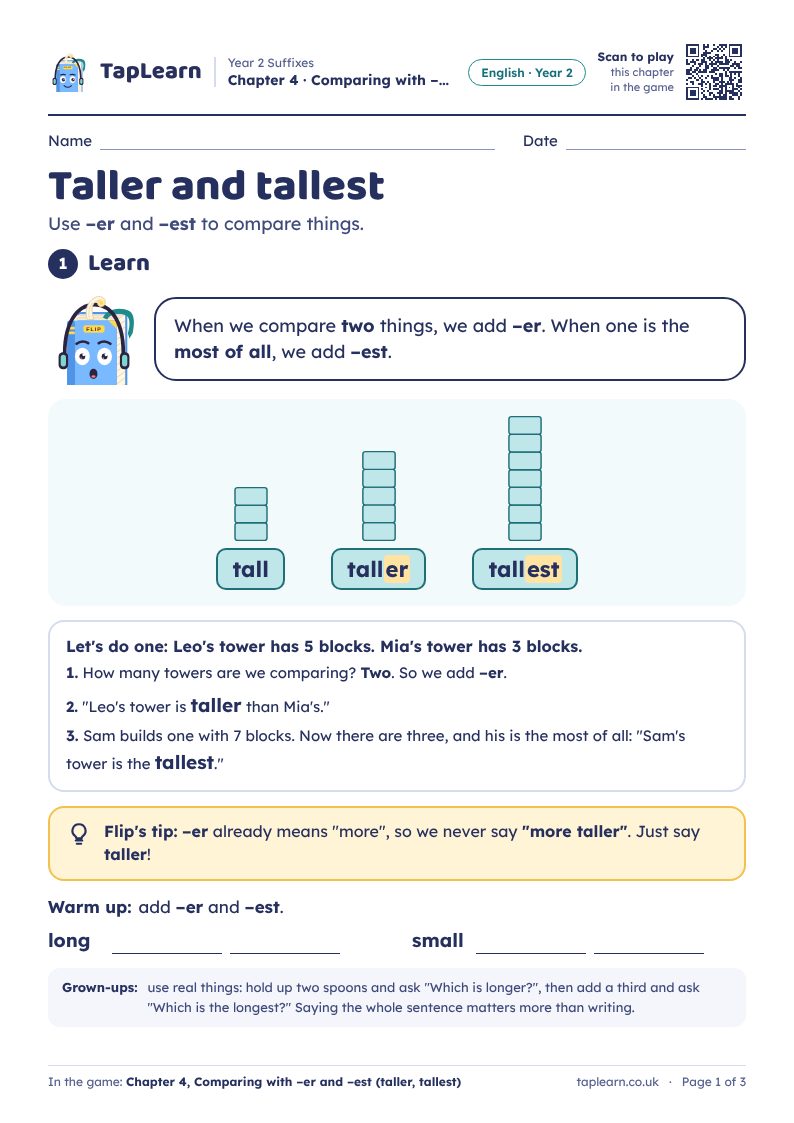
Taller and Tallest is a printable comparing with er and est worksheet for Year 2 (ages 6 to 7) that teaches children to add -er when comparing two things and -est for the most of all, and that -er already means more. It covers the Year 2 statement on using the suffixes -er and -est in adjectives.
This worksheet is for members
Membership opens every chapter of every game and every worksheet, for all your children.
See the plansAlready a member? Log in to print it.
Start with the free one: Making new nouns (chapter 1).
Print it on A4, in colour or black and white. Do it after the chapter, or before it to see what your child already knows.
What's on the worksheet
Your child uses -er to compare two things (taller) and -est for the most of all (tallest), and never says "more taller". Includes a line-it-up game with cups, spoons and socks, and an answers sheet.
- Page 1 · Learn
- Tall, taller and tallest, a worked example comparing block towers, Flip's tip never to say "more taller", and an add-er-and-est warm-up.
- Page 2 · Try it together
- Line it up!: put two cups side by side and compare them with -er, add a third and point to the tallest, then do the same with spoons (long) and socks (small).
- Page 3 · Practise
- Ring the right one, fill in a table of -er and -est words, finish words with er or est, fix "more taller", and a challenge about the softer of all.
- Answers sheet
- Every answer, mix-ups like most tallest, and family-line-up and animal-compare ideas.
3 A4 pages and an answers sheet · about 20 minutes
Using it at home
- Use real things: hold up two spoons and ask "Which is longer?", then add a third and ask "Which is the longest?"
- In line it up, if your child says "more longer", repeat it back the right way, "longer", without fuss.
- Line up the family: who is the tallest? Who has the longest hair?
Watch out for
- Mixing up -er and -est.
- Ask, "How many are we comparing?" Two: -er. Three or more and one is the most: -est.
- Saying "more taller" or "most tallest".
- The suffix already means more or most, so we only need one. Repeat the sentence back correctly.
- Being puzzled by spelling changes, like bigger or happier.
- This sheet uses words that don't change; those come later.
Questions from the worksheet
- Fill in the table. Add -er for comparing two and -est for the most of all: fast, cold, loud, old.
- Finish each word with er or est: A dog is fast___ than a snail. Sam is the tall___ boy in his class. Today is the cold___ day of the whole year!
- Fix the mistake. Write the sentence the right way: My tower is more taller than yours.
- Ava has three teddies. She says, "Bob is the softer of all my teddies." Is she right?
The answers are on the answers sheet, for grown-ups.
National curriculum in England
This worksheet practises this statement from the Year 2 english programme of study:
- Word: use of the suffixes –er, –est in adjectives and the use of –ly in Standard English to turn adjectives into adverbs
In the classroom
- Line up three pupils or objects for a tall, taller, tallest starter.
- Use Practise C as a mini-whiteboard check.
Questions and answers
When do you use -er and -est?
Use -er to compare two things (taller) and -est for the most of all (tallest).
Is it wrong to say "more taller"?
Yes. -er already means more, so just say taller.
What word often comes after an -er word?
Than: "A dog is faster than a snail."
More worksheets from Year 2 Suffixes: Build New Words with Toots the Train
- Chapter 1: Suffixes er and ness worksheet: Making new nouns Free
- Chapter 2: Compound words worksheet: Compound nouns Members
- Chapter 3: Suffixes ful and less worksheet: Full of or without? Members
- Chapter 5: Adding ly worksheet: Adding –ly Members
- Chapter 6: Suffix spelling worksheet: Spelling suffixes Members
 TapLearn