Compound words worksheet for Year 2: Compound nouns
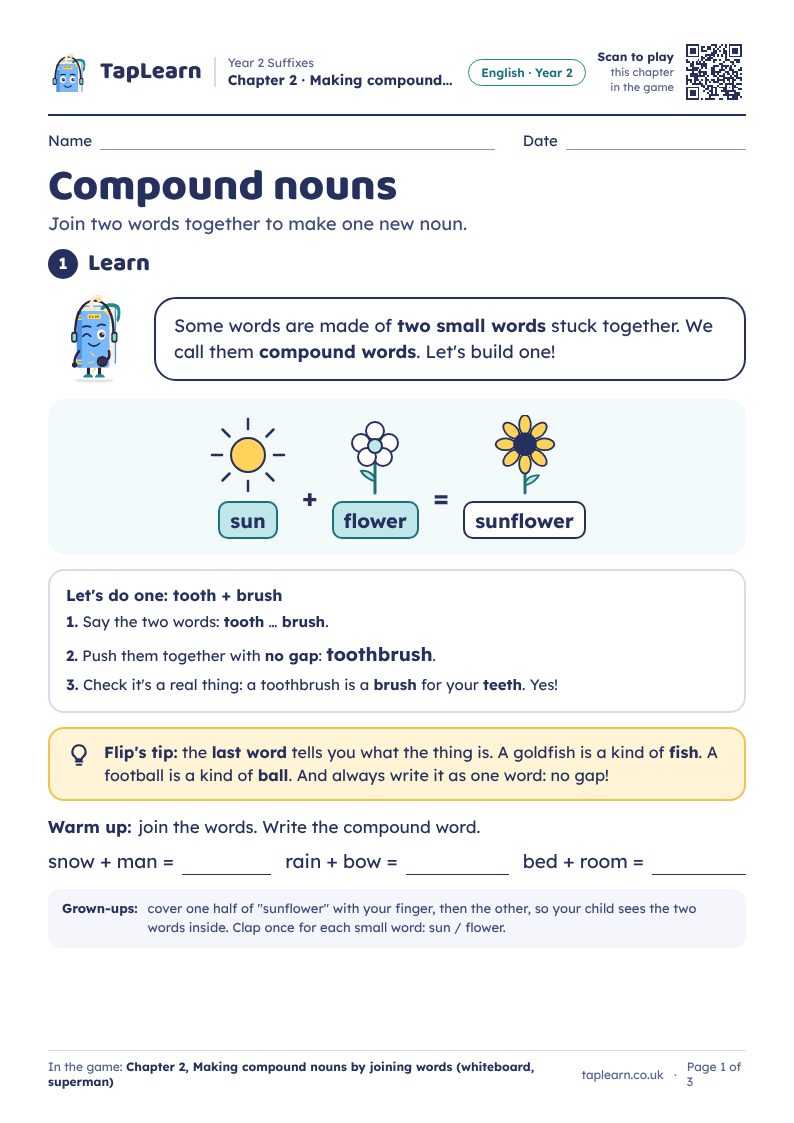
Compound Nouns is a printable compound words worksheet for Year 2 (ages 6 to 7) that teaches children to push two words together with no gap to make one new noun, like sunflower, and that the last word tells you what the thing is. It covers the Year 2 statement on forming nouns by compounding.
This worksheet is for members
Membership opens every chapter of every game and every worksheet, for all your children.
See the plansAlready a member? Log in to print it.
Start with the free one: Making new nouns (chapter 1).
Print it on A4, in colour or black and white. Do it after the chapter, or before it to see what your child already knows.
What's on the worksheet
Your child joins two words to make one new noun, like tooth + brush = toothbrush, with no gap in between. Includes a compound word hunt around the home and an answers sheet.
- Page 1 · Learn
- Sun + flower = sunflower, a worked example making toothbrush, Flip's tip that the last word tells you what it is, and a join-the-words warm-up.
- Page 2 · Try it together
- Compound word hunt: walk round your home looking for things whose names are two joined words, like toothbrush or teapot, say the two small words and write them in the table.
- Page 3 · Practise
- Join words to make compound words, match left and right words, tick real compound words and cross made-up ones, rewrite Leo's sentence with no gaps, and a challenge about fishgold.
- Answers sheet
- Every answer, mix-ups like "foot ball", and silly-compounds and story-spotting ideas.
3 A4 pages and an answers sheet · about 20 minutes
Using it at home
- Cover one half of sunflower with your finger, then the other, so your child sees the two words inside. Clap once for each small word.
- In the hunt, some names are two separate words, like washing machine. That isn't one compound word, because it has a gap.
- Take turns joining two words to invent a silly thing (a "sockbird"?), then name a real compound word.
Watch out for
- Leaving a gap, like "foot ball".
- Ask your child to read it as one word and run a finger under it: one word, one thing.
- Joining words that don't make a thing, like "teabrush".
- Ask, "What would that be? Have you ever seen one?"
- Being puzzled by words that change sound, like cupboard.
- Cupboard doesn't sound like cup and board, but it's still made of them.
Questions from the worksheet
- Join the two words. Write the compound word: foot + ball, tea + pot, cup + cake, rain + coat, gold + fish.
- Is it a real thing? Tick the real compound words. Cross the made-up ones: bedroom, cakefoot, rainbow, teabrush, sunshine, bookpot.
- Leo left gaps. Write his sentence with no gaps: Leo kicked the foot ball across the play ground.
- Mia says, "A fishgold is the same as a goldfish." Is she right? Why?
The answers are on the answers sheet, for grown-ups.
National curriculum in England
This worksheet practises this statement from the Year 2 english programme of study:
- Word: formation of nouns using suffixes such as –ness, –er and by compounding
In the classroom
- Hunt for compound words in a class story, such as bedtime and sunshine.
- Use Practise B as a matching task in pairs.
Questions and answers
What is a compound word?
A compound word is two words joined together to make one new word, like sun + flower = sunflower.
Do compound words have a space in them?
No. A compound word is written as one word with no gap: football, not foot ball.
Does the order of the words matter?
Yes. The last word tells you what the thing is: a goldfish is a fish; a "fishgold" isn't a real word.
More worksheets from Year 2 Suffixes: Build New Words with Toots the Train
- Chapter 1: Suffixes er and ness worksheet: Making new nouns Free
- Chapter 3: Suffixes ful and less worksheet: Full of or without? Members
- Chapter 4: Comparing with er and est worksheet: Taller and tallest Members
- Chapter 5: Adding ly worksheet: Adding –ly Members
- Chapter 6: Suffix spelling worksheet: Spelling suffixes Members
 TapLearn