Common exception words worksheet for Year 1: Where's the heart?
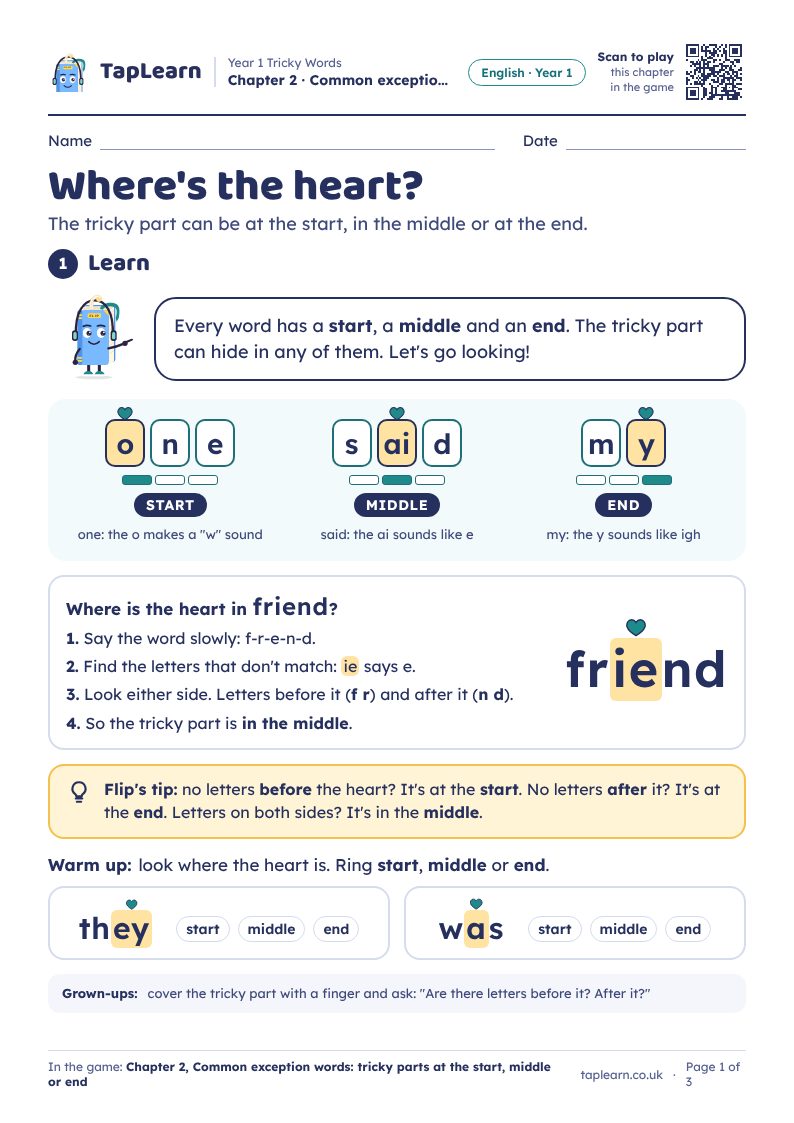
Where's the Heart? is a printable common exception words worksheet for Year 1 (ages 5 to 6) that teaches children to find the tricky part of words like one, said and my and say whether it is at the start, in the middle or at the end. It covers the Year 1 English statement to read common exception words, noting unusual correspondences between spelling and sound and where these occur in the word.
This worksheet is for members
Membership opens every chapter of every game and every worksheet, for all your children.
See the plansAlready a member? Log in to print it.
Start with the free one: Heart words (chapter 1).
Print it on A4, in colour or black and white. Do it after the chapter, or before it to see what your child already knows.
What's on the worksheet
Your child finds the tricky part of Year 1 common exception words and says if it is at the start, in the middle or at the end. Includes a start, middle, end jumping game and an answers sheet.
- Page 1 · Learn
- One, said and my show tricky parts at the start, middle and end, a worked example finding the ie in friend, Flip's tip on letters either side of the heart, and a warm-up.
- Page 2 · Try it together
- Start, middle, end jump: lay START, MIDDLE and END sheets on the floor, then listen to a word like once or school, find its tricky part and jump onto the right sheet.
- Page 3 · Practise
- Heart tricky parts and ring start, middle or end, sort words like he, go and my into pots that are tricky in the same way, ring tricky words in sentences, and a challenge.
- Answers sheet
- Every answer, mix-ups like picking a letter that isn't tricky, and stand-up-sit-down and same-pot ideas.
3 A4 pages and an answers sheet · about 20 minutes
Using it at home
- Cover the tricky part with a finger and ask: "Are there letters before it? After it?"
- In the jumping game, swap roles so your child reads a word and checks where you land.
- Say "he" and ask your child for another word where e says ee, like me, she, we or be.
Watch out for
- Picking a letter that isn't tricky, like the m in my.
- Sound out each letter together and ask, "Is that the sound we'd expect?"
- Mixing up start, middle and end.
- Cover the tricky part with a finger. Letters on both sides means middle.
- Looking for a middle in short words like he, go and my.
- Short words have no middle letters, so the tricky part is at the start or the end.
Questions from the worksheet
- Draw a heart over the tricky part. Then ring start, middle or end: of, friend, one, was, go, you.
- Some words are tricky in the same way. Write each word in the right pot: he, go, my, some, we, so, by, come.
- Read the sentence. Draw a ring round each tricky word: Dad said we can go.
- Mia says, "The tricky part of my is the m, because it's at the start." Is she right? Where is the tricky part really?
The answers are on the answers sheet, for grown-ups.
National curriculum in England
This worksheet practises this statement from the Year 1 english programme of study:
- Read common exception words, noting unusual correspondences between spelling and sound and where these occur in the word
In the classroom
- Play stand up, sit down as a whole class: stand if the tricky part is at the end, sit if it isn't.
- Use the word pots in Practise B as a group sort with word cards.
Questions and answers
What are common exception words?
Common exception words are words where part of the spelling doesn't match the usual sound, like the o in one or the ai in said. Children learn that part by heart.
Where can the tricky part of a word be?
It can be at the start, in the middle or at the end. In one it is at the start, in said it is in the middle and in my it is at the end.
Why do some words share the same tricky part?
Some words are tricky in the same way, like he, we and me, where e says ee. Learning them in groups helps children remember them.
 TapLearn