Sight words worksheet for Year 1: Heart words
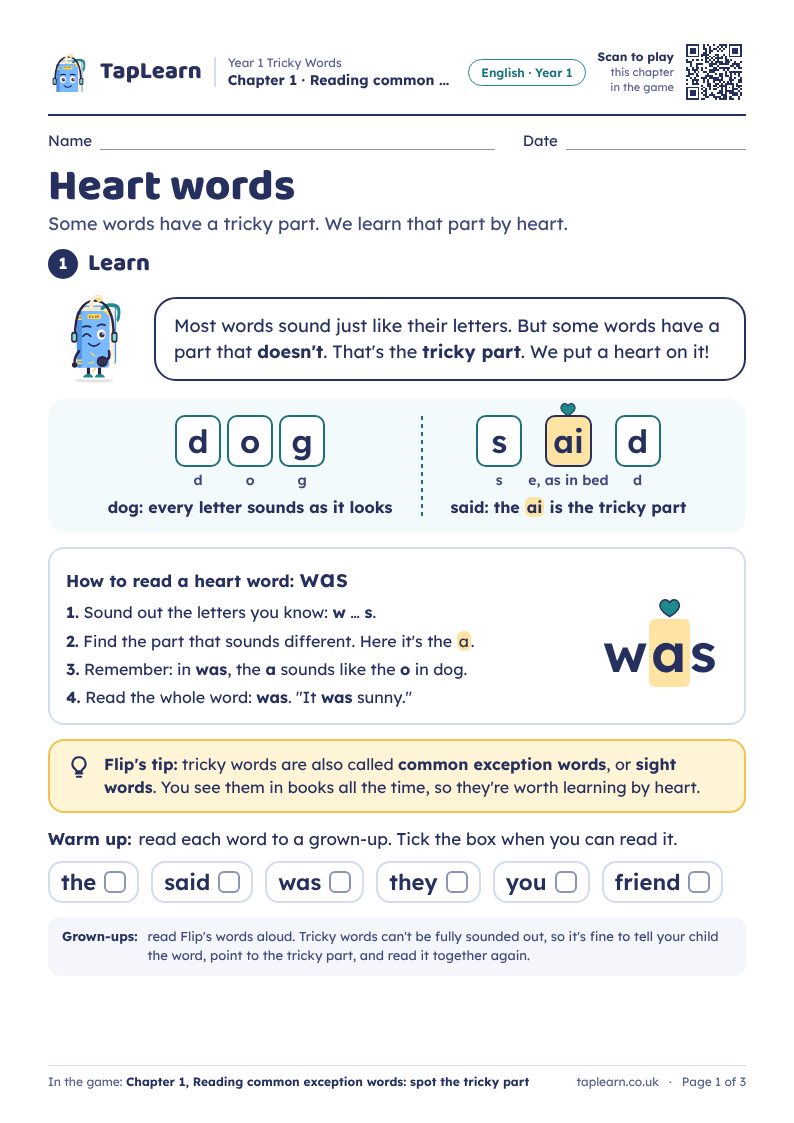
Heart Words is a printable sight words worksheet for Year 1 (ages 5 to 6) that teaches children to read tricky words like said, was and they by sounding out the parts they know and learning the tricky part by heart. It covers the Year 1 English statement to read common exception words, noting unusual correspondences between spelling and sound.
Free to print, no account needed.
▶ Play chapter 1 in the game · How the tricky words (common exception words) works
Print it on A4, in colour or black and white. Do it after the chapter, or before it to see what your child already knows.
What's on the worksheet
Your child reads Year 1 tricky words such as said, was, they and friend, and draws a heart over the tricky part of each one. Includes a heart word hunt in a book from home and an answers sheet.
- Page 1 · Learn
- Dog and said side by side to show a tricky part, a worked example reading was, Flip's tip that tricky words are also called common exception words or sight words, and a read-and-tick warm-up.
- Page 2 · Try it together
- Heart word hunt: open a book from home, hunt for the, was, said, they and you, read each one aloud and make a mark in its row, then see which word you found the most.
- Page 3 · Practise
- Draw hearts over tricky parts, ring the word that makes sense, such as was or saw, match each tricky part to the sound it makes, and a challenge about reading said.
- Answers sheet
- Every answer, mix-ups like sounding out every letter or mixing up was and saw, and story-time and finger-heart ideas.
3 A4 pages and an answers sheet · about 20 minutes
In the classroom
- Run the heart word hunt in pairs with class reading books, then tally which word appeared most.
- Use Practise C as a phonics starter: show each tricky part and ask what sound it makes.
Questions from the worksheet
- Read each word. Draw a little heart over its tricky part: was, said, they, of, school, friend.
- Read the sentence. Ring the word that makes sense: I ___ a dog. (was / saw)
- Leo reads said as "s-a-i-d, sayd". Is he right? What could you tell him?
The answers are on the answers sheet, for grown-ups.
National curriculum in England
This worksheet practises this statement from the Year 1 english programme of study:
- Read common exception words, noting unusual correspondences between spelling and sound and where these occur in the word
Using it at home
- Tricky words can't be fully sounded out, so it's fine to tell your child the word, point to the tricky part and read it together again.
- In the heart word hunt, let your child do the finding. If they stop at a word, ask "Which part is tricky?"
- Write a tricky word on a steamy window and let your child draw a heart over the tricky part.
Watch out for
- Sounding out every letter, reading said as "sayd".
- Praise it, then say: "This one has a tricky part. Let's find it."
- Mixing up look-alike words such as was and saw, or the and they.
- Run a finger under the word from left to right and check the first letter: w for was, s for saw.
- Putting the heart on letters that aren't tricky.
- Ask "Does s sound as we expect? Yes, so it isn't the tricky part."
Questions and answers
What are sight words?
Sight words are common words with a tricky part that can't be fully sounded out, like said or was. Schools also call them common exception words or tricky words.
What is a heart word?
A heart word is a tricky word where one part must be learned by heart. Children draw a heart over that part, like the ai in said.
How do you read a tricky word like was?
Sound out the letters you know, find the part that sounds different, then read the whole word. In was, the a sounds like the o in dog.
 TapLearn