Days of the week worksheet for Year 1
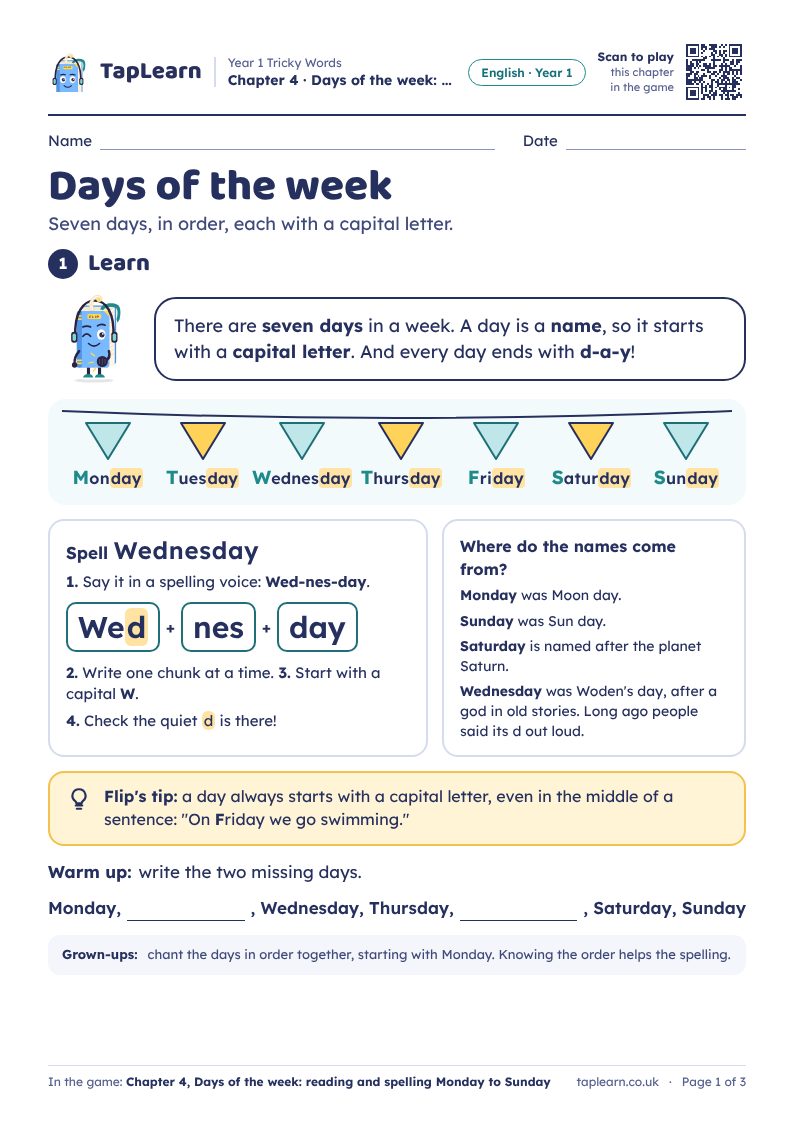
Days of the Week is a printable days of the week worksheet for Year 1 (ages 5 to 6) that teaches children to say the days in order and spell Monday to Sunday with a capital letter, chunking Wednesday as Wed-nes-day. It covers the Year 1 English statement to spell the days of the week.
This worksheet is for members
Membership opens every chapter of every game and every worksheet, for all your children.
See the plansAlready a member? Log in to print it.
Start with the free one: Heart words (chapter 1).
Print it on A4, in colour or black and white. Do it after the chapter, or before it to see what your child already knows.
What's on the worksheet
Your child says the days of the week in order and spells Monday to Sunday with a capital letter, including the quiet d in Wednesday. Includes a My Week chart to write and draw in and an answers sheet.
- Page 1 · Learn
- The seven days in order, a worked example spelling Wednesday in chunks, where day names come from, Flip's tip on capital letters mid-sentence, and a missing-days warm-up.
- Page 2 · Try it together
- My week: say the days in order clapping once for each, talk about one thing you do each day, then write each day in the chart and draw a tiny picture beside it.
- Page 3 · Practise
- Ring the right spelling, write the day before or after, correct days with a mistake like Wensday and Fryday, and a challenge about the two d's in Wednesday.
- Answers sheet
- Every answer, mix-ups like Munday and Toosday, and today-is and day-hop ideas.
3 A4 pages and an answers sheet · about 20 minutes
In the classroom
- Start each day by writing the date on the board and asking a child to spell the day aloud.
- Use Practise C as a mini-whiteboard check, correcting one misspelt day at a time.
Questions from the worksheet
- Ring the right spelling: Munday, monday, Monday.
- Which day is it? The day after Monday is ___. The day before Sunday is ___.
- Each day has a mistake. Write it the right way: monday, Wensday, Saterday, Fryday.
- Ava says, "Wednesday has two d's, but I can only hear one." Is she right? Draw a ring round the d you can't hear.
The answers are on the answers sheet, for grown-ups.
National curriculum in England
This worksheet practises this statement from the Year 1 english programme of study:
- Spell: the days of the week
Using it at home
- Chant the days in order together, starting with Monday. Knowing the order helps the spelling.
- While filling in My Week, let your child trace the grey capital and ask "What day is it today? What day was it yesterday?"
- Play day hop: say a day and your child says the next one, then the day before.
Watch out for
- Leaving out quiet letters, like Wensday.
- Use a spelling voice: say "Wed-nes-day" just as it's written.
- Spelling by sound, like Munday or Toosday.
- The o in Monday sounds like u, and the ue in Tuesday sounds like oo.
- Forgetting the capital letter.
- Days are names, like Ava or Leo, so they always start with a capital.
Questions and answers
Do days of the week have capital letters?
Yes. Days of the week are names, so they always start with a capital letter, even in the middle of a sentence.
Why does Wednesday have a silent d?
Wednesday was Woden's day, after a god in old stories, and long ago people said its d out loud. Saying Wed-nes-day in a spelling voice helps.
Where do the names of the days come from?
Monday was Moon day, Sunday was Sun day, and Saturday is named after the planet Saturn.
 TapLearn