Contractions worksheet for Year 1: I'm, I'll and we'll
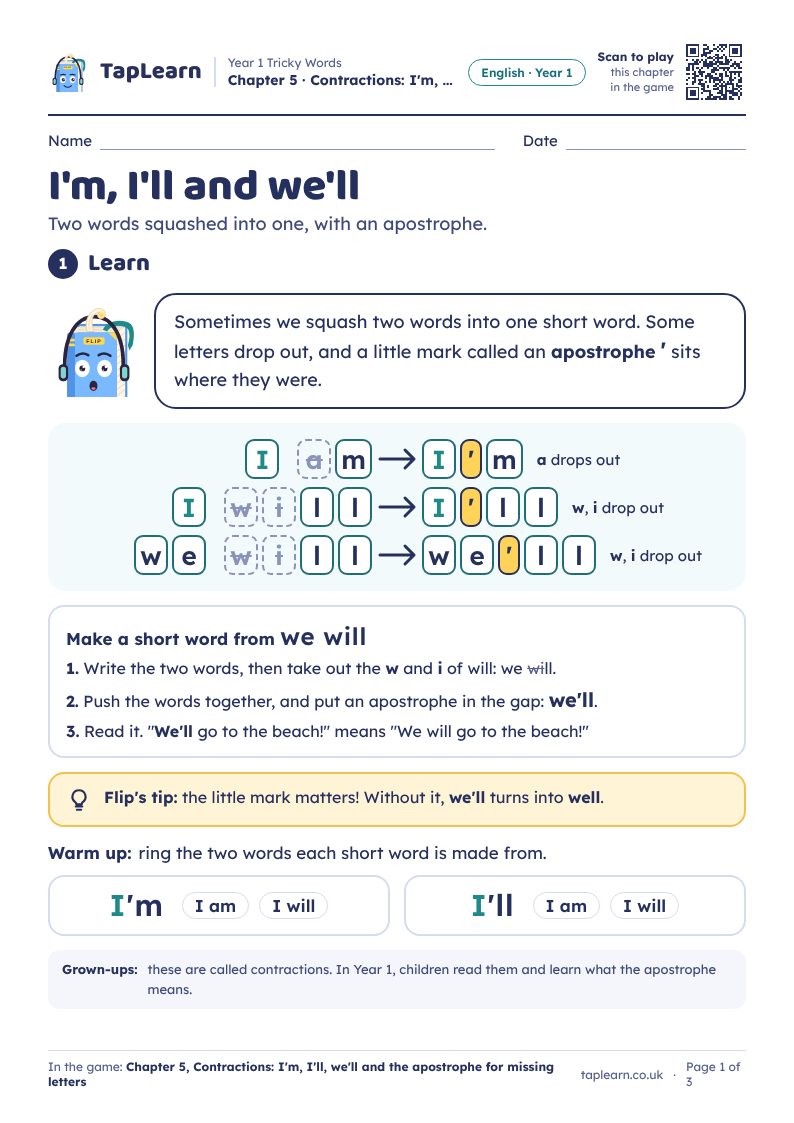
I'm, I'll and We'll is a printable contractions worksheet for Year 1 (ages 5 to 6) that teaches children to read short words made from two words and say which letters dropped out. It covers the Year 1 English statement to read words with contractions and understand that the apostrophe represents the omitted letters.
This worksheet is for members
Membership opens every chapter of every game and every worksheet, for all your children.
See the plansAlready a member? Log in to print it.
Start with the free one: Heart words (chapter 1).
Print it on A4, in colour or black and white. Do it after the chapter, or before it to see what your child already knows.
What's on the worksheet
Your child reads the contractions I'm, I'll and we'll and learns that the apostrophe shows where letters are missing. Includes a clap-and-squash game and an answers sheet.
- Page 1 · Learn
- I am, I will and we will squashed into I'm, I'll and we'll with the missing letters shown, a worked example making we'll, Flip's tip that we'll without its mark becomes well, and a warm-up.
- Page 2 · Try it together
- Clap and squash: the grown-up holds out two hands and says "I … am", the child claps them together and says "I'm!", then writes each short word with its apostrophe.
- Page 3 · Practise
- Put missing apostrophes back, fill in a table of two words and missing letters, ring what words like we'll and well mean in sentences, and a challenge about Leo's sentence.
- Answers sheet
- Every answer, mix-ups like reading we'll as well, and squash-it and spot-them ideas.
3 A4 pages and an answers sheet · about 20 minutes
In the classroom
- Play clap and squash as a whole class, with children calling out the short word.
- Use Leo's challenge as a shared writing moment, adding the apostrophe and the capital W.
Questions from the worksheet
- Each word has lost its apostrophe. Draw it back in the right place: I m, I ll, we ll, you ll.
- Read the sentence. Ring what the shaded word means: We'll go to the park. (well / we will)
- Leo wrote: "Well go to the park." But he meant we will. What has he missed? Write it the right way.
The answers are on the answers sheet, for grown-ups.
National curriculum in England
This worksheet practises this statement from the Year 1 english programme of study:
- Read words with contractions, and understand that the apostrophe represents the omitted letter(s)
Using it at home
- After clap and squash, ask "Which letters fell out when we clapped?" For all the will words, it's the w and the i.
- Say a sentence the long way, like "I am ready", and let your child say it the short way.
- In a story book, hunt for apostrophes together and work out the two long words.
Watch out for
- Not sure which letters are missing.
- Write the two words, then the short word underneath, and compare them letter by letter.
- Mixing up I'm and I'll.
- Say the long words: I'm keeps the m of am, I'll keeps the ll of will.
- Reading we'll as well, or I'll as ill.
- Point to the apostrophe: "This mark tells us letters are missing."
Questions and answers
What is a contraction in Year 1?
A contraction is a short word made by squashing two words together, like I'm from I am. Some letters drop out and an apostrophe takes their place.
What does the apostrophe in I'm mean?
It shows where a letter is missing. In I'm, the a of am has dropped out.
Why is we'll different from well?
We'll means we will, and the apostrophe shows the missing w and i. Without the apostrophe it becomes well, a different word.
 TapLearn