Spelling tricky words worksheet for Year 1: Spelling heart words
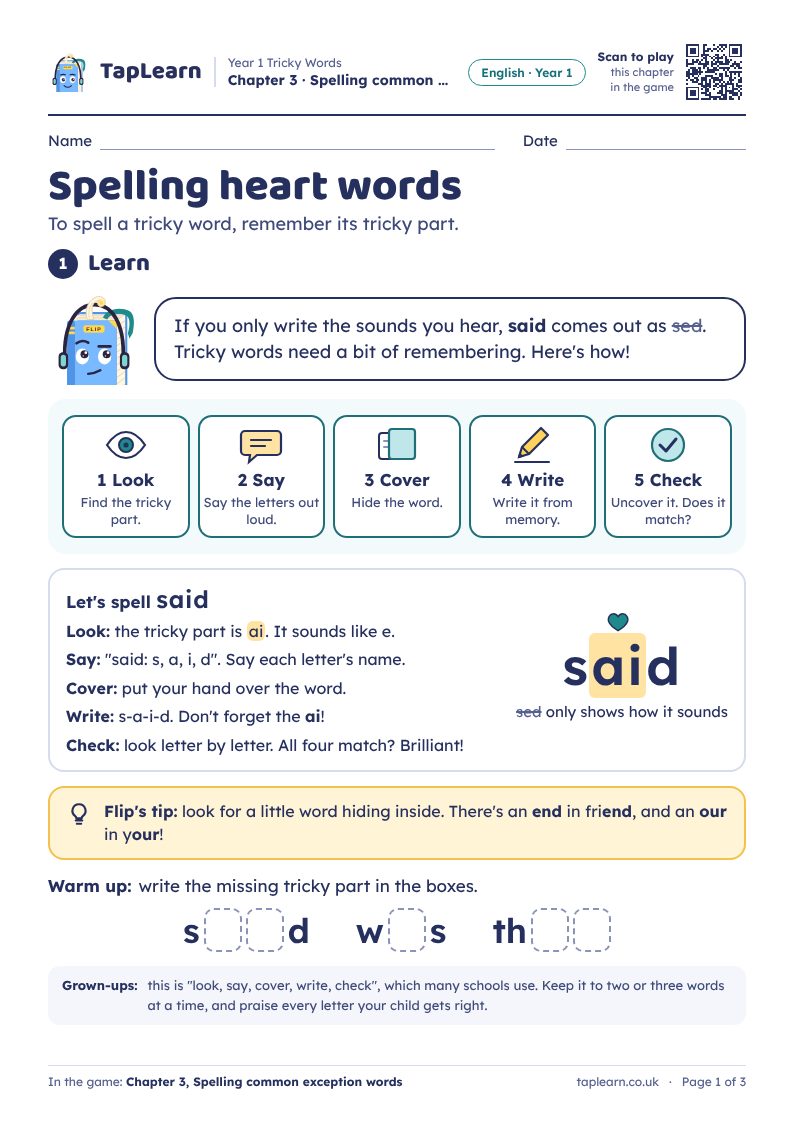
Spelling Heart Words is a printable spelling tricky words worksheet for Year 1 (ages 5 to 6) that teaches children to spell words like said, was and friend with look, say, cover, write, check, remembering the tricky part. It covers the Year 1 English statement to spell common exception words.
This worksheet is for members
Membership opens every chapter of every game and every worksheet, for all your children.
See the plansAlready a member? Log in to print it.
Start with the free one: Heart words (chapter 1).
Print it on A4, in colour or black and white. Do it after the chapter, or before it to see what your child already knows.
What's on the worksheet
Your child spells Year 1 tricky words such as said, was, they and friend by remembering the tricky part, using look, say, cover, write, check. Includes a fold-and-spell activity and an answers sheet.
- Page 1 · Learn
- The five steps of look, say, cover, write, check, a worked example spelling said with its ai, Flip's tip on spotting little words inside like end in friend, and a missing-part warm-up.
- Page 2 · Try it together
- Fold and spell: trace a heart over the tricky part of said, was, they, friend and are, say the letters, fold the page to cover the word, write it, then uncover and check.
- Page 3 · Practise
- Ring the right spelling, fill in tricky parts, write missing words as a grown-up reads sentences, and a challenge about woz and skool.
- Answers sheet
- Every answer, mix-ups like letters in the wrong order, and two-a-day and back-writing ideas.
3 A4 pages and an answers sheet · about 20 minutes
In the classroom
- Use fold and spell as a daily five-minute spelling routine with two new words.
- Read the Practise C sentences aloud as a short dictation and check with a partner.
Questions from the worksheet
- Ring the right spelling: thay, they, tehy; sed, siad, said.
- Fill in the tricky part. One letter goes in each box: fr__nd, s__ool.
- Leo wrote: "I woz at skool." Which two words has he spelt by how they sound? Write the sentence the right way.
The answers are on the answers sheet, for grown-ups.
National curriculum in England
This worksheet practises this statement from the Year 1 english programme of study:
- Spell: common exception words
Using it at home
- Keep it to two or three words at a time, and praise every letter your child gets right.
- In fold and spell, if a letter is wrong, don't rub it out. Uncover the word, look at the tricky part, cover it and use "Write again".
- Trace a word's letters on your child's back with a finger and see if they can guess the word.
Watch out for
- Spelling by sound, like sed for said or woz for was.
- Say: "Yes, that's how it sounds. This word has a tricky part. Let's look."
- Putting letters in the wrong order, like freind or siad.
- Say the letter names aloud together in order, then cover and try again.
- Leaving out quiet letters, like ar for are.
- Point out the letters we write but can't hear.
Questions and answers
How do you learn to spell tricky words?
Use look, say, cover, write, check: find the tricky part, say the letters, cover the word, write it from memory, then check it letter by letter.
Why does my child spell said as sed?
Sed is how the word sounds, which shows good phonics. Said has a tricky part, ai, that has to be remembered.
How is one different from won?
They sound the same but are different words. The number is always spelt o-n-e, and won is used in sentences like "we won the race".
 TapLearn