Prefix un worksheet for Year 1: Adding un
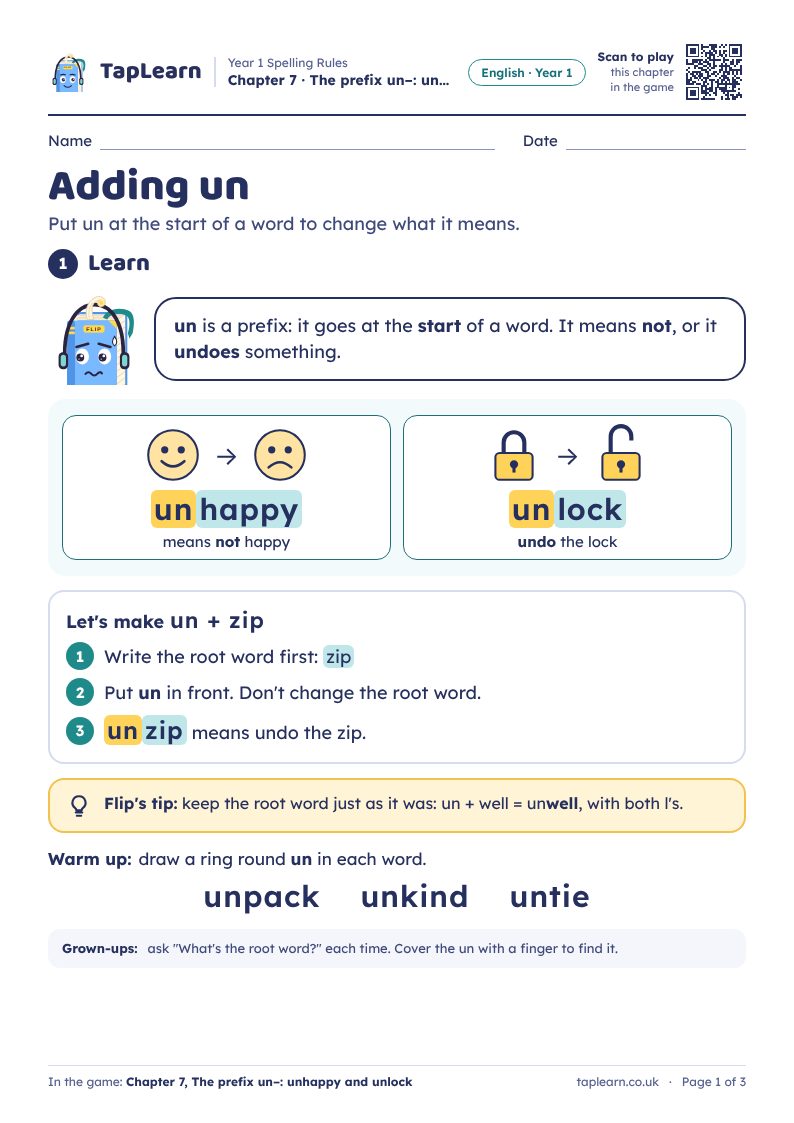
Adding un is a printable prefix un worksheet for Year 1 (ages 5 to 6) that teaches children to put un at the start of a root word without changing it, and that un means not (unhappy) or undoes something (unlock). It covers the Year 1 statement on adding prefixes and suffixes using the prefix un-.
This worksheet is for members
Membership opens every chapter of every game and every worksheet, for all your children.
See the plansAlready a member? Log in to print it.
Start with the free one: Double letters (chapter 1).
Print it on A4, in colour or black and white. Do it after the chapter, or before it to see what your child already knows.
What's on the worksheet
Your child adds the prefix un- to words like happy, lock and zip, and learns that it means not or undoes something. Includes an un game with a coat, laces and a bag, and an answers sheet.
- Page 1 · Learn
- Unhappy and unlock with their meanings, a worked example making unzip, Flip's tip to keep the root word as it was (unwell has both l's), and a ring-the-un warm-up.
- Page 2 · Try it together
- The un game: zip and unzip a coat, pack and unpack a bag, tie and untie laces and fold and unfold a tea towel, then write each pair with the root word first.
- Page 3 · Practise
- Ring the right spelling, add un to make new words, match un words to meanings, draw something you can do and undo, and a challenge about unhappy.
- Answers sheet
- Every answer, mix-ups like onlock and unwel, and un-do-it and opposites ideas.
3 A4 pages and an answers sheet · about 20 minutes
Using it at home
- Ask "What's the root word?" each time, and cover the un with a finger to find it.
- In the un game, the words all undo something. Words like unkind and unwell mean "not".
- Say a word like kind, fair or tidy and your child says the un word.
Watch out for
- Writing on- instead of un-, like onlock.
- Say the start slowly together: "u-n, un".
- Changing the root word, like unwel.
- Spell the root word first (well), then put un in front.
- Not being sure what un means.
- Act it out: lock and unlock, zip and unzip, and say "not happy" for unhappy.
Questions from the worksheet
- Draw a ring round the right spelling: onlock / unlock, unwell / unwel, unhappy / onhappy, unpak / unpack.
- Add un. Write the new word: un + kind, un + pack, un + tie, un + fair.
- What does it mean? Draw a line: unhappy, unlock, unwell.
- Sam says unhappy means very happy. Is he right? What does it really mean?
The answers are on the answers sheet, for grown-ups.
National curriculum in England
This worksheet practises this statement from the Year 1 english programme of study:
- Add prefixes and suffixes: using the prefix un–
In the classroom
- Play the opposites game as a starter: say kind, fair or tidy and pupils write the un word.
- Act out do-and-undo pairs as a class: pack and unpack, fold and unfold.
Questions and answers
What does the prefix un mean?
Un means not, as in unhappy (not happy), or it undoes something, as in unlock and unzip.
What is a prefix?
A prefix is a group of letters added to the start of a word to change its meaning, like un in unkind.
Does the root word change when you add un?
No. Keep the root word just as it was: un + well = unwell, with both l's.
More worksheets from Year 1 Spelling Rules: A Garden Adventure with Bea
- Chapter 1: Double letters worksheet Free
- Chapter 2: Ck words worksheet: ck at the end Members
- Chapter 3: Plurals worksheet: One or more: s or es Members
- Chapter 4: Adding s and es to verbs worksheet: Doing words: s or es Members
- Chapter 5: Suffixes ing, ed and er worksheet: Growing words Members
- Chapter 6: Adding er and est worksheet: Longer and longest Members
 TapLearn