Suffixes ing, ed and er worksheet for Year 1: Growing words
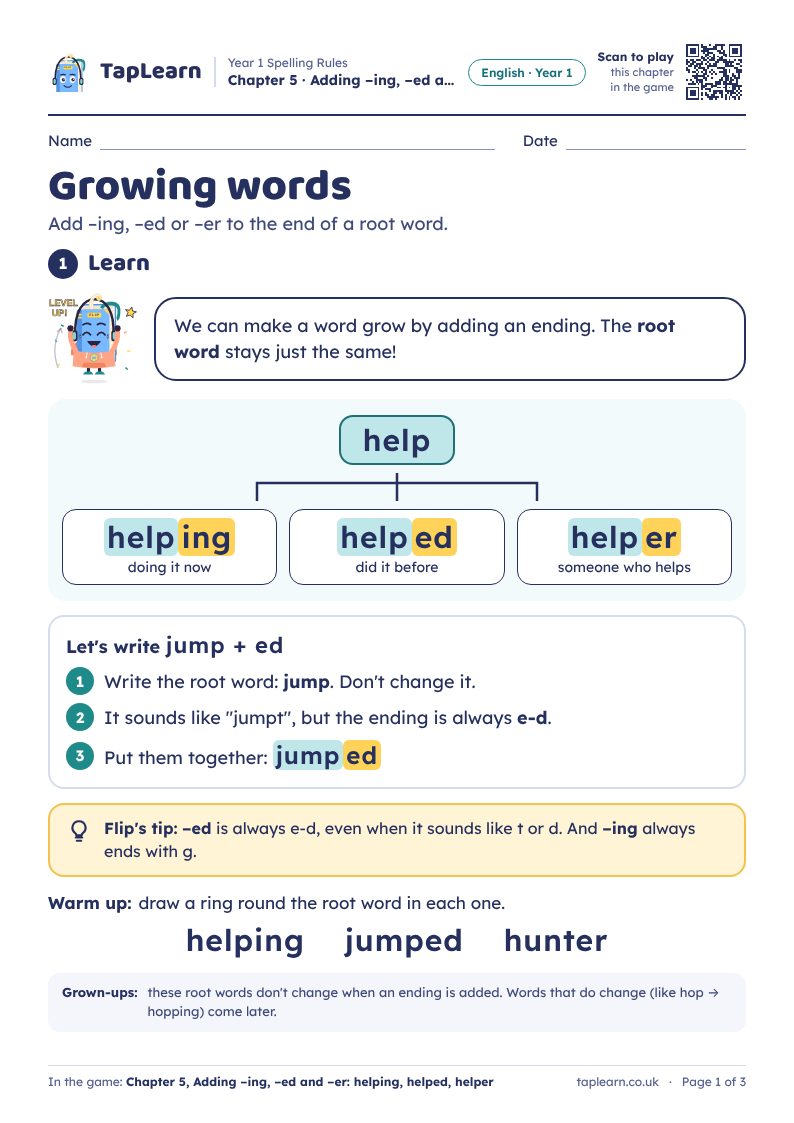
Growing Words is a printable suffixes ing, ed and er worksheet for Year 1 (ages 5 to 6) that teaches children to add an ending to a root word without changing it, as in helping, helped and helper, and to write -ed as e-d even when it sounds like t. It covers the Year 1 statement on using -ing, -ed, -er and -est where no change is needed in the spelling of root words.
This worksheet is for members
Membership opens every chapter of every game and every worksheet, for all your children.
See the plansAlready a member? Log in to print it.
Start with the free one: Double letters (chapter 1).
Print it on A4, in colour or black and white. Do it after the chapter, or before it to see what your child already knows.
What's on the worksheet
Your child adds -ing, -ed and -er to root words like help, jump and hunt without changing them, and always writes -ed as e-d. Includes a grow-a-word paper activity and an answers sheet.
- Page 1 · Learn
- Help growing into helping, helped and helper with meanings, a worked example writing jumped, Flip's tip on -ed and -ing, and a ring-the-root-word warm-up.
- Page 2 · Try it together
- Grow a word: write a root word like jump on one scrap and ing, ed and er on three others, put each ending after the root, read the new word and act it out.
- Page 3 · Practise
- Ring the right spelling, add endings to make new words, finish sentences with -ing or -ed, draw yourself helping and write a sentence, and a challenge about helpping.
- Answers sheet
- Every answer, mix-ups like jumpt and jumpin, and now-and-before and who-does-it ideas.
3 A4 pages and an answers sheet · about 20 minutes
Using it at home
- These root words don't change when an ending is added. Words that do change (like hop to hopping) come later.
- In grow a word, point out that the root word looks exactly the same in every box.
- Say "Now I am painting. Yesterday I…" and your child finishes: "painted".
Watch out for
- Spelling -ed as it sounds, like jumpt or buzd.
- Say, "It can sound like t or d, but we always write e-d."
- Writing -in for -ing, like jumpin.
- Say the word carefully together and listen for the g at the end.
- Changing the root word, like helpping.
- Cover the ending: the root word should look just like it did before.
Questions from the worksheet
- Draw a ring round the right spelling: jumped / jumpt, helpin / helping, buzd / buzzed, kickt / kicked.
- Add the ending. Write the new word: kick + ing, help + ed, paint + er, fish + ing.
- Finish each sentence with -ing or -ed: Yesterday I ___ over a puddle. (jump) Now I am ___ Mum. (help)
- Leo wrote helpping. Is that right? Look at the root word.
The answers are on the answers sheet, for grown-ups.
National curriculum in England
This worksheet practises this statement from the Year 1 english programme of study:
- Add prefixes and suffixes: using –ing, –ed, –er and –est where no change is needed in the spelling of root words
In the classroom
- Play who does it?: someone who paints is a painter; someone who helps is a…?
- Use grow a word with word cards in small groups.
Questions and answers
What is a root word?
A root word is the word before any ending is added, like help in helping, helped and helper.
How do you spell words ending in -ed?
-ed is always written e-d, even when it sounds like t (jumped) or d (buzzed).
Does the root word change when you add -ing?
Not for these Year 1 words. Just add the ending: help becomes helping, with one p.
More worksheets from Year 1 Spelling Rules: A Garden Adventure with Bea
- Chapter 1: Double letters worksheet Free
- Chapter 2: Ck words worksheet: ck at the end Members
- Chapter 3: Plurals worksheet: One or more: s or es Members
- Chapter 4: Adding s and es to verbs worksheet: Doing words: s or es Members
- Chapter 6: Adding er and est worksheet: Longer and longest Members
- Chapter 7: Prefix un worksheet: Adding un Members
 TapLearn