Double letters worksheet for Year 1
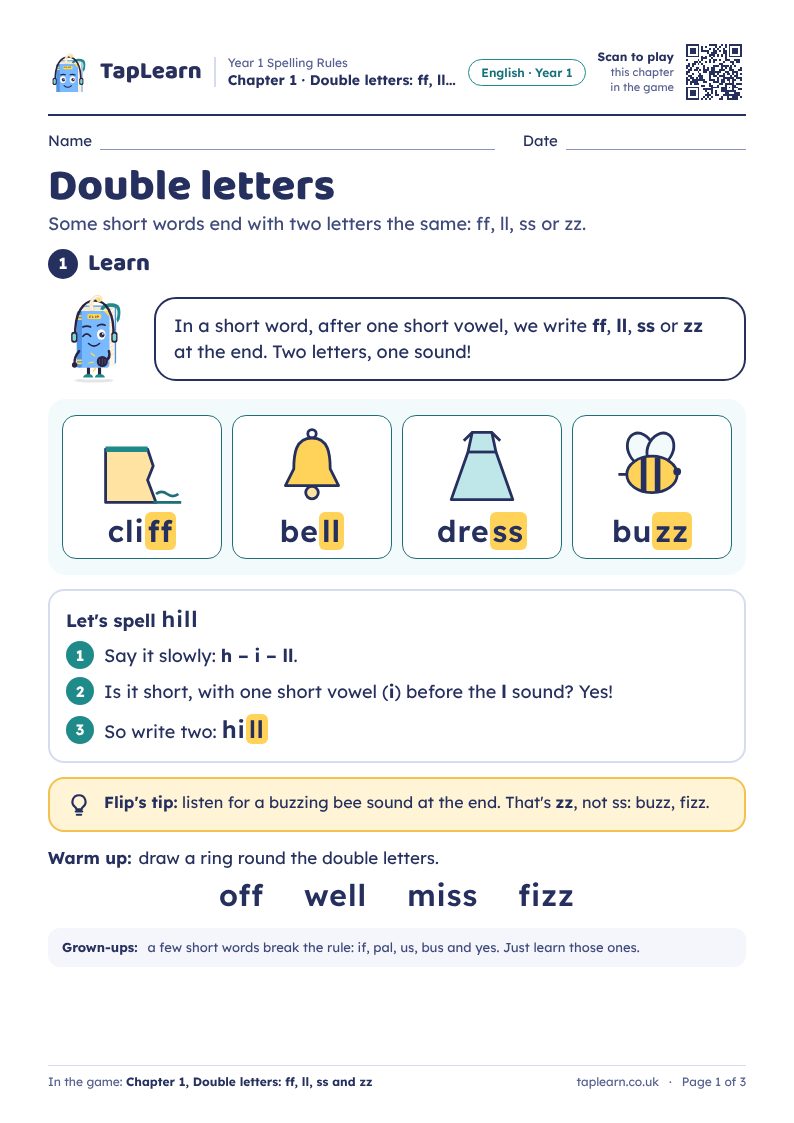
Double Letters is a printable double letters worksheet for Year 1 (ages 5 to 6) that teaches children to write ff, ll, ss or zz at the end of a short word after one short vowel, as in cliff, bell, dress and buzz. It covers the Year 1 statement on applying simple spelling rules and guidance from English appendix 1.
Free to print, no account needed.
Print it on A4, in colour or black and white. Do it after the chapter, or before it to see what your child already knows.
What's on the worksheet
Your child spells short words that end in ff, ll, ss and zz, like cliff, bell, dress and buzz, by listening for one short vowel before the end. Includes a double letter hunt at home and an answers sheet.
- Page 1 · Learn
- Cliff, bell, dress and buzz with the double letters shown, a worked example spelling hill, Flip's buzzing-bee tip for zz, and a ring-the-double-letters warm-up.
- Page 2 · Try it together
- Double letter hunt: look around your home for things whose names end in ff, ll, ss or zz, like a bell, a doll or a glass, say each slowly and write it in the right box.
- Page 3 · Practise
- Ring the right spelling, write the missing double letters, write rhyming words, draw something ending in ll, and a challenge about fiss.
- Answers sheet
- Every answer, mix-ups like bel for bell, and rhyme-chain and spell-it-aloud ideas.
3 A4 pages and an answers sheet · about 20 minutes
In the classroom
- Spell words aloud as a class, saying "double l" or "double z".
- Use Practise A as a mini-whiteboard spelling check.
Questions from the worksheet
- Draw a ring round the right spelling: bel / bell, dress / dres, buss / buzz, hill / hil, kis / kiss, puff / puf.
- Write a word that rhymes. It ends the same way! bell, hill, mess, puff.
- Sam wrote fiss for a fizzy drink. Is that right? What should it be?
The answers are on the answers sheet, for grown-ups.
National curriculum in England
This worksheet practises this statement from the Year 1 english programme of study:
- Apply simple spelling rules and guidance, as listed in English appendix 1
Using it at home
- A few short words break the rule: if, pal, us, bus and yes. Just learn those ones by heart.
- In the hunt, the zz box is the hardest. Try fizz, buzz or jazz, and off or puff for ff.
- Make rhyme chains: say bell, then take turns with well, tell, sell, fell. How long can you keep going?
Watch out for
- Writing one letter instead of two, like bel for bell.
- Ask, "Is it a short word with one short vowel before the end? Then double it."
- Using s for the buzzy z sound, like fiss for fizz.
- Make a bee noise together: zzz. That buzzy sound is zz.
- Doubling rule-breakers like bus and yes.
- If, pal, us, bus and yes have just one letter. They are worth learning by heart.
Questions and answers
Why do words like bell and kiss end in double letters?
In a short word with one short vowel, the f, l, s or z sound at the end is usually written twice: ff, ll, ss or zz.
Which words break the double letter rule?
A few short words have just one letter: if, pal, us, bus and yes.
How can children tell zz from ss?
Listen for a buzzing bee sound at the end. That's zz, as in buzz and fizz.
More worksheets from Year 1 Spelling Rules: A Garden Adventure with Bea
- Chapter 2: Ck words worksheet: ck at the end Members
- Chapter 3: Plurals worksheet: One or more: s or es Members
- Chapter 4: Adding s and es to verbs worksheet: Doing words: s or es Members
- Chapter 5: Suffixes ing, ed and er worksheet: Growing words Members
- Chapter 6: Adding er and est worksheet: Longer and longest Members
- Chapter 7: Prefix un worksheet: Adding un Members
 TapLearn