Adding s and es to verbs worksheet for Year 1: Doing words: s or es
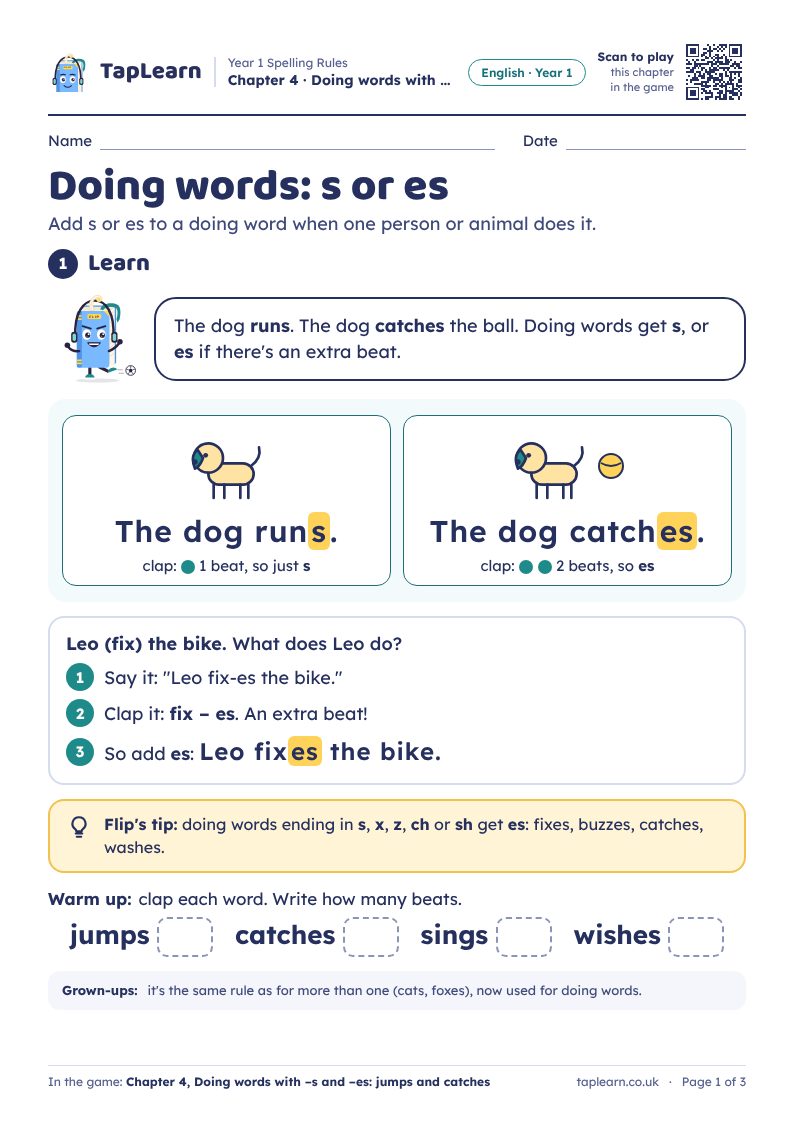
Doing Words: s or es is a printable adding s and es to verbs worksheet for Year 1 (ages 5 to 6) that teaches children to add s to a doing word when one person or animal does it, or es when there's an extra beat, as in catches and fixes. It covers the Year 1 statement on using the spelling rule for adding -s or -es as the plural marker for nouns and the third person singular marker for verbs.
This worksheet is for members
Membership opens every chapter of every game and every worksheet, for all your children.
See the plansAlready a member? Log in to print it.
Start with the free one: Double letters (chapter 1).
Print it on A4, in colour or black and white. Do it after the chapter, or before it to see what your child already knows.
What's on the worksheet
Your child adds -s or -es to doing words, like jumps and catches, by listening for an extra beat. Includes a what-does-the-dog-do? toy game and an answers sheet.
- Page 1 · Learn
- The dog runs and the dog catches compared by claps, a worked example with Leo fixes the bike, Flip's tip on words ending in s, x, z, ch or sh, and a warm-up.
- Page 2 · Try it together
- What does the dog do?: the grown-up makes a toy jump, hop or wash its face, the child says what it does ("The dog washes"), you clap the doing word and write it.
- Page 3 · Practise
- Ring s or es, write doing words in sentences, fix jumpes and catchs, write what your pet or toy does, and a challenge about swimes.
- Answers sheet
- Every answer, mix-ups like jumpes, and commentator and animal-actions ideas.
3 A4 pages and an answers sheet · about 20 minutes
Using it at home
- It's the same rule as for more than one (cats, foxes), now used for doing words.
- In the toy game, push, wash and catch all get es: pushes, washes, catches. Then swap jobs.
- Be a commentator for the family: "Dad washes the cups. Mia reads."
Watch out for
- Adding s when es is needed, like catchs.
- Clap it: catch-es has two beats, so it needs es.
- Adding es when only s is needed, like jumpes or swimes.
- Clap it: jumps is one beat, so just s.
- Changing the root word.
- The doing word stays the same; only s or es goes on the end.
Questions from the worksheet
- Draw a ring round s or es: The cat sit… Mum wash… The bee buzz… Leo kick…
- Write the doing word with s or es: Mia (run) to the gate. Dad (mix) the paint. Ava (brush) her hair.
- Oops! Fix each doing word: Sam jumpes. Mum catchs the ball.
- Ava wrote: The duck swimes. Is that right? Clap it to check.
The answers are on the answers sheet, for grown-ups.
National curriculum in England
This worksheet practises this statement from the Year 1 english programme of study:
- Add prefixes and suffixes: using the spelling rule for adding –s or –es as the plural marker for nouns and the third person singular marker for verbs
In the classroom
- Play animal actions: "A frog hops. A bee buzzes. A cat…?" and pupils finish and clap.
- Use Practise B as a sentence-writing task in pairs.
Questions and answers
When do you add s or es to a doing word?
When one person or animal does it, add s (the dog runs), or es if there's an extra beat (the dog catches).
Which doing words get es?
Doing words ending in s, x, z, ch or sh usually get es: fixes, buzzes, catches, washes.
Is the rule for doing words the same as for plurals?
Yes. It's the same clap-the-beats rule used for more than one, like cats and foxes.
More worksheets from Year 1 Spelling Rules: A Garden Adventure with Bea
- Chapter 1: Double letters worksheet Free
- Chapter 2: Ck words worksheet: ck at the end Members
- Chapter 3: Plurals worksheet: One or more: s or es Members
- Chapter 5: Suffixes ing, ed and er worksheet: Growing words Members
- Chapter 6: Adding er and est worksheet: Longer and longest Members
- Chapter 7: Prefix un worksheet: Adding un Members
 TapLearn