Adding er and est worksheet for Year 1: Longer and longest
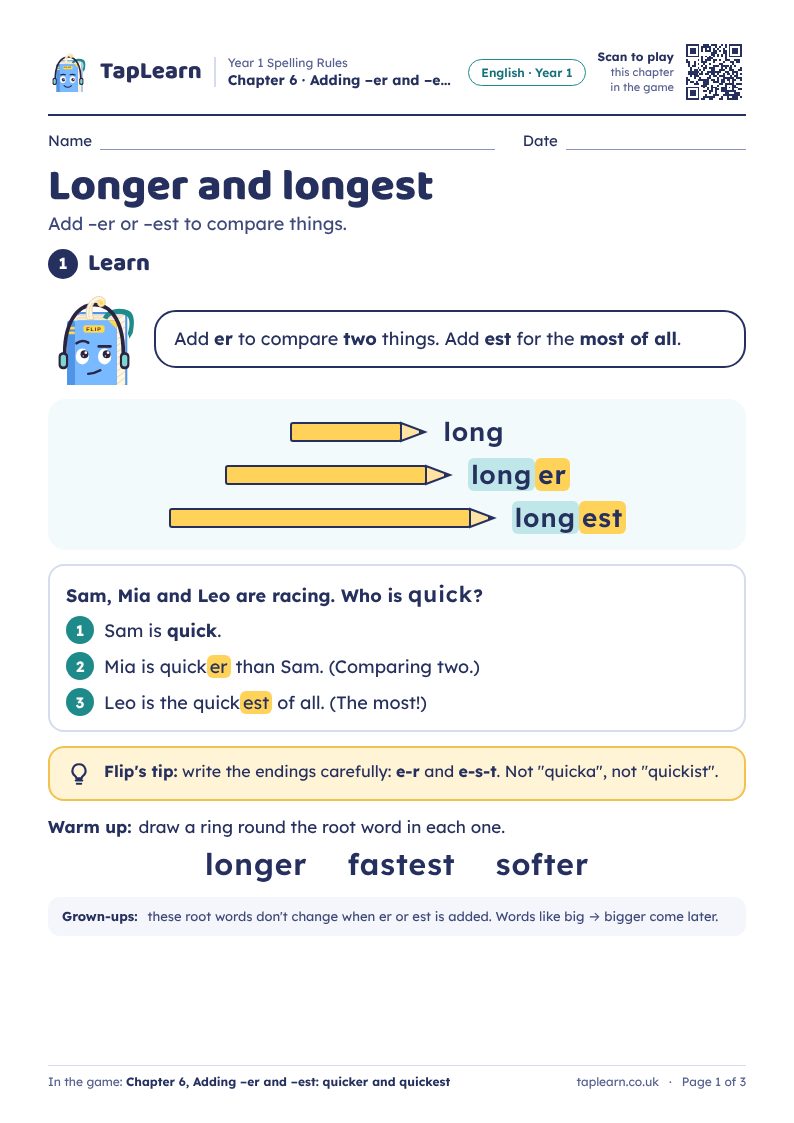
Longer and Longest is a printable adding er and est worksheet for Year 1 (ages 5 to 6) that teaches children to add er when comparing two things and est for the most of all, spelling the endings e-r and e-s-t. It covers the Year 1 statement on using -ing, -ed, -er and -est where no change is needed in the spelling of root words.
This worksheet is for members
Membership opens every chapter of every game and every worksheet, for all your children.
See the plansAlready a member? Log in to print it.
Start with the free one: Double letters (chapter 1).
Print it on A4, in colour or black and white. Do it after the chapter, or before it to see what your child already knows.
What's on the worksheet
Your child adds -er to compare two things and -est for the most of all, like quicker and quickest. Includes a line-them-up activity with socks or toys and an answers sheet.
- Page 1 · Learn
- Long, longer and longest, a worked example comparing three racers, Flip's tip to write e-r and e-s-t carefully, and a ring-the-root-word warm-up.
- Page 2 · Try it together
- Line them up: lay three socks or toys of different sizes in a line, point to the long, longer and longest one, then try soft and small, and write the words.
- Page 3 · Practise
- Label towers tall, taller and tallest, add er and est to fast, small and cold, write er or est in sentences, draw three snakes, and a challenge about quickist.
- Answers sheet
- Every answer, mix-ups like quicka, and family-line-up and loud-louder-loudest ideas.
3 A4 pages and an answers sheet · about 20 minutes
Using it at home
- These root words don't change when er or est is added. Words like big and bigger come later.
- When lining things up, ask "Which two are you comparing?" for er, and "Which one is the most of all?" for est.
- Clap quietly, then louder, then the loudest you can, saying the words as you go.
Watch out for
- Mixing up -er and -est.
- Ask, "How many are you comparing? Two? Use er. The most of all? Use est." A clue: than usually comes after er.
- Writing -er as it sounds, like quicka.
- Say, "It sounds like 'uh', but we write e-r."
- Writing -est as -ist, like quickist.
- Say the ending slowly together: e-s-t.
Questions from the worksheet
- Add er and est: fast, small, cold.
- Write er or est in each box: A mouse is small___ than a cat. This is the long___ snake of all. My bag is light___ than your bag.
- Draw three snakes: long, longer and longest. Label them.
- Mia wrote: Leo is the quickist. Is that right? How should it be spelt?
The answers are on the answers sheet, for grown-ups.
National curriculum in England
This worksheet practises this statement from the Year 1 english programme of study:
- Add prefixes and suffixes: using –ing, –ed, –er and –est where no change is needed in the spelling of root words
In the classroom
- Line up three pupils by height for a tall, taller, tallest starter.
- Use Practise C as a mini-whiteboard check.
Questions and answers
When do you use -er and -est?
Use -er to compare two things (Mia is quicker than Sam) and -est for the most of all (Leo is the quickest).
How do you spell -est?
It's always e-s-t, as in longest and quickest, not -ist.
What word often comes after -er?
Than often follows an -er word: "A mouse is smaller than a cat."
More worksheets from Year 1 Spelling Rules: A Garden Adventure with Bea
- Chapter 1: Double letters worksheet Free
- Chapter 2: Ck words worksheet: ck at the end Members
- Chapter 3: Plurals worksheet: One or more: s or es Members
- Chapter 4: Adding s and es to verbs worksheet: Doing words: s or es Members
- Chapter 5: Suffixes ing, ed and er worksheet: Growing words Members
- Chapter 7: Prefix un worksheet: Adding un Members
 TapLearn