Word choice worksheet for Year 3: Upgrade your words
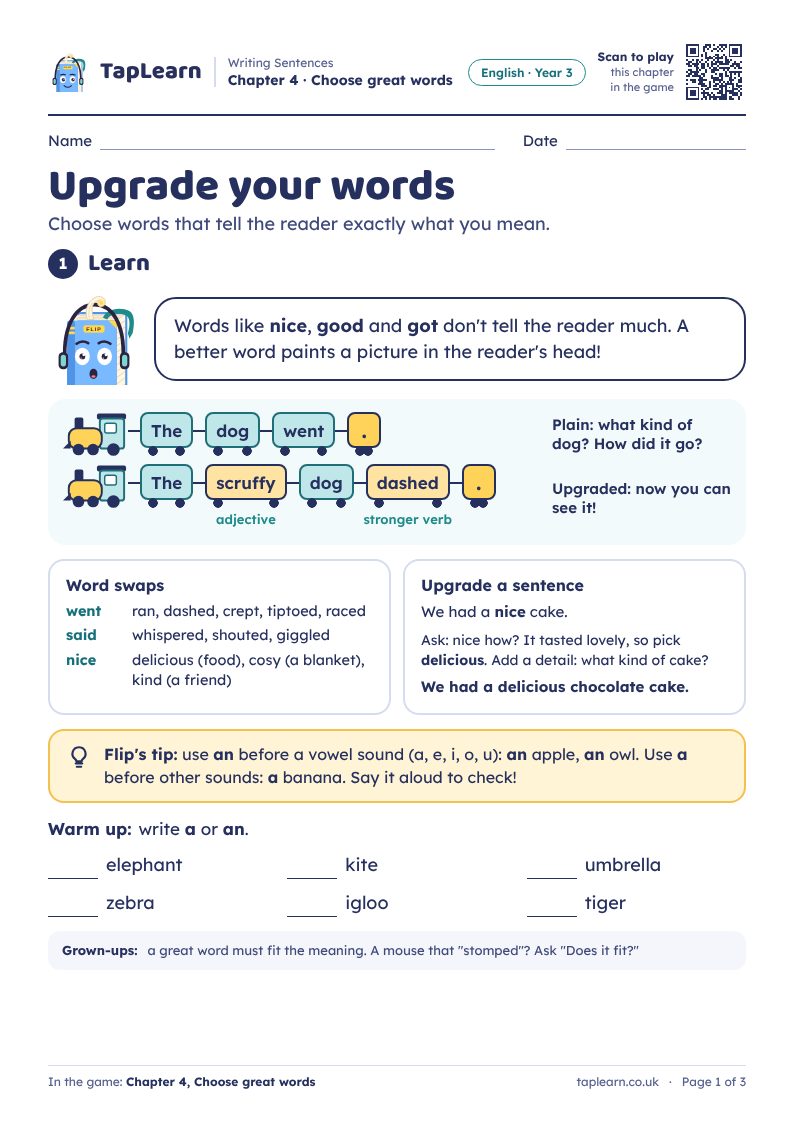
Upgrade Your Words is a printable word choice worksheet for Year 3 (ages 7 to 8) that teaches children to swap dull words for adjectives and strong verbs that fit the meaning, and to choose a or an. Children ring words that fit, replace dull words and add adjectives to describe nouns.
Free to print, no account needed.
Print it on A4, in colour or black and white. Do it after the chapter, or before it to see what your child already knows.
What's on the worksheet
Your child swaps dull words like nice, good and got for adjectives and verbs that fit the meaning, and uses a or an correctly. Includes an upgrade-the-word game and an answers sheet.
- Page 1 · Learn
- The dog went upgraded to The scruffy dog dashed, a word swap bank for went, said and nice, Flip's a-or-an tip, and a warm-up.
- Page 2 · Try it together
- Upgrade the word: take turns upgrading one word at a time in plain sentences like The dog went, checking every word still fits, then write the version you both like.
- Page 3 · Practise
- Ring the word that fits, swap dull words for better ones, add adjectives to describe nouns, write about a picture with an adjective and a strong verb, and a challenge about an juicy orange.
- Answers sheet
- Every answer, mix-ups like exciting words that don't fit, and upgrade-the-word and a-or-an snap games.
3 A4 pages and an answers sheet · about 25 minutes
In the classroom
- Run upgrade the word as a class relay: each table upgrades one word in a plain sentence and passes it on.
- Use the a-or-an warm-up as a quick mini-whiteboard check.
Questions from the worksheet
- Draw a ring round the word that fits the meaning best: The mouse stomped / crept quietly past the sleeping cat.
- Swap the dull word for a better one. Write the new sentence: The pizza was good.
- Add an adjective in each gap: Mia found a ___ shell on the ___ beach.
- Sam wrote: I ate an juicy orange. He says "an" is right because orange starts with o. Is he right? Why?
The answers are on the answers sheet, for grown-ups.
Using it at home
- A great word must fit the meaning: a mouse that stomped doesn't. Ask "Does it fit?"
- Be silly sometimes in upgrade the word, then talk about which words make the clearest picture.
- Name things around you with a or an, like "an egg" and "a cup", and check each one together.
Watch out for
- Using dull words like nice, good and got.
- Ask "What do you really mean? Nice how?"
- Mixing up a and an, as in a orange.
- Say both aloud and hear which is easier. It depends on the word straight after.
- Choosing exciting words that don't fit, like a mouse that stomped.
- Ask "Does it match what happened?"
Questions and answers
How can children make their sentences more interesting?
They can swap dull words like nice, good and got for adjectives and verbs that paint a clearer picture, as long as the new words fit the meaning.
When do you use a or an?
Use an before a word starting with a vowel sound, like an apple, and a before other sounds, like a banana. It depends on the word straight after.
Is it 'an juicy orange' or 'a juicy orange'?
It is a juicy orange, because the word straight after is juicy, which starts with a j sound.
 TapLearn