Sentence punctuation worksheet for Year 3: Capitals and end marks
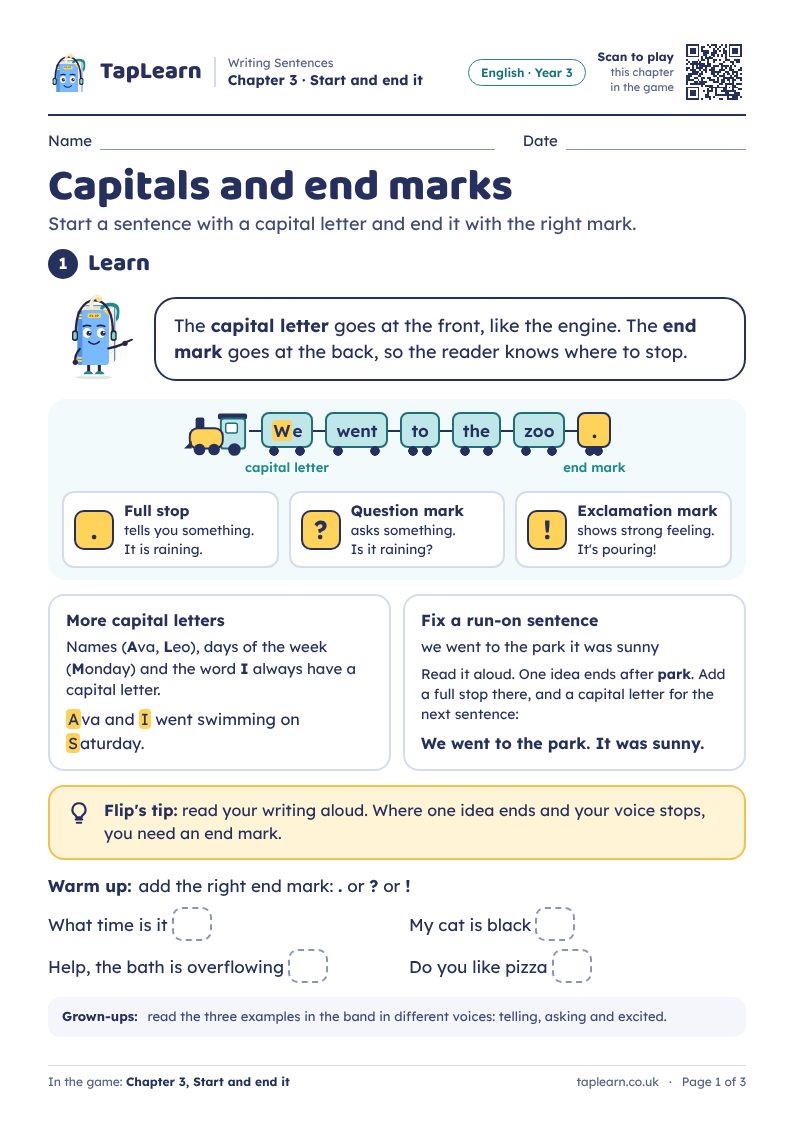
Capitals and End Marks is a printable sentence punctuation worksheet for Year 3 (ages 7 to 8) that teaches children to start sentences with a capital letter and end them with a full stop, question mark or exclamation mark. Children also add capitals for names, days and I, and split run-on sentences.
Free to print, no account needed.
Print it on A4, in colour or black and white. Do it after the chapter, or before it to see what your child already knows.
What's on the worksheet
Your child starts sentences with a capital letter, uses capitals for names, days and I, chooses a full stop, question mark or exclamation mark, and fixes run-on sentences. Includes a punctuation hunt in a story book and an answers sheet.
- Page 1 · Learn
- What full stops, question marks and exclamation marks do, capitals for names, days and I, how to fix a run-on sentence, and an end-mark warm-up.
- Page 2 · Try it together
- Punctuation hunt: tally the capital letters and end marks on a page of a story book, then read a question and an exclamation aloud in the right voice.
- Page 3 · Practise
- Ring letters that should be capitals, choose end marks, split run-on sentences into two, write a question and a sentence with your name and a day, and a challenge.
- Answers sheet
- Every answer, mix-ups like a full stop on a question, and air punctuation and capital spotting games.
3 A4 pages and an answers sheet · about 25 minutes
In the classroom
- Use air punctuation as a starter: read sentences in different voices and children draw the end mark.
- Give pairs a run-on paragraph to split into sentences, then compare where each pair put the full stops.
Questions from the worksheet
- Draw a ring round every letter that should be a capital: next monday, sam and i are going to the zoo.
- Which end mark does each sentence need? Write . or ? or ! — What a huge wave
- These are run-on sentences. Write each one as two sentences: the dog barked it wanted a walk
- Mia wrote: on saturday i went to the park. She says only the first word needs a capital letter. Is she right?
The answers are on the answers sheet, for grown-ups.
Using it at home
- Read the three examples on page 1 in different voices: telling, asking and excited.
- In the punctuation hunt you'll probably find far more full stops than anything else. Talk about why: most sentences tell us something.
- Say a sentence and let your child draw the end mark in the air with a finger.
Watch out for
- Missing capitals at the start, or for names and I.
- Ask "Is this the start of a sentence, a name, a day or I?"
- Using a full stop on a question, or no end mark at all.
- Read it aloud: does your voice ask, tell or exclaim?
- Running sentences together with no full stop.
- Read aloud and listen for where one idea ends.
Questions and answers
When do you use a question mark or exclamation mark?
Use a question mark when a sentence asks something and an exclamation mark when it shows strong feeling. A full stop ends a sentence that tells you something.
Which words need capital letters in Year 3?
The first word of every sentence, names of people, days of the week and the word I always need capital letters.
What is a run-on sentence?
A run-on sentence joins two ideas with no full stop. Fix it by adding a full stop where one idea ends and a capital letter for the next.
 TapLearn