Writing sentences worksheet for Year 3: Say it, check it
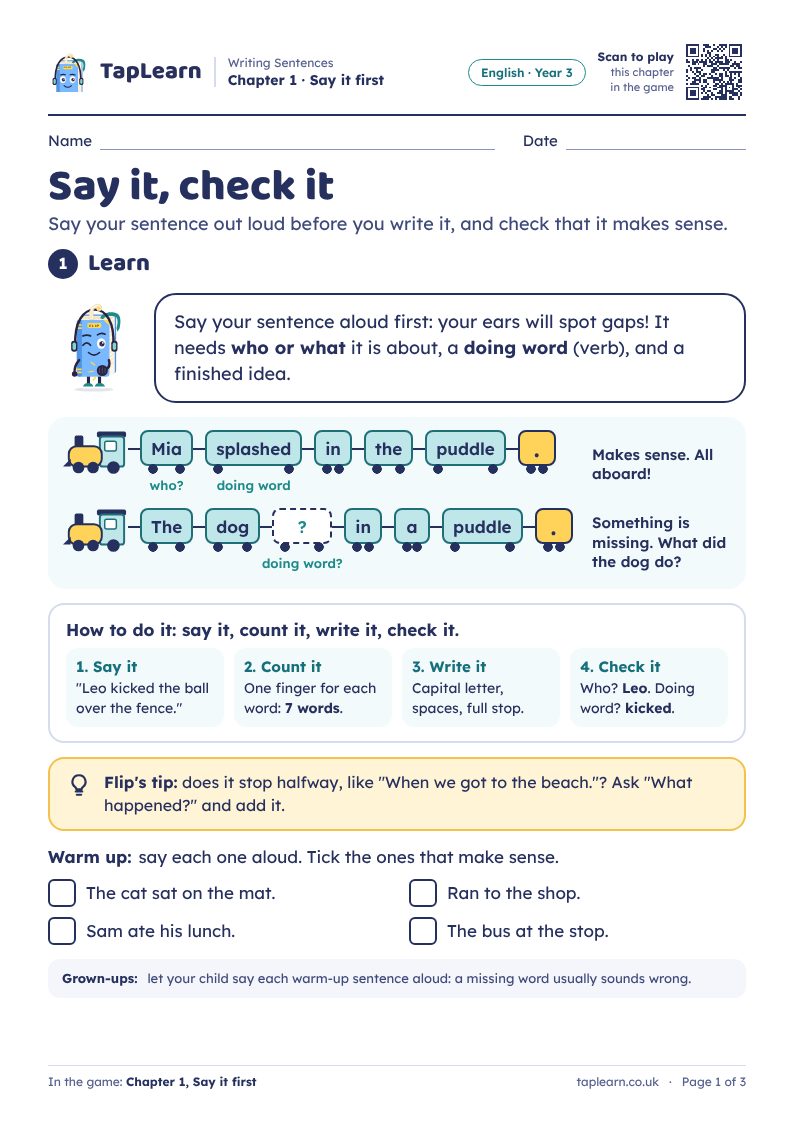
Say It, Check It is a printable writing sentences worksheet for Year 3 (ages 7 to 8) that teaches children to say a sentence aloud before writing it and check it has who it is about, a doing word and a finished idea. Children spot what is missing, finish half-sentences and count the words in their own.
Free to print, no account needed.
Print it on A4, in colour or black and white. Do it after the chapter, or before it to see what your child already knows.
What's on the worksheet
Your child says a sentence aloud before writing it, then checks it says who or what it is about, has a doing word and finishes the idea. Includes a sentence fingers activity with things from home and an answers sheet.
- Page 1 · Learn
- A complete sentence and one missing its doing word, the say it, count it, write it, check it steps, Flip's tip on unfinished ideas, and a which-make-sense warm-up.
- Page 2 · Try it together
- Sentence fingers: pick a spoon, sock or toy, say a sentence about it, count the words on your fingers, then write it and check the written words match the count.
- Page 3 · Practise
- Decide whether sentences are missing who or the doing word, finish sentences from a word box, complete half-finished ideas, write about a picture, and a challenge.
- Answers sheet
- Every answer, the three things a sentence can be missing, and teatime sentences and spot-the-gap games.
3 A4 pages and an answers sheet · about 25 minutes
In the classroom
- Play spot the gap as a starter: say sentences with a word missing and children name what's missing.
- Use the warm-up in pairs, with one child reading each sentence aloud and the other deciding if it makes sense.
Questions from the worksheet
- These are not full sentences yet. What is missing: who it is about, or the doing word? The dog in a puddle.
- Each idea stops halfway. Finish it so the sentence makes sense: If it rains tomorrow,
- Choose a word from the box to finish the sentence: Leaves ___ from the trees.
- Leo wrote: When we got to the beach. He says it is a sentence because it has a capital letter and a full stop. Is he right? Why?
The answers are on the answers sheet, for grown-ups.
Using it at home
- Go first in sentence fingers so your child hears a full sentence, then say one with a word missing for them to spot.
- If the written count doesn't match the spoken count, read the sentence aloud together to find the missing or extra word.
- At teatime, take turns to say a sentence about your day and count its words on your fingers.
Watch out for
- Leaving out the doing word, as in The dog in a puddle.
- Ask "What did the dog do?"
- Leaving out who it is about, as in Splashed in the puddle.
- Ask "Who splashed?"
- Stopping before the idea is finished, as in When we got to the beach.
- Ask "And then what happened?"
Questions and answers
What makes a complete sentence in Year 3?
A complete sentence says who or what it is about, has a doing word (verb) and finishes its idea. It starts with a capital letter and ends with a full stop, question mark or exclamation mark.
Why should children say a sentence before writing it?
Saying it aloud lets them hear gaps, such as a missing word or an unfinished idea, before they write.
Is 'When we got to the beach.' a sentence?
No. It has a capital letter and a full stop, but the idea isn't finished. Adding what happened, such as "we ran into the sea", completes it.
 TapLearn