Word order in sentences worksheet for Year 3: Word order trains
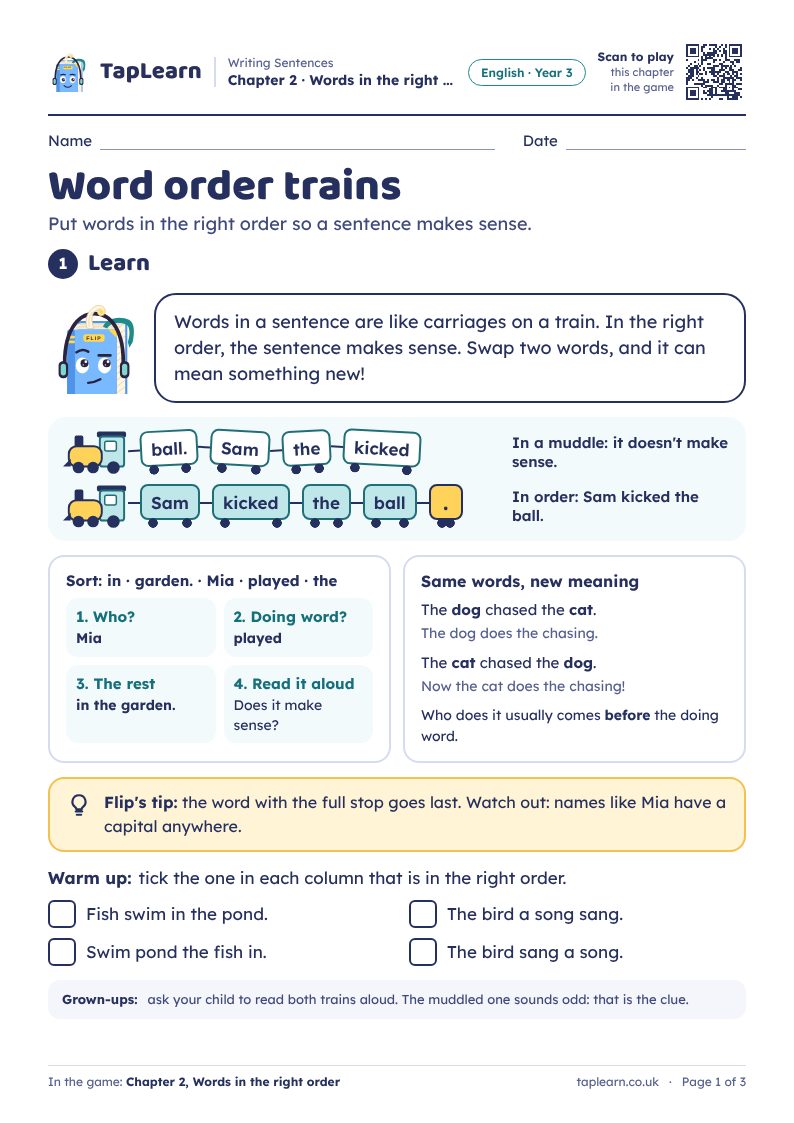
Word Order Trains is a printable word order in sentences worksheet for Year 3 (ages 7 to 8) that teaches children to put words in an order that makes sense and to see how swapping two words can change the meaning. Children unjumble sentences, fix words in the wrong place and make two sentences from the same words.
Free to print, no account needed.
Print it on A4, in colour or black and white. Do it after the chapter, or before it to see what your child already knows.
What's on the worksheet
Your child puts jumbled words in the right order to make sentences, and sees how swapping who does what changes the meaning. Includes a mix-up sentence game with torn paper words and an answers sheet.
- Page 1 · Learn
- Sam kicked the ball shown muddled and in order, steps for sorting a jumbled sentence, how The dog chased the cat changes when swapped, and a warm-up.
- Page 2 · Try it together
- Mix-up sentences: tear a written sentence into words, mix them up for your child to rebuild, then swap the dog and the cat and talk about what changed. Then swap jobs.
- Page 3 · Practise
- Put words in order, swap who does what and decide if it still makes sense, fix one word in the wrong place, make two sentences from the same words, and a cheese-and-mouse challenge.
- Answers sheet
- Every answer, mix-ups like swapping who does what, and silly swaps and spoken jumble games.
3 A4 pages and an answers sheet · about 25 minutes
In the classroom
- Give groups word cards for a sentence and ask them to stand in order, then swap two children to change the meaning.
- Play spoken jumble as a starter: say words in a muddle and the class says them back in order.
Questions from the worksheet
- Put the words in order. Write the sentence: garden. grow the Flowers in
- Swap who does what and write the new sentence. Does it make sense? The boy ate the apple.
- One word is in the wrong place. Ring it, then write the sentence correctly: We to went the beach.
- Mia sorted these words: cheese · mouse · the · ate · The. She wrote The cheese ate the mouse. Is she right?
The answers are on the answers sheet, for grown-ups.
Using it at home
- Ask your child to read both trains on page 1 aloud: the muddled one sounds odd, and that is the clue.
- If your child gets stuck rebuilding a sentence, ask "Who is this about?" and "What did they do?" and find those words first.
- Try silly swaps aloud: "The girl walked the dog" becomes "The dog walked the girl!"
Watch out for
- Jumbling the order so the sentence doesn't make sense.
- Find who it is about, then the doing word, then the rest, and read it aloud.
- Swapping who does what, so the meaning changes.
- Ask "Who did the chasing?" Who does it usually comes before the doing word.
Questions and answers
Why does word order matter in a sentence?
Words need to be in the right order for a sentence to make sense. Swapping two words can change the meaning completely.
How do you unjumble a sentence?
Find who it is about, then the doing word, then the rest. The word with the full stop goes last, and reading it aloud checks it.
What happens if you swap who does what?
The meaning changes: The dog chased the cat becomes The cat chased the dog, so a different animal does the chasing.
 TapLearn