Verb prefixes and suffixes worksheet for Year 5: Verb builder
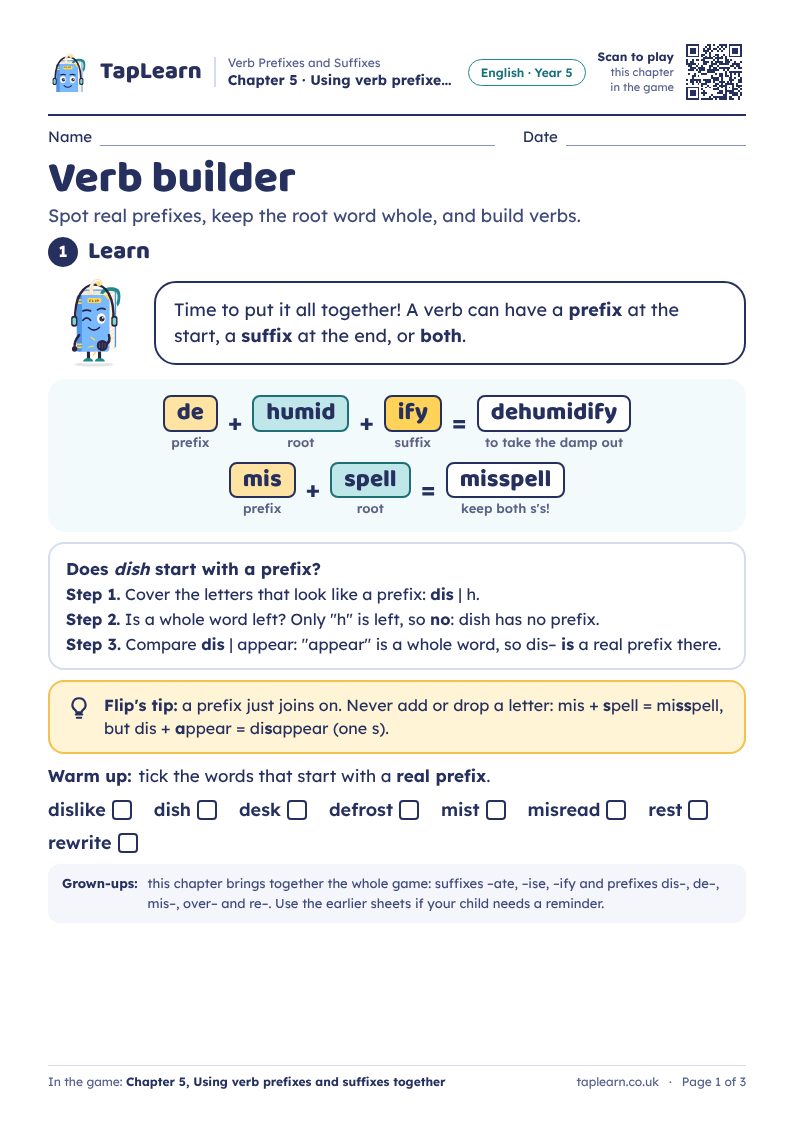
Verb Builder is a printable verb prefixes and suffixes worksheet for Year 5 (ages 9 to 10) that teaches children to tell a real prefix from a look-alike, keep the root word whole, and build verbs like dehumidify and reactivate. It covers the Year 5 statements on converting nouns or adjectives into verbs using suffixes and on verb prefixes.
This worksheet is for members
Membership opens every chapter of every game and every worksheet, for all your children.
See the plansAlready a member? Log in to print it.
Start with the free one: Making verbs (chapter 1).
Print it on A4, in colour or black and white. Do it after the chapter, or before it to see what your child already knows.
What's on the worksheet
Your child spots real prefixes, spells verbs like misspell and disappear without changing the root word, and builds verbs with a prefix and a suffix. Includes a fold-and-check word strip activity and an answers sheet.
- Page 1 · Learn
- Dehumidify and misspell built from parts, a worked example showing dish has no prefix, Flip's tip never to add or drop a letter, and a tick-the-real-prefix warm-up.
- Page 2 · Try it together
- Fold and check: write misspell, disappear, overreact, dish, reach and desk on strips, fold the first letters back, and see whether a whole word is left.
- Page 3 · Practise
- Join prefixes and roots, ring the correct spelling, build verbs with a prefix and a suffix, write the prefix to finish verbs in sentences, and a challenge about dissappear.
- Answers sheet
- Every answer, mix-ups like mispell and dissappear, and build-it-bigger and real-or-fake ideas.
3 A4 pages and an answers sheet · about 25 minutes
Using it at home
- Look at misspell and overreact together: the prefix ends with the same letter the root starts with, so you get a double letter.
- In fold and check, unfold the strip to show both letters stay in misspell, and only one s appears in disappear.
- Start with a root (active) and keep adding parts together: activate, reactivate, deactivate.
Watch out for
- Dropping a letter where a double appears, like mispell or overeact.
- Write the prefix, then the whole root word, without changing either.
- Adding an extra letter, like dissappear or dissagree.
- Fold the prefix back: the root word must be spelt exactly as normal.
- Thinking look-alike words like dish, desk, mist or reach have a prefix.
- If no whole word is left after the "prefix", it isn't one.
Questions from the worksheet
- Join the prefix and the root word. Watch the letters where they meet: mis + spell, dis + appear, over + react, dis + appoint, dis + satisfy.
- Draw a ring round the correct spelling: mispell / misspell, disappear / dissappear, overreact / overeact, disapoint / disappoint.
- Build a verb with a prefix and a suffix. Use your suffix rules: re + active + ate, over + simple + ify, re + class + ify, de + motive + ate.
- Write dis, de, mis, over or re to finish each verb: The plant drooped because I ___watered it. Can you ___code this secret message?
- Sam writes dissappear. He says, "dis– ends in s, so there must be two s's, like in misspell." Is he right? Explain.
The answers are on the answers sheet, for grown-ups.
National curriculum in England
This worksheet practises these statements from the Year 5 english programme of study:
- Word: converting nouns or adjectives into verbs using suffixes
- Word: verb prefixes
In the classroom
- Play real or fake as a starter: say discover, desk, repaint, river and pupils show thumbs up or down.
- Use Practise C to build verbs in pairs, then check the spelling rules together.
Questions and answers
Why does misspell have two s's?
Mis ends in s and spell starts with s. The prefix is just added, so both letters stay: mis + spell = misspell.
Why does disappear have only one s?
Appear starts with a, so dis + appear = disappear. A double letter only happens when the root starts with the letter the prefix ends with.
How can you tell if a word has a real prefix?
Cover the letters that look like a prefix. If a whole word is left, like appear in disappear, it's a real prefix; dish and desk have none.
 TapLearn