Dis, de and mis prefixes worksheet for Year 5: dis, de or mis?
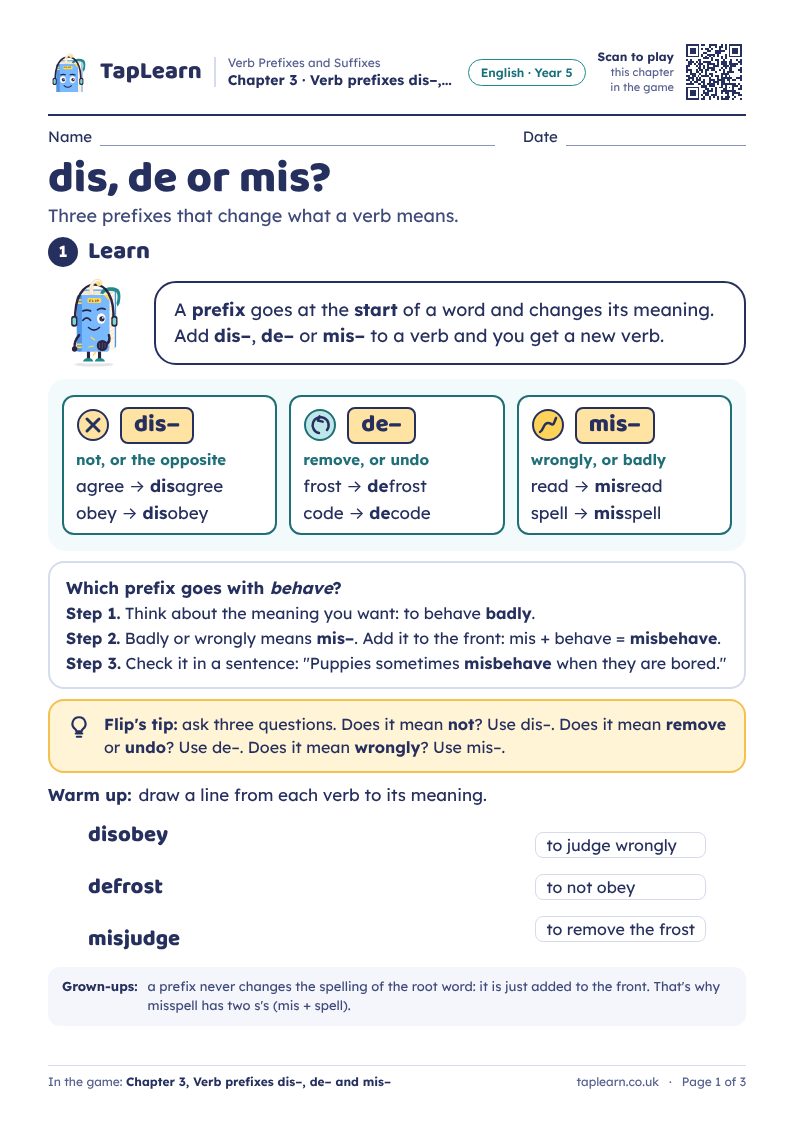
dis, de or mis? is a printable dis, de and mis prefixes worksheet for Year 5 (ages 9 to 10) that teaches children that dis– means not, de– means remove or undo, and mis– means wrongly, as in disobey, decode and misspell. It covers the Year 5 statement on verb prefixes.
This worksheet is for members
Membership opens every chapter of every game and every worksheet, for all your children.
See the plansAlready a member? Log in to print it.
Start with the free one: Making verbs (chapter 1).
Print it on A4, in colour or black and white. Do it after the chapter, or before it to see what your child already knows.
What's on the worksheet
Your child uses the verb prefixes dis– (not), de– (remove or undo) and mis– (wrongly) to change a verb's meaning, as in disagree, defrost and misread. Includes a not, undo or wrongly? cup game and an answers sheet.
- Page 1 · Learn
- The three prefixes and their meanings with example verbs, a worked example choosing mis– for behave, Flip's three-question tip, and a match-the-meaning warm-up.
- Page 2 · Try it together
- Not, undo or wrongly?: the grown-up reads verbs like agree, frost and read, the child drops pasta in the dis–, de– or mis– cup, says the new verb and what it means, then writes it.
- Page 3 · Practise
- Add dis–, de– or mis– to make real verbs, fill the gaps in sentences, correct verbs with the wrong prefix, write sentences with disobey and decode, and a challenge about misagree.
- Answers sheet
- Every answer, mix-ups like dis– and mis–, and prefix-challenge and say-the-opposite ideas.
3 A4 pages and an answers sheet · about 25 minutes
Using it at home
- A prefix never changes the spelling of the root word: it is just added to the front. That's why misspell has two s's.
- In the cup game, swap so your child reads a verb and you choose, and get one wrong on purpose ("misagree!") to see if they catch you.
- Say a verb (appear, obey, connect) and your child says its dis– opposite.
Watch out for
- Mixing up dis– and mis–.
- Ask, "Is it not doing it, or doing it wrongly?" Disobey is not obeying; misbehave is behaving badly.
- Mixing up dis– and de–.
- de– usually takes something away or undoes it (defrost, decode, dethrone). dis– is mostly "not" (dislike).
- Changing the root word, as in mispell.
- The prefix is just added: mis + spell = misspell.
Questions from the worksheet
- Add dis–, de– or mis– to make a real verb: like, appear, lead, throne, understand, judge, activate, obey.
- Write dis, de or mis in each gap: Take the bread out of the freezer to ___frost it. Spies ___code secret messages.
- Each verb in bold has the wrong prefix. Write the correct verb: The puppy disbehaved in the park. I deagree with that idea.
- Leo says, "Misagree means the same as disagree, because both prefixes mean something has gone wrong." Is he right? Explain.
The answers are on the answers sheet, for grown-ups.
National curriculum in England
This worksheet practises this statement from the Year 5 english programme of study:
- Word: verb prefixes
In the classroom
- Play not, undo or wrongly? as a starter with three corners of the room.
- Use Practise C as an editing task in pairs.
Questions and answers
What does the prefix dis- mean?
Dis– usually means not, or the opposite: disagree means not agree and disobey means not obey.
What do the prefixes de- and mis- mean?
De– means remove or undo, as in defrost and decode. Mis– means wrongly or badly, as in misread and misbehave.
Does adding a prefix change the spelling of the root word?
No. The prefix is just added to the front, so mis + spell makes misspell, with two s's.
 TapLearn