Over and re prefixes worksheet for Year 5: Too much or again?
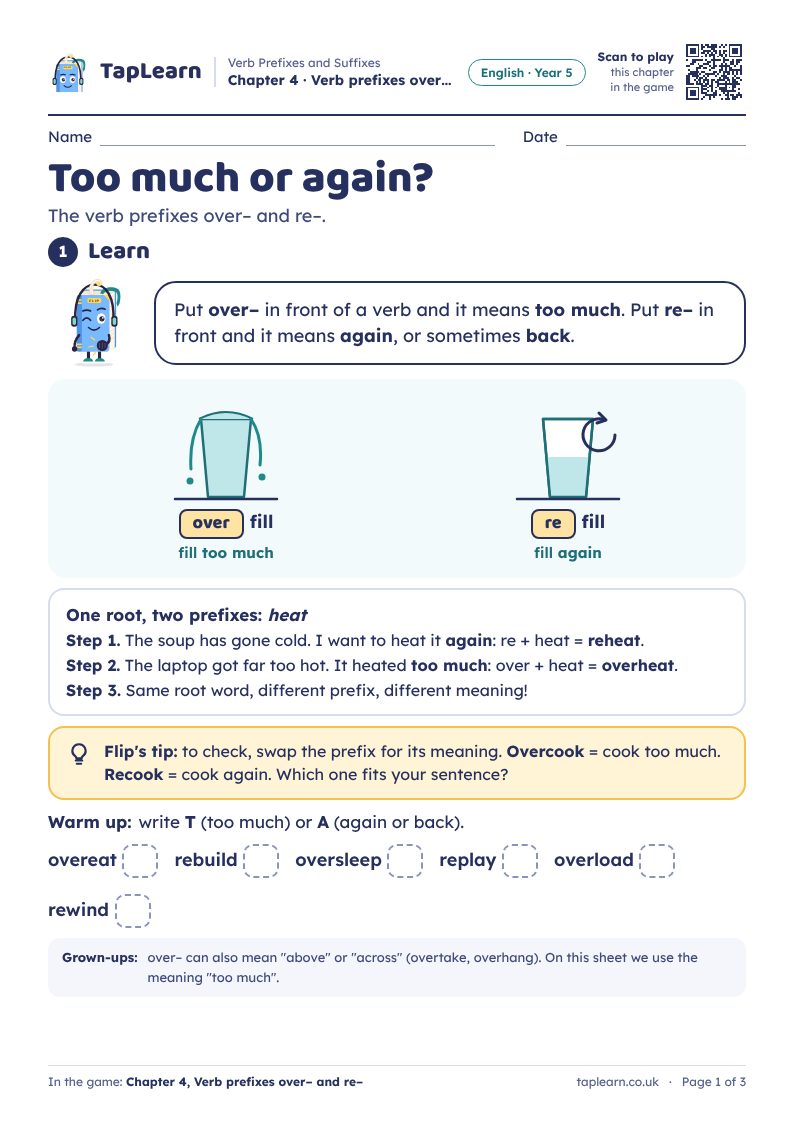
Too Much or Again? is a printable over and re prefixes worksheet for Year 5 (ages 9 to 10) that teaches children that over– means too much and re– means again or back, so one root like heat can become overheat or reheat. It covers the Year 5 statement on verb prefixes.
This worksheet is for members
Membership opens every chapter of every game and every worksheet, for all your children.
See the plansAlready a member? Log in to print it.
Start with the free one: Making verbs (chapter 1).
Print it on A4, in colour or black and white. Do it after the chapter, or before it to see what your child already knows.
What's on the worksheet
Your child uses the verb prefixes over– (too much) and re– (again or back) to change a verb's meaning, as in overheat and reheat. Includes a kitchen and tidy-up verb hunt and an answers sheet.
- Page 1 · Learn
- Overfill and refill compared, a worked example with reheat and overheat, Flip's tip to swap the prefix for its meaning, and a too-much-or-again warm-up.
- Page 2 · Try it together
- Kitchen and tidy-up hunt: walk round a room and, for things like a cup, a bin or a plant, think of an over– verb and a re– verb, then write them and say a sentence with each.
- Page 3 · Practise
- Add over– or re– to match a meaning, choose verbs to finish sentences, explain pairs like reload and overload, write your own sentences, and a challenge about overfill.
- Answers sheet
- Every answer, mix-ups like over– and re–, and cooking-talk and again-or-too-much ideas.
3 A4 pages and an answers sheet · about 25 minutes
Using it at home
- Over– can also mean above or across (overtake, overhang), but this sheet uses the meaning too much.
- On the hunt, just look and talk: don't switch anything on. Ideas: cup (overfill, refill), bin (overflow, reuse), book (reread).
- Say a verb (rethink, overreact, reuse, overwork) and your child says whether it means again or too much.
Watch out for
- Mixing up over– and re–.
- Ask, "Is it too much, or is it doing it again?" Swap the prefix for its meaning and read it aloud.
- Being puzzled by other meanings of over–, like overtake.
- Overtake and overhang use over– to mean above or across.
- Thinking words like ready or reach start with re–.
- There's no root word left after re, so it isn't a prefix.
Questions from the worksheet
- Add over– or re– to make a verb with this meaning: cook too much, write again, sleep too long, fill again, wind back.
- Use a verb from the box (overcook, overflow, refill, replay, overslept, rebuild) to finish each sentence: The bath will ___ if you leave the tap running.
- Same root, different prefix. Write what each verb means: reload, overload, refill, overfill.
- Mia reads a sign: "Don't overfill the kettle." She says it means "Don't fill the kettle again." Is she right? What does it really mean?
The answers are on the answers sheet, for grown-ups.
National curriculum in England
This worksheet practises this statement from the Year 5 english programme of study:
- Word: verb prefixes
In the classroom
- Use the warm-up as a T or A card-show starter.
- Give pairs a root like heat or fill to write over– and re– sentences for.
Questions and answers
What does the prefix over- mean?
On verbs, over– usually means too much: overcook means cook too much and overfill means fill too much.
What does the prefix re- mean?
Re– means again or back: refill means fill again and rewind means wind back.
What is the difference between reheat and overheat?
Reheat means heat again, like cold soup. Overheat means heat too much, like a laptop that gets far too hot.
 TapLearn