Ise and ify spelling worksheet for Year 5: Suffix spelling rules
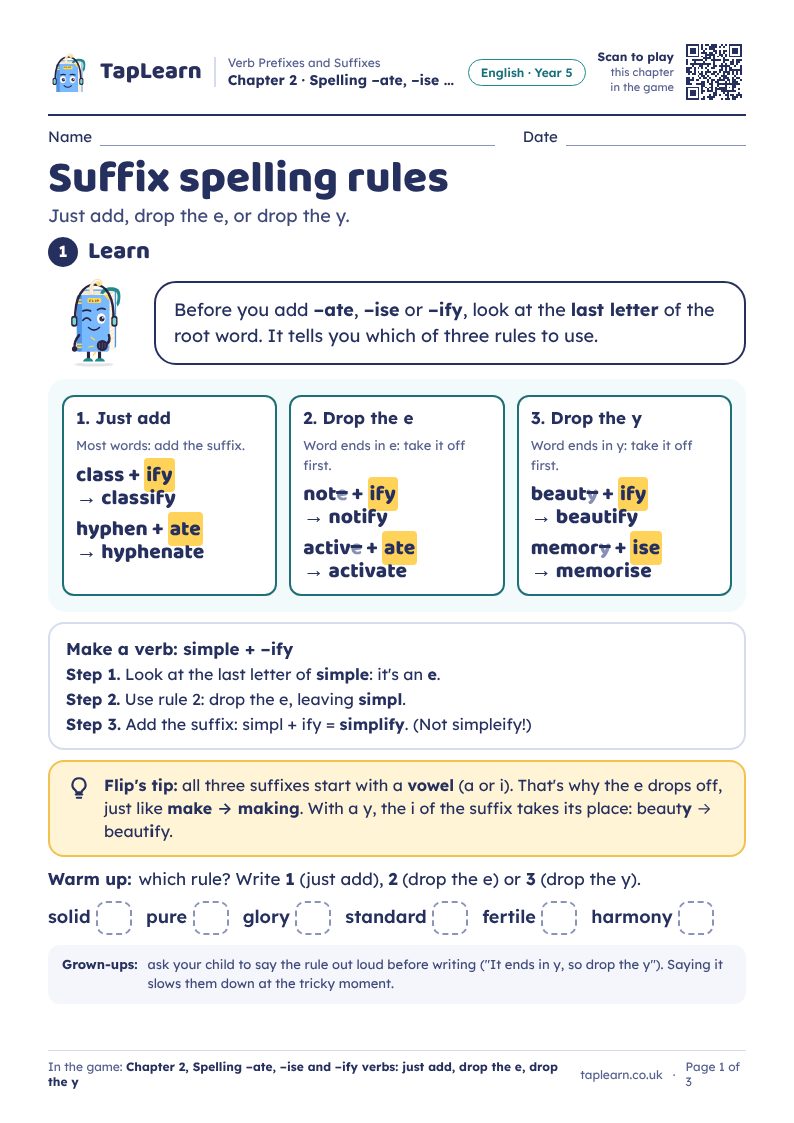
Suffix Spelling Rules is a printable ise and ify spelling worksheet for Year 5 (ages 9 to 10) that teaches children to look at the last letter of the root word and just add the suffix, drop the e (simplify) or drop the y (beautify). It covers the Year 5 statement on converting nouns or adjectives into verbs using suffixes.
This worksheet is for members
Membership opens every chapter of every game and every worksheet, for all your children.
See the plansAlready a member? Log in to print it.
Start with the free one: Making verbs (chapter 1).
Print it on A4, in colour or black and white. Do it after the chapter, or before it to see what your child already knows.
What's on the worksheet
Your child spells verbs ending in –ate, –ise and –ify by choosing a rule: just add, drop the e or drop the y. Includes a three-cup rule sort with word cards and an answers sheet.
- Page 1 · Learn
- The three rules with examples like notify and memorise, a worked example turning simple into simplify, Flip's tip on why the e drops, and a which-rule warm-up.
- Page 2 · Try it together
- Rule sort: write twelve root words like note, beauty and solid on paper, pick each one, say its rule and drop it in the just add, drop the e or drop the y cup, then write the verb.
- Page 3 · Practise
- Add the suffix, ring the correct spelling, work backwards to the root word and rule, make verbs to finish sentences, and a challenge about beautyfy.
- Answers sheet
- Every answer, mix-ups like noteify and solidfy, and a call-and-spell idea.
3 A4 pages and an answers sheet · about 25 minutes
Using it at home
- Ask your child to say the rule out loud before writing ("It ends in y, so drop the y"). Saying it slows them down at the tricky moment.
- When the rule-sort cups are full, tip one out and ask your child to spell each verb from memory.
- Say a root word (note, beauty, sterile, sympathy) and ask for the verb spelt aloud, plus the rule used.
Watch out for
- Keeping the final e or y, as in noteify or beautyfy.
- A suffix starting with a vowel pushes the e off (hope, hoping); for a y, cover it with a finger before adding the suffix.
- Dropping a letter that isn't e or y, as in solidfy.
- Any other last letter stays: solid + ify = solidify.
Questions from the worksheet
- Add the suffix. Write the verb: fossil + ise, pure + ify, glory + ify, motive + ate, apology + ise, harmony + ise.
- Draw a ring round the correct spelling: noteify / notify, beautify / beautyfy, memoryise / memorise, solidify / solidfy.
- Work backwards. Write the root word, and the rule that was used (1, 2 or 3): falsify, summarise, electrify, categorise.
- Make a verb from the word in brackets: Please ___ your lines for the school play. (memory) This filter will ___ the water. (pure)
- Sam writes beautyfy. He says, "I kept the whole word beauty and just added –fy." Is he right? What has he mixed up?
The answers are on the answers sheet, for grown-ups.
National curriculum in England
This worksheet practises this statement from the Year 5 english programme of study:
- Word: converting nouns or adjectives into verbs using suffixes
In the classroom
- Run the rule sort as a group activity with root-word cards.
- Use Practise B as a quick mini-whiteboard spelling check.
Questions and answers
When do you drop the e before adding -ify or -ise?
Drop the final e because the suffix starts with a vowel: simple becomes simplify and note becomes notify.
What happens to a final y before -ify or -ise?
Drop the y and add the suffix: beauty becomes beautify and memory becomes memorise.
Is it beautify or beautyfy?
It's beautify. The suffix is –ify, and the y of beauty drops: beaut + ify.
 TapLearn