Book covers worksheet for Reception: Explore the cover
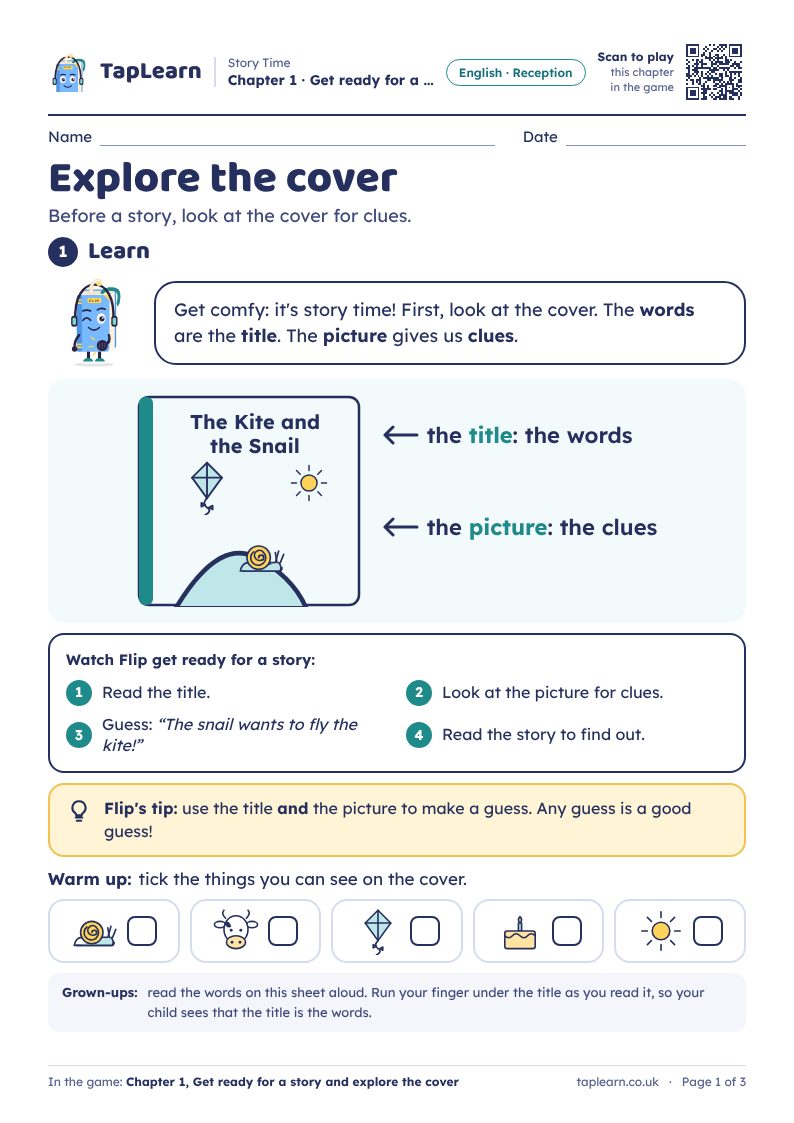
Explore the Cover is a printable book covers worksheet for Reception (ages 4 to 5) that teaches children that the title is the words on the front and the picture gives clues, so they can guess what a story might be about. It links to the Reception (EYFS) statements on engaging in storytimes and on talking with children about the books read with them.
Free to print, no account needed.
Print it on A4, in colour or black and white. Do it after the chapter, or before it to see what your child already knows.
What's on the worksheet
Your child gets ready for a story and uses the title and the cover picture to guess what it might be about. Includes a cover detective activity with a picture book and an answers sheet.
- Page 1 · Learn
- The cover of The Kite and the Snail with the title and picture labelled, Flip's four steps to get ready for a story, Flip's any-guess-is-good tip, and a tick-what-you-see warm-up.
- Page 2 · Try it together
- Cover detective: look at a picture book's cover together, read the title, point to things in the picture, draw a guess, then read the story and draw what really happened.
- Page 3 · Practise
- Ring the title on three covers, match cover clues to what each story might be about, draw a cover for The Hungry Bird, and a challenge about title and picture.
- Answers sheet
- Every answer, mix-ups like guessing without looking, and bedtime-guess and title-spotting ideas.
3 A4 pages and an answers sheet · about 15 minutes
Using it at home
- Read the words on the sheet aloud and run your finger under the title, so your child sees that the title is the words.
- In cover detective, accept every guess, then ask, "What in the picture made you think that?" A surprise ending is fun too.
- Before a bedtime story, look at the cover and ask, "What do you think will happen?"
Watch out for
- Guessing without looking at the picture.
- Ask, "What can you see? What might happen to them?"
- Mixing up the title and the picture.
- Point and say, "These are the words: the title. This is the picture."
- Worrying about a "wrong" guess.
- Guesses don't have to be right: the fun is reading to find out.
Questions from the worksheet
- Draw a ring round the title on each cover: Duck in the Rain, Teddy Can't Sleep, Mia's Big Cake.
- Look at the picture clues. Draw a line to what the story might be about: Mia has a party. A duck who loves puddles. A teddy who can't get to sleep.
- Draw a cover picture for this title: The Hungry Bird.
- Sam says, "The title is the picture on the front." Is he right?
The answers are on the answers sheet, for grown-ups.
National curriculum in England
This worksheet practises these statements from the Reception english programme of study:
- Engage in storytimes
- It is crucial for children to develop a life-long love of reading. Reading consists of two dimensions: language comprehension and word reading. Language comprehension (necessary for both reading and writing) starts from birth. It only develops when adults talk with children about the world around them and the books (stories and non-fiction) they read with them, and enjoy rhymes, poems and songs together
In the classroom
- Before story time, show the cover and collect guesses on the board, then check after reading.
- Point to the title on every class book you share.
Questions and answers
What is the title of a book?
The title is the words on the front cover: the name of the book.
Why look at the cover before reading a story?
The title and picture give clues, so children can guess what the story might be about and listen to find out.
Does a guess about a story have to be right?
No. Any guess is a good guess. The fun is reading to see what really happens.
 TapLearn