Who, what, where questions worksheet for Reception: Who, what, where?
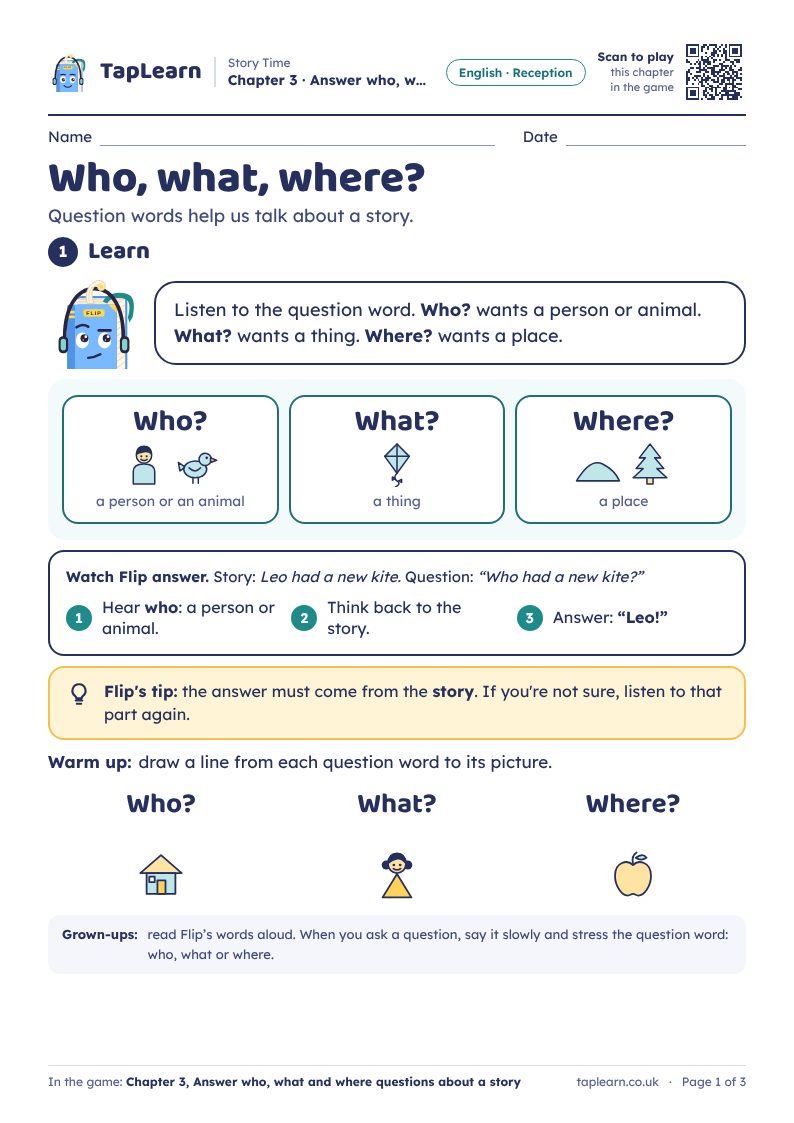
Who, What, Where? is a printable who, what, where questions worksheet for Reception (ages 4 to 5) that teaches children that who wants a person or animal, what wants a thing and where wants a place. It links to the Reception (EYFS) statements on listening attentively and responding with relevant questions, comments and actions when being read to.
This worksheet is for members
Membership opens every chapter of every game and every worksheet, for all your children.
See the plansAlready a member? Log in to print it.
Start with the free one: Explore the cover (chapter 1).
Print it on A4, in colour or black and white. Do it after the chapter, or before it to see what your child already knows.
What's on the worksheet
Your child listens to a short story and answers who, what and where questions by ringing, matching and drawing. Includes a question cards game with a storybook and an answers sheet.
- Page 1 · Learn
- Who, what and where with what each one wants, Flip answering a question about Leo's kite, Flip's tip that the answer comes from the story, and a match-the-question-word warm-up.
- Page 2 · Try it together
- Question cards: write Who?, What? and Where? on scraps with a picture, read a story, then take turns picking a card and asking a question about the story that starts with it.
- Page 3 · Practise
- Listen to Leo's Kite, then ring who was in it, what got stuck and where Leo took his kite, draw where the kite got stuck, and a challenge about a where answer.
- Answers sheet
- Every answer, mix-ups like answering where with a name, and car-questions and puppet-asks ideas.
3 A4 pages and an answers sheet · about 15 minutes
Using it at home
- When you ask a question, say it slowly and stress the question word: who, what or where.
- With the question cards, if your child answers a where question with a name, hold up the Where? card and say, "Where wants a place."
- Let a teddy ask your child questions about the day: "Where did you play?"
Watch out for
- Mixing up who, what and where, like answering where with a name.
- Repeat the question word and say what kind of answer it needs.
- Giving answers that weren't in the story.
- Say, "What a fun idea! Let's look: what did the story say?"
- Pointing instead of saying.
- Pointing is a good start. Then say the word together.
Questions from the worksheet
- Who was in Leo's Kite? Draw a ring round them.
- What got stuck in the tree? Draw a ring round it.
- Where did Leo take his kite? Draw a ring round the place.
- Mia was asked, "Where did the kite get stuck?" She said, "Leo!" Is that right? What does a where question need?
The answers are on the answers sheet, for grown-ups.
National curriculum in England
This worksheet practises these statements from the Reception english programme of study:
- Listen attentively and respond to what they hear with relevant questions, comments and actions when being read to and during whole class discussions and small group interactions
- Listen to and talk about stories to build familiarity and understanding
In the classroom
- Use question cards after class story time, with pupils taking turns to ask.
- Ask one who, one what and one where question after each shared story.
Questions and answers
What do who, what and where questions ask for?
Who asks for a person or animal, what asks for a thing and where asks for a place.
How can I help my child answer questions about a story?
Stress the question word, then think back to the story together. If they're not sure, listen to that part again.
What if my child gives an answer that wasn't in the story?
Praise the idea, then look back together: "What did the story say?"
 TapLearn