Repeated refrains worksheet for Reception: Join in!
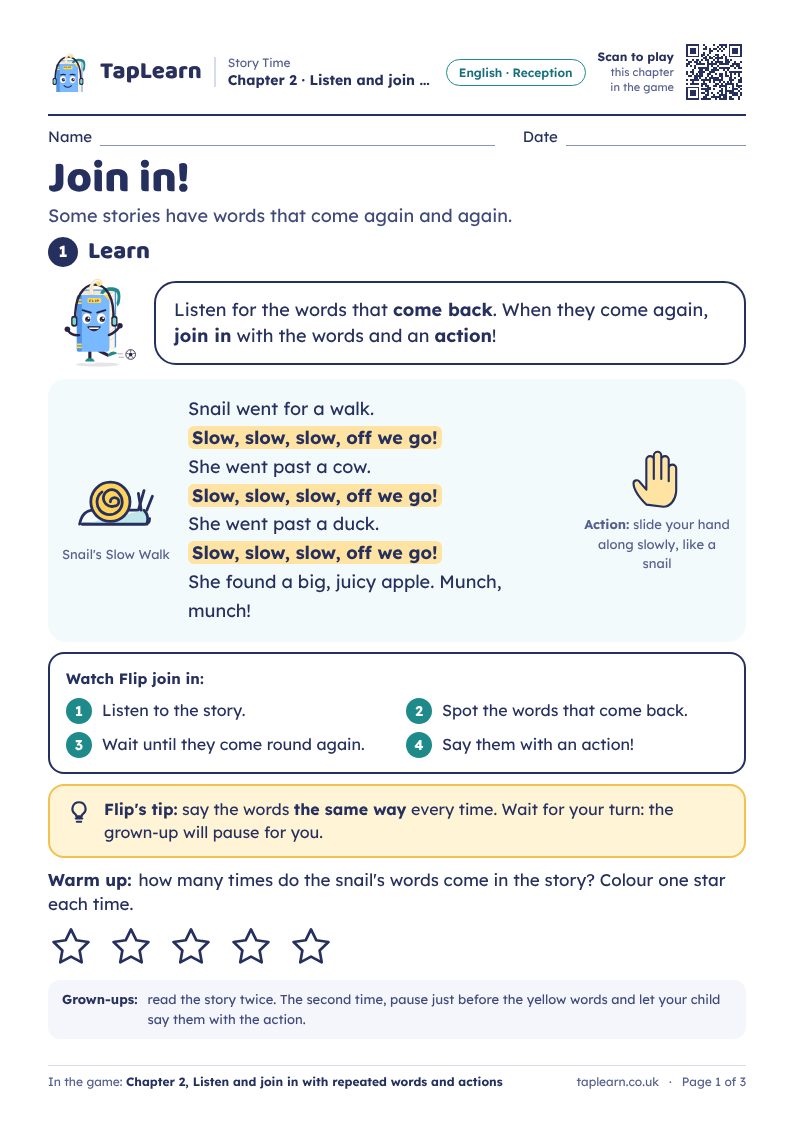
Join In! is a printable repeated refrains worksheet for Reception (ages 4 to 5) that teaches children to listen for the words that come back in a story, like "Slow, slow, slow, off we go!", and join in with them and an action. It links to the Reception (EYFS) statements on engaging in storytimes and listening attentively and responding with relevant questions, comments and actions when being read to.
This worksheet is for members
Membership opens every chapter of every game and every worksheet, for all your children.
See the plansAlready a member? Log in to print it.
Start with the free one: Explore the cover (chapter 1).
Print it on A4, in colour or black and white. Do it after the chapter, or before it to see what your child already knows.
What's on the worksheet
Your child spots the words that come again and again in a story and joins in with them and an action. Includes a short read-aloud snail story, a pause-and-join-in activity and an answers sheet.
- Page 1 · Learn
- A short story, Snail's Slow Walk, with a repeated line and an action, Flip's four steps to join in, Flip's tip to wait for your turn, and a count-the-repeats warm-up.
- Page 2 · Try it together
- Pause and join in: read a favourite book with a repeated line, find the words that come back, make up an action, then read again with the grown-up pausing so the child joins in.
- Page 3 · Practise
- Ring the words that come back in a duck story, match words to actions, tick who joined in with the right words, make up a repeated line for a frog story, and a challenge.
- Answers sheet
- Every answer, mix-ups like joining in too early, and song-swap and bath-time-refrain ideas.
3 A4 pages and an answers sheet · about 15 minutes
Using it at home
- Read the snail story twice. The second time, pause just before the repeated words and let your child say them with the action.
- In pause and join in, you might write the words for your child. Many favourite picture books repeat a line.
- Make up a bath-time line ("Scrub, scrub, bubbles in the tub!") and say it together.
Watch out for
- Changing the words each time.
- Say the line together slowly first, then let your child say it alone.
- Joining in too early.
- Use a signal, like a raised finger or a look, just before the words come.
- Being shy about joining in.
- Some children do the action before they say the words: that's joining in too!
Questions from the worksheet
- Listen to the story. Draw a ring round the words that come back every time: "Drip, drop, here comes the rain!"
- Draw a line from the words to the action that goes with them: Stamp, stamp, stamp! Clap, clap, hooray! Shh, shh, fast asleep.
- Make up your own words to come back in a story about a frog. Draw your action.
- Sam shouts the words before the story gets to them. Is that the right time to join in? When should he join in?
The answers are on the answers sheet, for grown-ups.
National curriculum in England
This worksheet practises these statements from the Reception english programme of study:
- Engage in storytimes
- Listen attentively and respond to what they hear with relevant questions, comments and actions when being read to and during whole class discussions and small group interactions
- Listen to and talk about stories to build familiarity and understanding
In the classroom
- At story time, pause before a repeated line and let the class say it with an action.
- Sing a song with a chorus and have the class join in only on the chorus.
Questions and answers
What is a refrain in a story?
A refrain is a line that comes again and again in a story, like "Slow, slow, slow, off we go!"
Why is joining in with stories good for young children?
It helps them listen carefully, remember the words and take part in story time.
When should a child join in with a repeated line?
Wait until the story gets to the words, then say them the same way each time, with an action.
 TapLearn