Why questions worksheet for Reception: Why? Because…
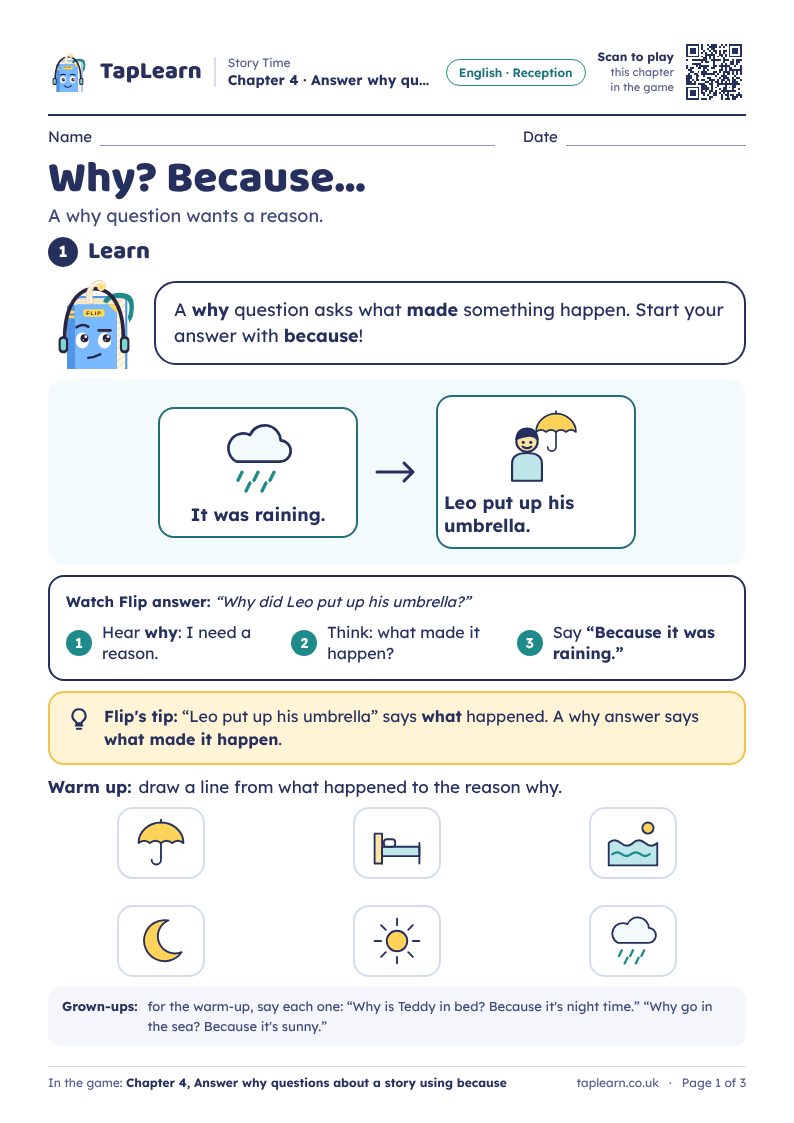
Why? Because… is a printable why questions worksheet for Reception (ages 4 to 5) that teaches children that a why question asks what made something happen, and to start the answer with because. It links to the Reception (EYFS) statements on listening attentively and responding with relevant questions, comments and actions when being read to.
This worksheet is for members
Membership opens every chapter of every game and every worksheet, for all your children.
See the plansAlready a member? Log in to print it.
Start with the free one: Explore the cover (chapter 1).
Print it on A4, in colour or black and white. Do it after the chapter, or before it to see what your child already knows.
What's on the worksheet
Your child answers why questions about a short story by giving a reason that starts with because. Includes Teddy's why game with a soft toy and an answers sheet.
- Page 1 · Learn
- Leo's umbrella and the rain as an example, Flip answering a why question in three steps, Flip's tip on what happened versus why, and a match-to-the-reason warm-up.
- Page 2 · Try it together
- Teddy's why game: the grown-up makes a teddy do something, like hide under a blanket, and asks why; the child gives a reason starting with because, then you swap.
- Page 3 · Practise
- Listen to Teddy's Picnic, ring why Mia put up her umbrella and why Teddy was sad, tick the answer that gives a reason, draw why you like the park, and a challenge.
- Answers sheet
- Every answer, mix-ups like saying what instead of why, and why-walk and bedtime-why ideas.
3 A4 pages and an answers sheet · about 15 minutes
Using it at home
- For the warm-up, say each one aloud: "Why is Teddy in bed? Because it's night time."
- In Teddy's why game, any sensible reason is fine. If your child repeats what happened, ask, "Yes, but what made him do it?"
- On a walk, wonder aloud ("Why is that dog wearing a coat?") and find a because together.
Watch out for
- Saying what happened instead of why, like "Mia put up her umbrella".
- Ask, "Yes! And what made her do that?"
- Giving reasons that weren't in the story.
- Say, "Let's listen to that part again and find out."
- Forgetting because.
- Start the sentence for your child ("Because…") and let them finish it.
Questions from the worksheet
- Why did Mia put up her umbrella? Draw a ring round the reason.
- Why was Teddy sad? Draw a ring round the reason.
- Mia asked, "Why did Teddy hug me?" Which answer gives a reason? "Teddy gave Mia a big hug." or "Because she gave him her apple."
- Why do you like going to the park? Draw it. Say, "Because…"
- Sam says, "Teddy was sad because he was tired." Did the story say that? What really made Teddy sad?
The answers are on the answers sheet, for grown-ups.
National curriculum in England
This worksheet practises these statements from the Reception english programme of study:
- Listen attentively and respond to what they hear with relevant questions, comments and actions when being read to and during whole class discussions and small group interactions
- Listen to and talk about stories to build familiarity and understanding
In the classroom
- After a class story, ask one why question and collect because answers.
- Play Teddy's why game with a class puppet.
Questions and answers
What does a why question ask for?
A why question asks for a reason: what made something happen. Answers usually start with because.
How can I help my child answer why questions?
Start the answer for them with "Because…" and let them finish it with something from the story.
What is the difference between what happened and why?
What happened tells the event ("Mia put up her umbrella"). Why gives the reason ("because it was raining").
 TapLearn