Questions and comments worksheet for Reception: I wonder…
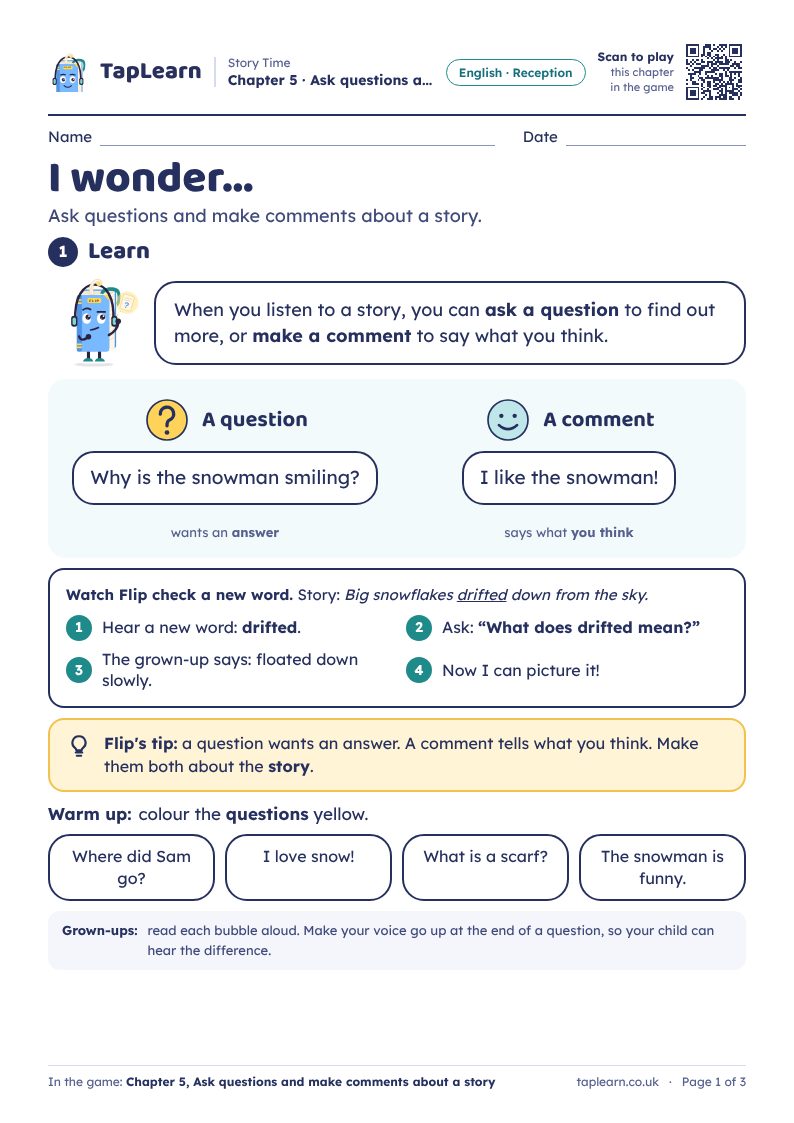
I Wonder… is a printable questions and comments worksheet for Reception (ages 4 to 5) that teaches children that a question wants an answer and a comment says what you think, and to ask what a new word like drifted means. It links to the Reception (EYFS) statements on making comments about what they have heard and asking questions to clarify their understanding.
This worksheet is for members
Membership opens every chapter of every game and every worksheet, for all your children.
See the plansAlready a member? Log in to print it.
Start with the free one: Explore the cover (chapter 1).
Print it on A4, in colour or black and white. Do it after the chapter, or before it to see what your child already knows.
What's on the worksheet
Your child asks questions to find out more or check a new word, makes comments about a story, and tells the two apart. Includes a question-or-comment card activity and an answers sheet.
- Page 1 · Learn
- A question and a comment about a snowman compared, Flip checking the new word drifted, Flip's tip to keep both about the story, and a colour-the-questions warm-up.
- Page 2 · Try it together
- Question or comment?: draw a ? card and a smiley card, read a story, and when the grown-up says "I wonder…", the child holds up a card and asks a question or makes a comment.
- Page 3 · Practise
- Listen to Sam's Snowy Day, tick question or comment for four lines, ring the question that is about the story, draw a favourite part and ask a question, and a challenge.
- Answers sheet
- Every answer, mix-ups like questions not about the story, and I-wonder-walk and one-comment-each ideas.
3 A4 pages and an answers sheet · about 15 minutes
Using it at home
- Read each speech bubble aloud and make your voice go up at the end of a question, so your child hears the difference.
- In the card activity, model it first: "I wonder why the fox is hiding." If a question drifts from the story, ask for one about the story too.
- After a story, each person says one thing they liked about it.
Watch out for
- Talking about things not in the story, like "Can I have a biscuit?"
- Say, "Let's save that for later. What do you wonder about the story?"
- Mixing up questions and comments.
- Ask, "Do you want me to answer that, or are you telling me what you think?"
- Not asking about new words.
- Show it's good to ask: "Hmm, I wonder what that word means."
Questions from the worksheet
- Is it a question or a comment? Tick the ? or the smile: Why did Sam put on his boots? I like Sam's snowman. What does drifted mean? The snow looks cold!
- Which question is about Sam's story? Draw a ring round it: What's for tea? What did Sam make? Can I have a biscuit?
- Draw your favourite part of Sam's story. Ask a question about it. The grown-up writes it.
- Mia says, "I like the snowman" is a question. Is she right?
The answers are on the answers sheet, for grown-ups.
National curriculum in England
This worksheet practises these statements from the Reception english programme of study:
- It is crucial for children to develop a life-long love of reading. Reading consists of two dimensions: language comprehension and word reading. Language comprehension (necessary for both reading and writing) starts from birth. It only develops when adults talk with children about the world around them and the books (stories and non-fiction) they read with them, and enjoy rhymes, poems and songs together
- Listen attentively and respond to what they hear with relevant questions, comments and actions when being read to and during whole class discussions and small group interactions
- Make comments about what they have heard and ask questions to clarify their understanding
In the classroom
- Use ? and smiley cards at class story time for questions and comments.
- Take an I wonder walk round the school grounds, saying "I wonder…" about things you see.
Questions and answers
What is the difference between a question and a comment?
A question wants an answer, like "Who made the snowman?" A comment tells what you think, like "I like the snowman!"
Why should young children ask about new words?
Asking what a word means helps them understand and picture the story, like learning that drifted means floated down slowly.
How can I encourage my child to ask questions about a story?
Stop once while reading and say "I wonder…", then invite your child to ask their own question.
 TapLearn