Punctuating speech worksheet for Year 3: Speech sandwiches
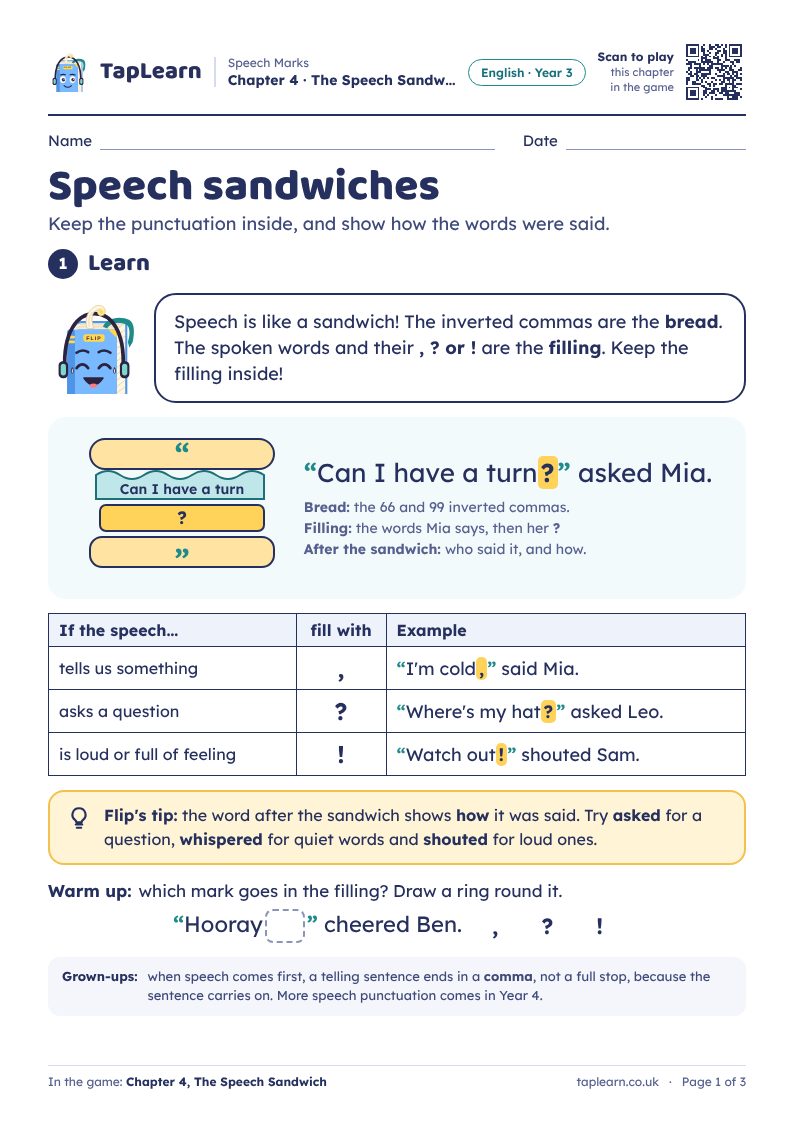
Speech Sandwiches is a printable punctuating speech worksheet for Year 3 (ages 7 to 8) that teaches children to keep the comma, question mark or exclamation mark inside the closing inverted commas and choose words like whispered or shouted. It covers the Years 3–4 English national curriculum statement: using and punctuating direct speech.
Free to print, no account needed.
Print it on A4, in colour or black and white. Do it after the chapter, or before it to see what your child already knows.
What's on the worksheet
Keep the comma, question mark or exclamation mark inside the closing inverted commas, and choose words like asked, whispered or shouted to show how something is said. With a say-it-like-this game, and answers.
- Page 1 · Learn
- Speech as a sandwich with inverted commas as the bread and the words plus their punctuation as the filling, and when to use a comma, ? or !. Warm-up: which mark goes in the filling?
- Page 2 · Try it together
- Say it like this: pull a word like whispered, giggled or grumbled from a cup and say a line that way for the grown-up to guess, then write favourites as speech sandwiches.
- Page 3 · Practise
- Choose asked, whispered, shouted or giggled for four lines, add the right mark inside the box, tick or cross where the mark sits, write what you'd say to a spider, and Sam's full stop challenge.
- Answers sheet
- All answers, three mix-ups to watch for, and a word swap guessing game for story time.
3 A4 pages and an answers sheet · about 20 minutes
Using it at home
- If your child picks "asked" in the game, the line has to become a question, so the filling needs a question mark.
- Talk about how each word, like whispered or grumbled, changes the picture in your head.
Watch out for
- Putting the mark outside the 99, like “Can I come too”?
- Say, "The ? belongs to the words Leo says, so it stays in the sandwich with them."
- Using a full stop before "said".
- Ask, "Has the sentence finished yet?" If "said Mia" comes next, use a comma.
- Using "said" for everything.
- That's not wrong. Ask, "How did they say it? Loudly? Quietly?" and pick a word together.
Questions from the worksheet
- Choose the best word to show how it was said: “Shh, the baby is asleep,” ___ Mum.
- Write the right mark inside the box: , or ? or ! “What time is it ” asked Dad.
- Is the mark inside the sandwich? Put a tick or a cross: “Can I come too”? asked Leo.
- Sam wrote: “I'm hungry.” said Mia. He says a full stop is right, because Mia is telling us something. Is he right? Why?
The answers are on the answers sheet, for grown-ups.
National curriculum in England
This worksheet practises these statements from the Years 3–4 english programme of study:
- Indicate grammatical and other features by: using and punctuating direct speech
- Punctuation: introduction to inverted commas to punctuate direct speech (Year 3 english)
- Terminology: preposition, conjunction, word family, prefix, clause, subordinate clause, direct speech, consonant, consonant letter, vowel, vowel letter, inverted commas (or 'speech marks') (Year 3 english)
In the classroom
- Play say it like this as a whole-class game, with volunteers acting out a line and the class guessing the word.
- Word swap: cover the word after speech in a shared text and pupils guess it from the punctuation.
Questions and answers
Does the question mark go inside or outside speech marks?
The question mark goes inside the closing inverted commas, because it belongs to the spoken words: “Where's my hat?” asked Leo. The same goes for commas and exclamation marks.
Why is there a comma and not a full stop before said?
When speech comes first, the sentence carries on with who said it, so a telling sentence ends its speech with a comma: “I'm cold,” said Mia.
 TapLearn