Inverted commas worksheet for Year 3: Writing 66 and 99
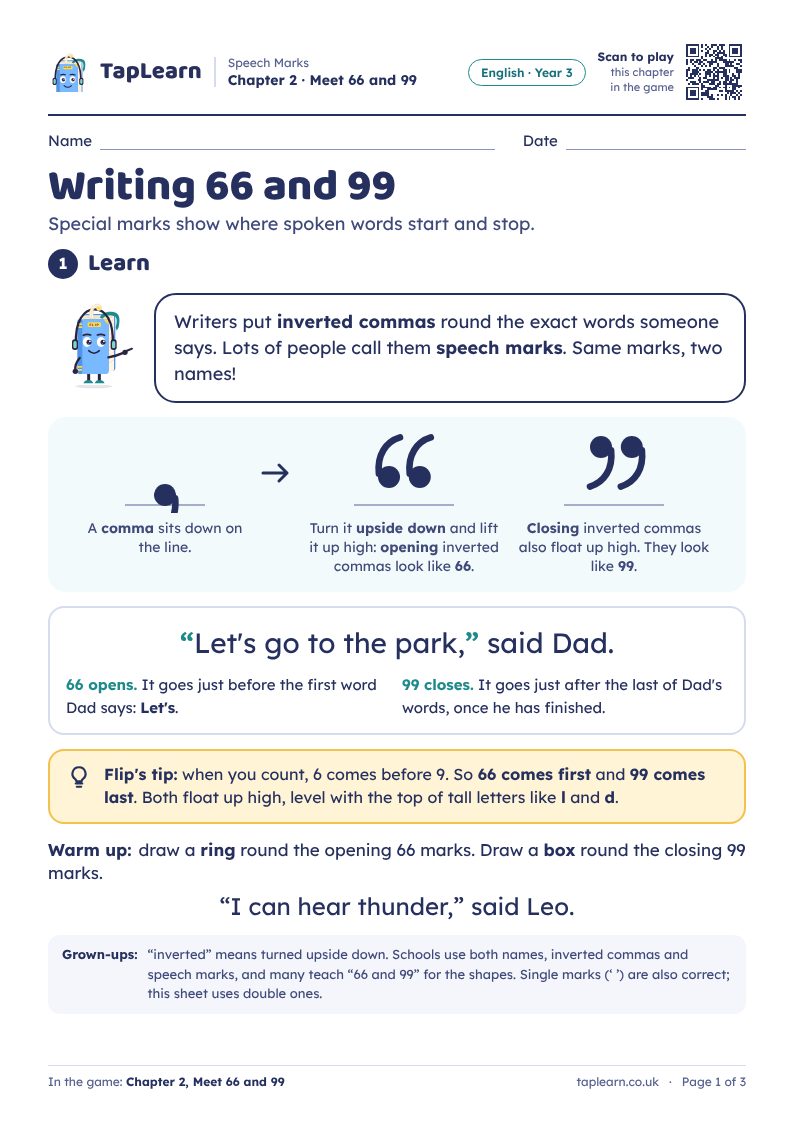
Writing 66 and 99 is a printable inverted commas worksheet for Year 3 (ages 7 to 8) that teaches children to write opening inverted commas like 66 and closing ones like 99, the right way round and up high. It covers the Year 3 English national curriculum statement: introduction to inverted commas to punctuate direct speech.
Free to print, no account needed.
Print it on A4, in colour or black and white. Do it after the chapter, or before it to see what your child already knows.
What's on the worksheet
Learn why speech marks are called inverted commas, then trace and write opening (66) and closing (99) marks the right way round, and always close the speech. With a 66 and 99 hunt in a story book, and answers.
- Page 1 · Learn
- Why speech marks are called inverted commas, how 66 opens and 99 closes, and where each one goes in a sentence. Warm-up: ring the 66 marks and box the 99 marks.
- Page 2 · Try it together
- 66 and 99 hunt: point to every mark on a story page, count the 66s and 99s on three pages, then fix a sentence the grown-up writes with a mistake.
- Page 3 · Practise
- Trace and write opening and closing marks, add 66 or 99 in boxes, tick or cross sentences with flipped or missing marks, rewrite sentences with inverted commas, and Mia's challenge.
- Answers sheet
- All answers, three mix-ups to watch for, and finger-marks and sky-writing ideas.
3 A4 pages and an answers sheet · about 20 minutes
Using it at home
- Use the counting trick together: 6 comes before 9, so 66 comes first and 99 comes last.
- On your hunt, if the 66s and 99s don't match, look at why: some books use single marks, and long speech can run over two paragraphs.
Watch out for
- Writing the marks the wrong way round.
- Say "6 comes before 9, so 66 comes first." Trace a big 6 and 9 in the air.
- Forgetting to close the speech.
- Ask, "Where do the words stop?" Every 66 needs a 99.
- Writing the marks down on the line.
- Inverted commas float up high, level with tall letters. Down on the line they look like commas.
Questions from the worksheet
- Are the inverted commas right? Put a tick or a cross: ”Where is my bag?“ asked Leo.
- Write these sentences again. Add the inverted commas: That is my football, said Leo.
- Write these sentences again. Add the inverted commas: Is it snowing? asked Mia.
- Mia wrote: “I found a shell, said Mia. Her friend says something is missing. What has Mia forgotten, and where should it go?
The answers are on the answers sheet, for grown-ups.
National curriculum in England
This worksheet practises these statements from the Years 3–4 english programme of study:
- Indicate grammatical and other features by: using and punctuating direct speech
- Punctuation: introduction to inverted commas to punctuate direct speech (Year 3 english)
- Terminology: preposition, conjunction, word family, prefix, clause, subordinate clause, direct speech, consonant, consonant letter, vowel, vowel letter, inverted commas (or 'speech marks') (Year 3 english)
In the classroom
- Finger marks: pupils curl two fingers into 66 as a partner starts speaking and 99 as they stop.
- Mini-whiteboard check: show a sentence with flipped or missing marks and pupils write it correctly.
Questions and answers
Why are speech marks called inverted commas?
Inverted means turned upside down, and speech marks look like commas turned upside down and lifted up high. Schools use both names for the same marks.
What do 66 and 99 mean in speech marks?
66 and 99 describe the shapes of opening and closing inverted commas. 66 goes just before the first spoken word and 99 goes just after the last one.
 TapLearn