Speech marks worksheet for Year 3: Catching spoken words
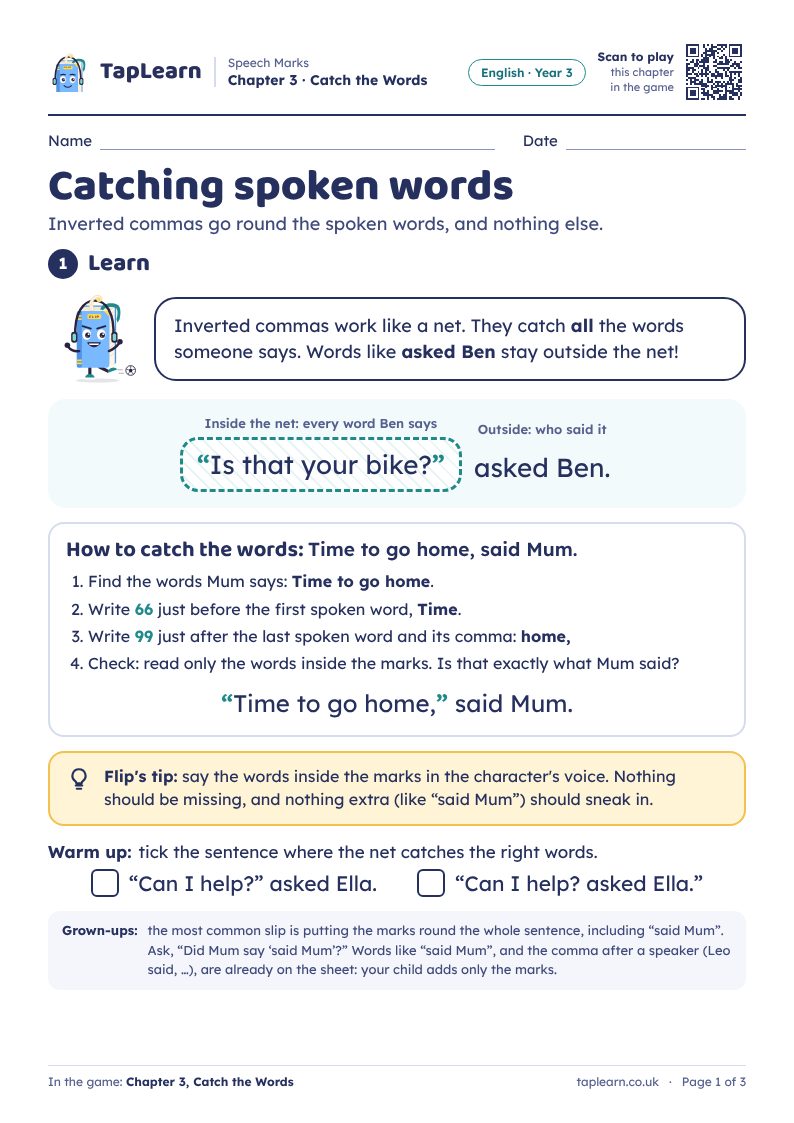
Catching Spoken Words is a printable speech marks worksheet for Year 3 (ages 7 to 8) that teaches children to put inverted commas round every word someone says and leave words like "said Ben" outside. It covers the Year 3 English national curriculum statement: introduction to inverted commas to punctuate direct speech.
Free to print, no account needed.
Print it on A4, in colour or black and white. Do it after the chapter, or before it to see what your child already knows.
What's on the worksheet
Put inverted commas round only the words someone says, with every spoken word inside and words like "said Ben" left outside. With a spoon catch game to place and check the marks, and answers.
- Page 1 · Learn
- Inverted commas as a net that catches the spoken words, and four steps to punctuate "Time to go home," said Mum. Warm-up: tick the sentence with the net in the right place.
- Page 2 · Try it together
- Spoon catch: lay two teaspoons round the spoken words, read only the words between them in a character voice, then write the 66 and 99 where the spoons are.
- Page 3 · Practise
- Ring the correctly punctuated sentence in each box, add inverted commas to six sentences, including speaker-first ones, write speech from pictures, and Leo's challenge.
- Answers sheet
- All answers, three mix-ups to watch for, and a clap catch idea for story time.
3 A4 pages and an answers sheet · about 20 minutes
Using it at home
- If a spoon lands after "yawned Max", read the words aloud with it included and let your child hear the mistake.
- Words like "said Mum" and the comma after a speaker are already on the sheet, so your child only adds the marks.
Watch out for
- Putting the marks round the whole sentence.
- Ask, "Did Dad say 'said Dad'?" Move the 99 to where Dad stops.
- Leaving spoken words outside the marks.
- Read the caught words aloud, like "Sit…", and ask, "Is that all Mum said?"
- Placing the 66 wrongly when the speaker comes first.
- In "Leo said, I'm ready to go." the 66 goes after the comma, before I'm.
Questions from the worksheet
- Write the inverted commas round the words each person says: Can I stroke your dog? asked Mia.
- Write the inverted commas round the words each person says: Leo said, I'm ready to go.
- Write the inverted commas round the words each person says: Dad asked, Who wants pancakes?
- Leo wrote: “We need more milk, said Dad.” Is he right? Write it the right way.
The answers are on the answers sheet, for grown-ups.
National curriculum in England
This worksheet practises these statements from the Years 3–4 english programme of study:
- Indicate grammatical and other features by: using and punctuating direct speech
- Punctuation: introduction to inverted commas to punctuate direct speech (Year 3 english)
- Terminology: preposition, conjunction, word family, prefix, clause, subordinate clause, direct speech, consonant, consonant letter, vowel, vowel letter, inverted commas (or 'speech marks') (Year 3 english)
In the classroom
- Clap catch: read speech from a class story and pupils clap as the spoken words start and stop.
- Pairs play spoon catch with sentences on strips of paper, taking turns to place and check.
Questions and answers
Where do speech marks go in a sentence?
Speech marks go round only the words someone says. In “Time to go home,” said Mum, the marks wrap Time to go home and its comma, and said Mum stays outside.
What if the speaker comes first in a sentence?
Then the opening inverted commas go after the comma that follows the speaker, before the first spoken word: Leo said, “I'm ready to go.”
 TapLearn