Direct speech worksheet for Year 3: Spotting spoken words
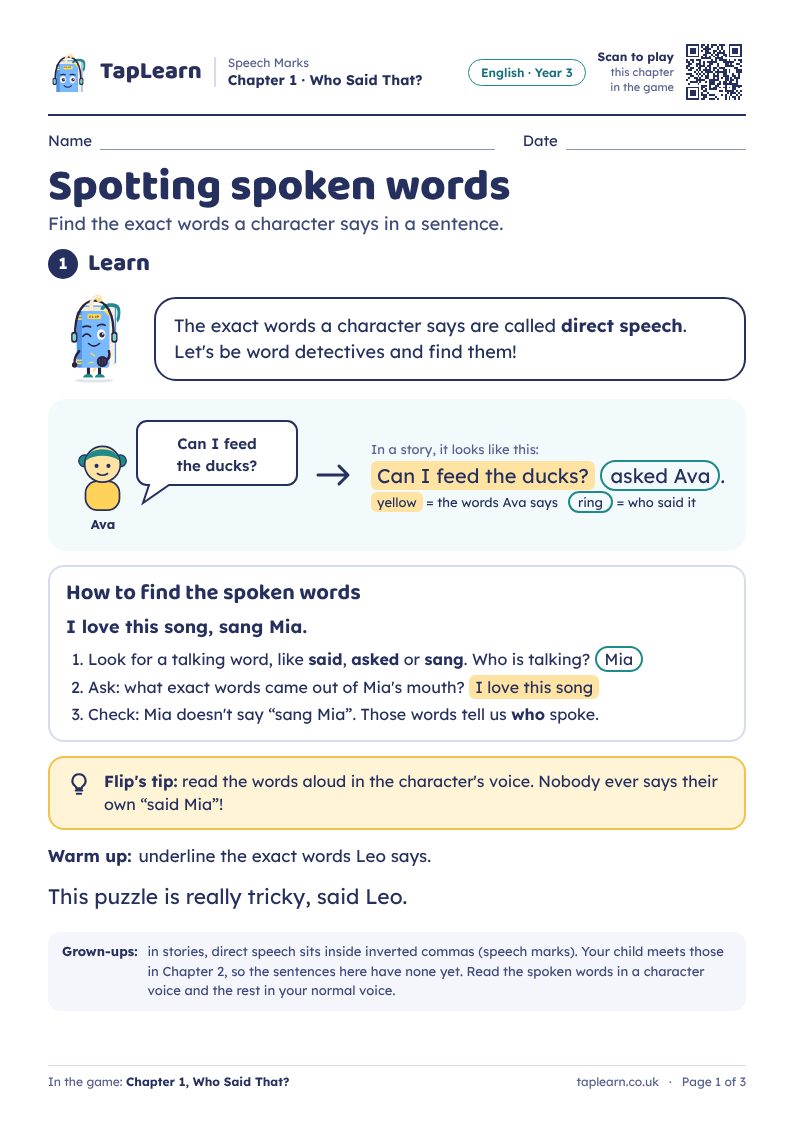
Spotting Spoken Words is a printable direct speech worksheet for Year 3 (ages 7 to 8) that teaches children to find the exact words a character says and leave out words like "said Mia". It builds the Year 3 English terminology of direct speech, ready for punctuating it with inverted commas.
Free to print, no account needed.
Print it on A4, in colour or black and white. Do it after the chapter, or before it to see what your child already knows.
What's on the worksheet
Find the exact words a character says (direct speech), keep words like "said Mia" out, and tell exact words from sentences that only report what was said. With a character voices read-aloud, and answers.
- Page 1 · Learn
- What direct speech is, shown with a speech bubble and a story sentence, and three steps to find the spoken words. Warm-up: underline the exact words Leo says.
- Page 2 · Try it together
- Character voices: read a story page together, with the child reading only the words a character says in a funny voice, then write 3 lines of speech and who said them.
- Page 3 · Practise
- Ring the speaker and underline the spoken words, tick exact words or reported speech, write sentences from speech bubbles, and Ben's "said Ava" challenge.
- Answers sheet
- All answers, three mix-ups to watch for, and exact-words and bubble-spotting ideas.
3 A4 pages and an answers sheet · about 20 minutes
Using it at home
- Read the spoken words in a character voice and everything else in your normal voice, so your child hears the difference.
- Swap roles for a page and let your child catch you out if you read "she shouted" in a character voice.
Watch out for
- Counting "said Mia" as spoken words.
- Ask your child to say the words as the character would, then ask, "Did Mia say 'said Mia'?"
- Mixing up exact words with a sentence that reports them.
- Ask, "What exact words did Mia use?" Clues to reported speech are that or if, and she instead of I.
- Missing the speech when the speaker comes first.
- When a sentence starts "Leo shouted," the spoken words come after it.
Questions from the worksheet
- Draw a ring round who is speaking. Underline the exact words they say: Is it lunchtime yet? asked Sam.
- Leo shouted, Come back here! Who is speaking, and what exact words do they say?
- Is it the exact words, or does the sentence just tell us what was said? Mia said that she was hungry.
- Ben reads: We're lost, said Ava. He says, "The words Ava says are We're lost, said Ava." Is he right?
The answers are on the answers sheet, for grown-ups.
National curriculum in England
This worksheet practises these statements from the Years 3–4 english programme of study:
- Indicate grammatical and other features by: using and punctuating direct speech
- Punctuation: introduction to inverted commas to punctuate direct speech (Year 3 english)
- Terminology: preposition, conjunction, word family, prefix, clause, subordinate clause, direct speech, consonant, consonant letter, vowel, vowel letter, inverted commas (or 'speech marks') (Year 3 english)
In the classroom
- Starter: project a comic strip and ask pupils which words are in the bubbles and who says them.
- Use the exact words or reported speech table as a paired card sort.
Questions and answers
What is direct speech?
Direct speech is the exact words a character says, like I'm hungry in "I'm hungry," said Mia. In stories it goes inside inverted commas.
What is the difference between direct and reported speech?
Direct speech gives the exact words someone said. Reported speech tells us what they said in other words, like Mia said that she was hungry.
 TapLearn