Oral storytelling worksheet for Years 3–6: Stories and feelings
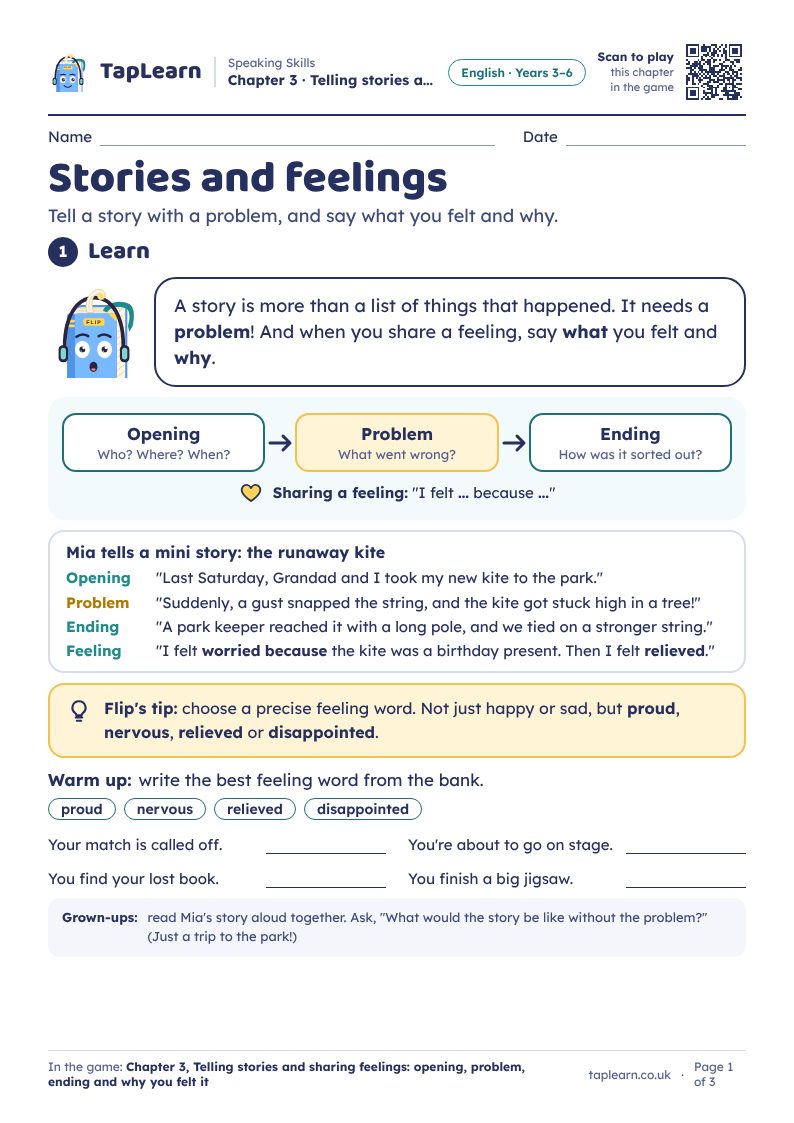
Stories and Feelings is a printable oral storytelling worksheet for Years 3 to 6 (ages 7 to 11) that teaches children that a story needs a problem, and to share a feeling with a precise word and a reason. It covers the national curriculum spoken language statement to give well-structured descriptions, explanations and narratives for different purposes, including for expressing feelings.
This worksheet is for members
Membership opens every chapter of every game and every worksheet, for all your children.
See the plansAlready a member? Log in to print it.
Start with the free one: Plan your talk (chapter 1).
Print it on A4, in colour or black and white. Do it after the chapter, or before it to see what your child already knows.
What's on the worksheet
Your child tells a story with an opening, a problem and an ending, and shares a feeling by saying what they felt and why. Includes a story-in-a-bag activity and an answers sheet.
- Page 1 · Learn
- Opening, problem and ending explained, Mia's runaway kite story with a feeling and reason, Flip's tip to choose precise feeling words like relieved, and a feeling-word warm-up.
- Page 2 · Try it together
- Story in a bag: pull out three everyday things one at a time, using them for the opening, the problem and the ending, then finish with "I felt … because …" and swap.
- Page 3 · Practise
- Decide if passages are stories or lists, order Leo's muddled puppy story, finish feeling sentences with a reason, plan a mini story, and a challenge about Sam's weekend.
- Answers sheet
- Every answer, mix-ups like a list with no problem, and teatime-feelings and oops-story ideas.
3 A4 pages and an answers sheet · about 25 minutes
Using it at home
- Read Mia's story aloud and ask "What would the story be like without the problem?"
- In story in a bag, tick each part as you hear it. On your turn, leave out the problem on purpose and see if your child spots it.
- At teatime, take turns finishing "Today I felt … because …".
Watch out for
- Telling a list, not a story.
- Ask "What went wrong? How was it sorted out?"
- Naming a feeling with no reason.
- Prompt with "…because?" every time.
- Jumbling the parts.
- Count the parts on three fingers before telling: opening, problem, ending.
Questions from the worksheet
- Is it a story (with a problem) or just a list of events? "We went to the beach. We had sandwiches. Then we went home."
- Share the feeling. Finish each sentence with a feeling and a reason: You scored your first goal. I felt ___ because ___.
- Plan a mini story about a day when something went wrong: opening, problem, ending.
- Sam tells his class, "At the weekend I felt happy." Is that enough to share a feeling? What should he add?
The answers are on the answers sheet, for grown-ups.
National curriculum in England
This worksheet practises this statement from the Years 1–6 english programme of study:
- Give well-structured descriptions, explanations and narratives for different purposes, including for expressing feelings
In the classroom
- Run story in a bag in small groups with a bag of classroom objects.
- Use Leo's muddled story as a sorting activity with sentence strips.
Questions and answers
What makes a good spoken story?
A good story has an opening that says who, where and when, a problem where something goes wrong, and an ending where it is sorted out.
How do children share a feeling clearly?
Use a precise feeling word and a reason: "I felt nervous because I was about to go on stage."
What is the difference between a story and a list of events?
A list just says what happened next. A story has a problem that gets sorted out.
More worksheets from Speaking Skills: Shine on Stage with Echo the Microphone
- Chapter 1: Planning a talk worksheet: Plan your talk Free
- Chapter 2: Describing and explaining worksheet: Describe and explain Members
- Chapter 4: Speaking audibly and fluently worksheet: A clear, steady voice Members
- Chapter 5: Spoken Standard English worksheet: Speaking Standard English Members
- Chapter 6: Hooking an audience worksheet: Hook your listeners Members
 TapLearn