Planning a talk worksheet for Years 3–6: Plan your talk
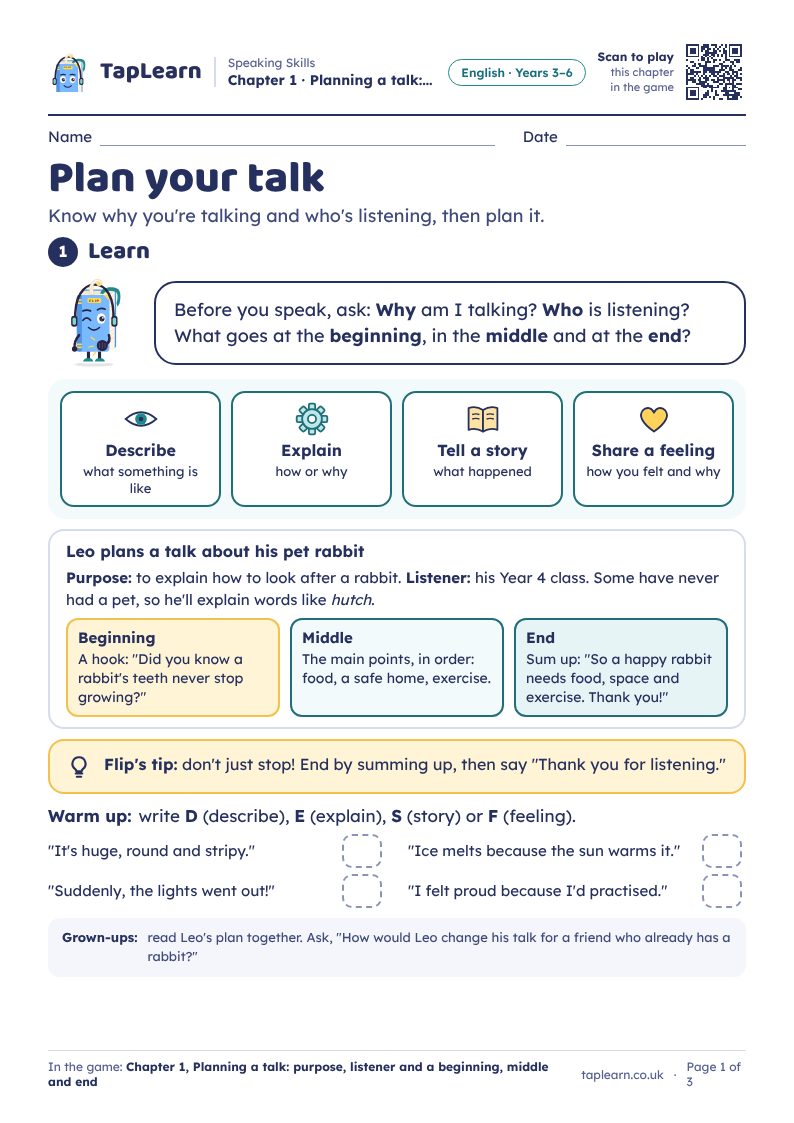
Plan Your Talk is a printable planning a talk worksheet for Years 3 to 6 (ages 7 to 11) that teaches children to ask why they're talking and who is listening, then plan a hook, main points in order and an ending. It covers the national curriculum spoken language statement to give well-structured descriptions, explanations and narratives for different purposes, including for expressing feelings.
Free to print, no account needed.
Print it on A4, in colour or black and white. Do it after the chapter, or before it to see what your child already knows.
What's on the worksheet
Your child chooses a talk's purpose, thinks about who is listening, and plans a beginning, middle and end. Includes a two-listeners speaking activity and an answers sheet.
- Page 1 · Learn
- Four purposes for a talk, Leo's plan for a talk about his rabbit with a hook, middle and ending, Flip's tip to sum up and say thank you, and a purpose warm-up.
- Page 2 · Try it together
- Two listeners: plan a piece of news on your fingers, tell it to a toy pretending to be a 5-year-old, then to the grown-up as the head teacher, and note what you changed.
- Page 3 · Practise
- Ring the purpose of four talks, match listeners to the right way to start, put Sam's castle trip talk in order, plan your own talk, and a challenge about Mia's ending.
- Answers sheet
- Every answer, mix-ups like talking the same way to everyone, and finger-plan and purpose ping-pong ideas.
3 A4 pages and an answers sheet · about 25 minutes
Using it at home
- Read Leo's plan together and ask "How would Leo change his talk for a friend who already has a rabbit?"
- In two listeners, play your part: as the 5-year-old, ask "What's that?" about a long word. Afterwards ask how they knew the talk had ended.
- Before your child tells you about their day, ask them to plan it on their fingers: one beginning, two middle, one end.
Watch out for
- Mixing up purposes.
- Ask "Are you saying what it's like, how or why, what happened, or how you felt?"
- Talking the same way to everyone.
- Ask "Who's listening? What do they already know?"
- Stopping without an ending.
- Practise a closing line: sum up, then "Thank you."
Questions from the worksheet
- What is the purpose of each talk? Ring describe, explain, tell a story or share a feeling: How a seed grows into a sunflower. Why I was nervous at my first swimming club.
- Join each listener to the best way to start: a 5-year-old cousin, the head teacher, your best friend.
- Plan a talk: my favourite place, how to make a sandwich or my best day. Write the purpose, the listener and a beginning, middle and end.
- Mia's holiday talk finishes "…and then we had lunch," and she sits down. Is that a good ending? What could she say instead?
The answers are on the answers sheet, for grown-ups.
National curriculum in England
This worksheet practises this statement from the Years 1–6 english programme of study:
- Give well-structured descriptions, explanations and narratives for different purposes, including for expressing feelings
In the classroom
- Run two listeners in pairs, with one partner role-playing a younger child and then a visitor.
- Play purpose ping-pong as a starter: call out a topic and children give a purpose and first sentence.
Questions and answers
How do children plan a talk?
Decide why you're talking and who is listening, then plan a beginning with a hook, a middle with the main points in order, and an ending that sums up.
What are the purposes of a talk?
A talk can describe what something is like, explain how or why, tell a story about what happened, or share how you felt and why.
How should a child end a talk?
Sum up the main idea, then say "Thank you for listening", so listeners know the talk has finished.
More worksheets from Speaking Skills: Shine on Stage with Echo the Microphone
- Chapter 2: Describing and explaining worksheet: Describe and explain Members
- Chapter 3: Oral storytelling worksheet: Stories and feelings Members
- Chapter 4: Speaking audibly and fluently worksheet: A clear, steady voice Members
- Chapter 5: Spoken Standard English worksheet: Speaking Standard English Members
- Chapter 6: Hooking an audience worksheet: Hook your listeners Members
 TapLearn