Spoken Standard English worksheet for Years 3–6: Speaking Standard English
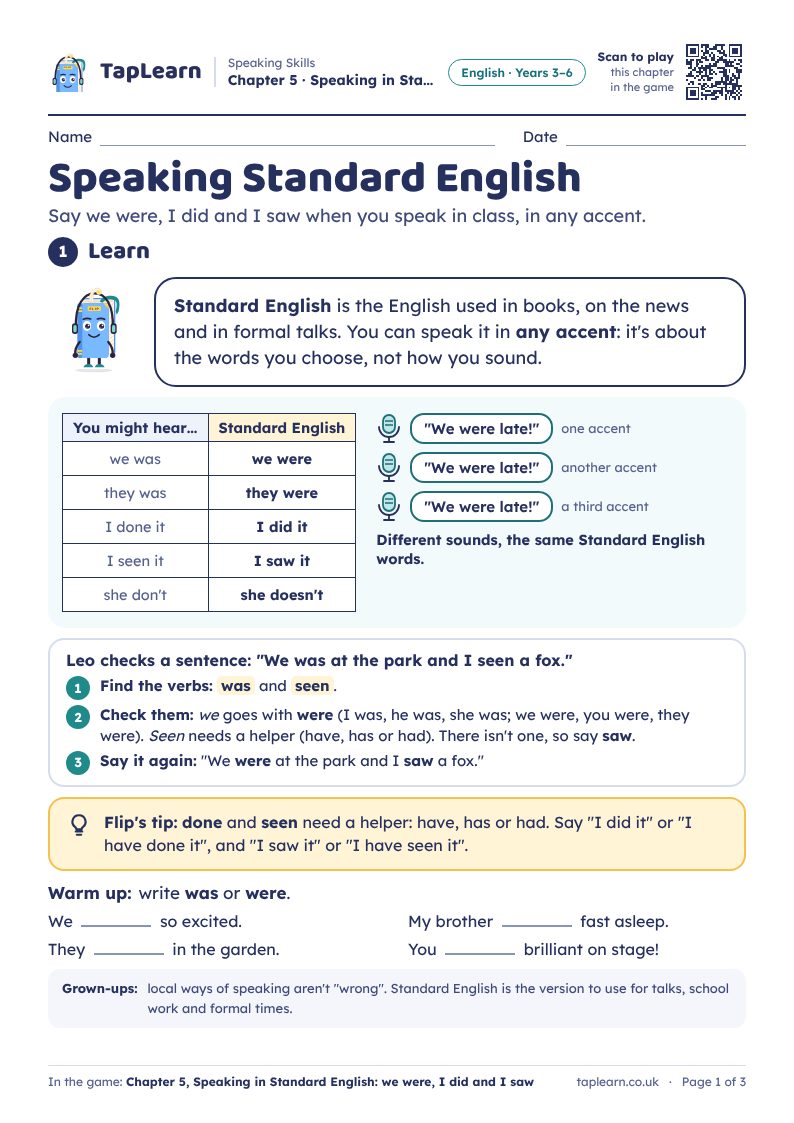
Speaking Standard English is a printable spoken Standard English worksheet for Years 3 to 6 (ages 7 to 11) that teaches children to say we were, I did and I saw, and that Standard English is about words, not accent. It covers the national curriculum spoken language statement to speak audibly and fluently with an increasing command of Standard English.
This worksheet is for members
Membership opens every chapter of every game and every worksheet, for all your children.
See the plansAlready a member? Log in to print it.
Start with the free one: Plan your talk (chapter 1).
Print it on A4, in colour or black and white. Do it after the chapter, or before it to see what your child already knows.
What's on the worksheet
Your child uses Standard English when speaking, such as we were, I did and I saw, and learns that it can be spoken in any accent. Includes a spot-the-switch listening game and an answers sheet.
- Page 1 · Learn
- Common spoken forms and their Standard English versions, the same sentence in three accents, Leo checking the verbs in a sentence, Flip's tip on done and seen, and a was-or-were warm-up.
- Page 2 · Try it together
- Spot the switch: the grown-up reads six sentences, the child holds up a spoon for any that aren't Standard English and says them correctly, then says "We were amazed!" in different voices.
- Page 3 · Practise
- Ring the Standard English choice, rewrite sentences in Standard English, ring times to use it, decide true or false about accents, and a challenge about a Yorkshire accent.
- Answers sheet
- Every answer, mix-ups like thinking it means changing your accent, and newsroom and verb-echo ideas.
3 A4 pages and an answers sheet · about 25 minutes
Using it at home
- Local ways of speaking aren't "wrong". Standard English is the version to use for talks, school work and formal times.
- Keep spot the switch light and playful. If your child holds up the spoon for a correct sentence, read it again and check the verb together.
- Say "they was" or "I seen" and let your child echo it back in Standard English.
Watch out for
- Saying we was or they was.
- Practise aloud: "I was, he was; we were, you were, they were."
- Saying I done, I seen or she don't.
- Done and seen need have, has or had. With he, she or it, say doesn't.
- Thinking Standard English means changing your accent.
- It doesn't: praise their own voice and check the words.
Questions from the worksheet
- Draw a ring round the Standard English: They was / were late for the bus. Yesterday we saw / seen a rainbow.
- Say each sentence in Standard English, then write it: "He done a brilliant drawing." "It don't matter."
- Ring the times when you should use Standard English: giving a talk to your class, chatting with a friend at home, welcoming visitors in assembly.
- Mia says, "I've got a strong Yorkshire accent, so I can't speak Standard English." Is she right? What would you tell her?
The answers are on the answers sheet, for grown-ups.
National curriculum in England
This worksheet practises this statement from the Years 1–6 english programme of study:
- Speak audibly and fluently with an increasing command of Standard English
In the classroom
- Play spot the switch as a whole class, with children showing a card for non-standard sentences.
- Discuss the accent question in Practise D to show Standard English can be spoken in any accent.
Questions and answers
What is spoken Standard English?
Standard English is the English used in books, on the news and in formal talks. It's about which words and verb forms you use.
Do you need to change your accent to speak Standard English?
No. An accent is how words sound. You can say "We were amazed" in any accent and it's Standard English.
Is "I seen it" Standard English?
No. Seen needs a helper like have, so say "I saw it" or "I have seen it".
More worksheets from Speaking Skills: Shine on Stage with Echo the Microphone
- Chapter 1: Planning a talk worksheet: Plan your talk Free
- Chapter 2: Describing and explaining worksheet: Describe and explain Members
- Chapter 3: Oral storytelling worksheet: Stories and feelings Members
- Chapter 4: Speaking audibly and fluently worksheet: A clear, steady voice Members
- Chapter 6: Hooking an audience worksheet: Hook your listeners Members
 TapLearn