Describing and explaining worksheet for Years 3–6: Describe and explain
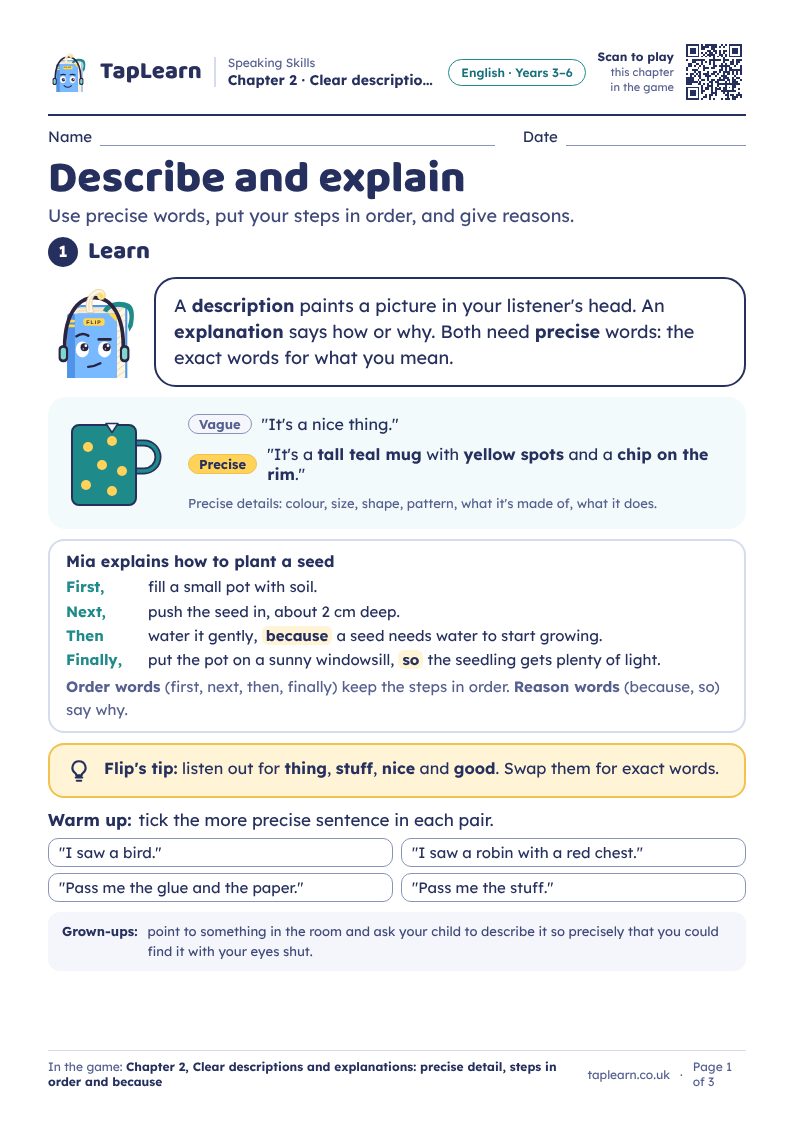
Describe and Explain is a printable describing and explaining worksheet for Years 3 to 6 (ages 7 to 11) that teaches children to swap vague words for precise ones, keep steps in order and give reasons with because and so. It covers the national curriculum spoken language statement to give well-structured descriptions, explanations and narratives for different purposes, including for expressing feelings.
This worksheet is for members
Membership opens every chapter of every game and every worksheet, for all your children.
See the plansAlready a member? Log in to print it.
Start with the free one: Plan your talk (chapter 1).
Print it on A4, in colour or black and white. Do it after the chapter, or before it to see what your child already knows.
What's on the worksheet
Your child gives clear descriptions with precise detail, and explains steps in order using first, next, because and so. Includes a robot instructions activity and an answers sheet.
- Page 1 · Learn
- Vague and precise descriptions of a mug, Mia's explanation of planting a seed with order and reason words, Flip's tip to swap thing, stuff and nice, and a tick-the-precise warm-up.
- Page 2 · Try it together
- Robot instructions: the grown-up is a robot who only does exactly what they hear, and the child explains how to fold a T-shirt using first, next, then and finally until it works.
- Page 3 · Practise
- Ring the more precise words, describe a kite with three details, order the steps for washing hands, fill gaps with because or so, and a challenge about a washing machine.
- Answers sheet
- Every answer, mix-ups like steps out of order, and draw-what-I-say and because-chain ideas.
3 A4 pages and an answers sheet · about 25 minutes
Using it at home
- Point to something in the room and ask your child to describe it so precisely you could find it with your eyes shut.
- In robot instructions, be a very literal robot: if they say "fold it", ask "fold what, where?"
- Play draw what I say: sit back to back while one person describes a simple picture and the other draws it.
Watch out for
- Using vague words like thing, stuff or nice.
- Ask "What colour? What size? What is it called?"
- Explaining steps out of order.
- Ask your child to act each step out as they say it.
- Leaving out the reason.
- "Because" gives a reason and "so" gives a result. Ask "Why?" after a step.
Questions from the worksheet
- Draw a ring round the more precise words: My bag holds my stuff / reading book and lunchbox.
- How to wash your hands: number the steps 1 to 5 in order.
- Fill each gap with because or so: It was pouring with rain, ___ we played inside.
- Ava explains a washing machine: "You put the stuff in, then it goes round and it's done." Is that clear? Say it better, with precise words and order words.
The answers are on the answers sheet, for grown-ups.
National curriculum in England
This worksheet practises this statement from the Years 1–6 english programme of study:
- Give well-structured descriptions, explanations and narratives for different purposes, including for expressing feelings
In the classroom
- Play robot instructions in pairs with a classroom task, like sharpening a pencil.
- Use a because chain as a quick oral warm-up before writing explanations.
Questions and answers
What makes a spoken description clear?
Precise details, such as colour, size, shape, pattern and what it's made of, instead of vague words like thing or nice.
How do order words help an explanation?
Words like first, next, then and finally keep the steps in order, so the listener can follow them.
What is the difference between because and so?
Because gives a reason: "We wear coats because it's cold." So gives a result: "It rained, so we played inside."
More worksheets from Speaking Skills: Shine on Stage with Echo the Microphone
- Chapter 1: Planning a talk worksheet: Plan your talk Free
- Chapter 3: Oral storytelling worksheet: Stories and feelings Members
- Chapter 4: Speaking audibly and fluently worksheet: A clear, steady voice Members
- Chapter 5: Spoken Standard English worksheet: Speaking Standard English Members
- Chapter 6: Hooking an audience worksheet: Hook your listeners Members
 TapLearn