Hooking an audience worksheet for Years 3–6: Hook your listeners
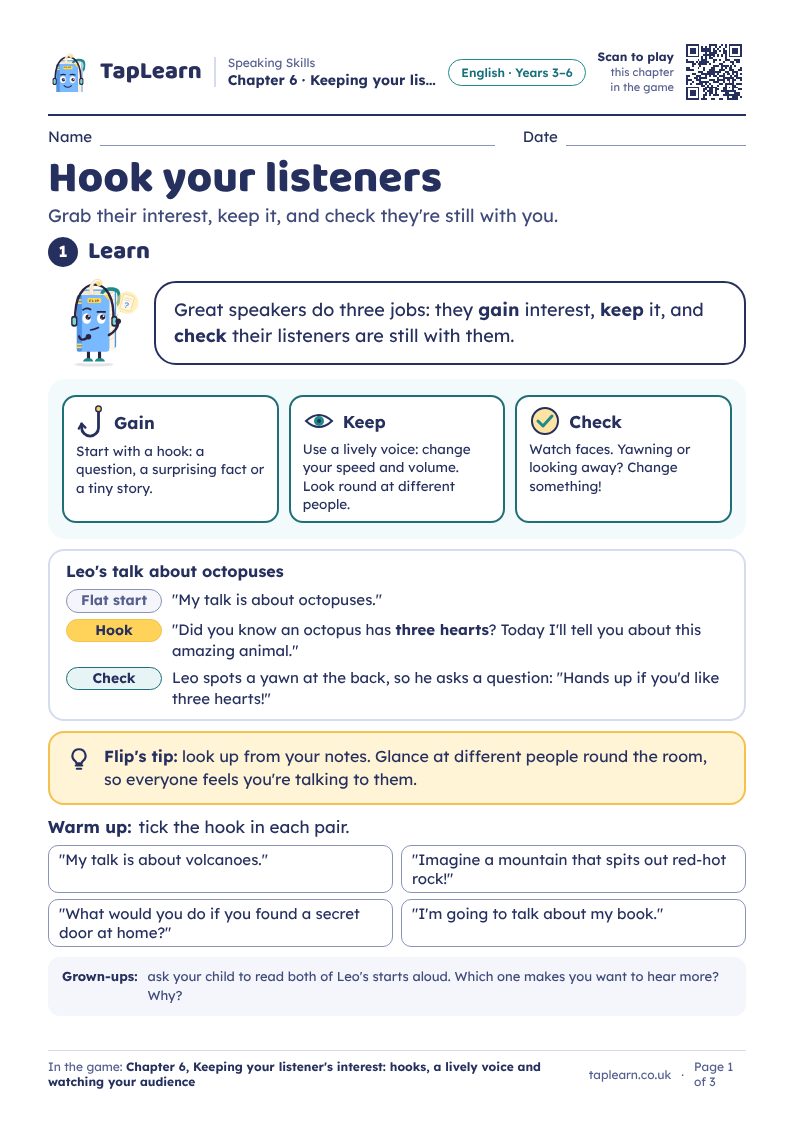
Hook Your Listeners is a printable hooking an audience worksheet for Years 3 to 6 (ages 7 to 11) that teaches children to start with a question or surprising fact, use a lively voice, and change something when listeners look bored. It covers the national curriculum spoken language statement to gain, maintain and monitor the interest of the listener.
This worksheet is for members
Membership opens every chapter of every game and every worksheet, for all your children.
See the plansAlready a member? Log in to print it.
Start with the free one: Plan your talk (chapter 1).
Print it on A4, in colour or black and white. Do it after the chapter, or before it to see what your child already knows.
What's on the worksheet
Your child learns to gain, keep and check a listener's interest: starting with a hook, using a lively voice and eye contact, and spotting when listeners drift off. Includes a face cards talk activity and an answers sheet.
- Page 1 · Learn
- Gain, keep and check explained, Leo's flat start and hook for a talk about octopuses, how he reacts to a yawn, Flip's tip to look up from your notes, and a tick-the-hook warm-up.
- Page 2 · Try it together
- Face cards: draw interested, confused and bored faces, give a 1-minute talk with a hook, and react whenever the grown-up holds up a card, by explaining again or asking a question.
- Page 3 · Practise
- Ring hook or flat start, spot listeners losing interest in Mia's audience, match signs to what to do, write a hook for a talk, and a challenge about Sam reading in a flat voice.
- Answers sheet
- Every answer, mix-ups like missing bored signs, and win-me-back and hook-swap ideas.
3 A4 pages and an answers sheet · about 25 minutes
Using it at home
- Ask your child to read both of Leo's starts aloud and say which one makes you want to hear more, and why.
- In face cards, hold up the cards at random and act them out a little, then ask which was hardest to deal with.
- Take turns turning a flat start, like "This is about dogs", into a hook.
Watch out for
- Starting with no hook.
- Ask "What's the most surprising thing about your topic? Start with that."
- Using a flat voice or keeping eyes on the notes.
- Practise one sentence three ways: excited, mysterious and whispery.
- Missing signs that listeners are bored.
- Ask "What were your listeners' faces doing?" and plan one thing to change.
Questions from the worksheet
- Is each opening a hook or a flat start? "Crash! That was the sound of our tent falling down." "Today I am going to tell you about the Romans."
- Join each sign to the best thing to do: listeners look puzzled; listeners are yawning and fidgeting; the back row says, "We can't hear!"
- Write a hook for one talk: my favourite animal, the best day ever or how to make a paper aeroplane.
- Sam reads his whole talk from his notes in one flat voice, without looking up. His audience starts chatting. What could he do differently? Give three ideas.
The answers are on the answers sheet, for grown-ups.
National curriculum in England
This worksheet practises this statement from the Years 1–6 english programme of study:
- Gain, maintain and monitor the interest of the listener(s)
In the classroom
- Use face cards during short class talks, with the audience holding up cards.
- Run hook swap as a starter before presentations.
Questions and answers
What is a hook in a talk?
A hook is an opening that grabs listeners' interest, like a question, a surprising fact or a tiny story.
How do you keep an audience interested?
Use a lively voice that changes speed and volume, and look round at different people instead of at your notes.
What should you do if listeners look bored?
Change something: ask a question, change your voice or give an example. If they look puzzled, explain again.
More worksheets from Speaking Skills: Shine on Stage with Echo the Microphone
- Chapter 1: Planning a talk worksheet: Plan your talk Free
- Chapter 2: Describing and explaining worksheet: Describe and explain Members
- Chapter 3: Oral storytelling worksheet: Stories and feelings Members
- Chapter 4: Speaking audibly and fluently worksheet: A clear, steady voice Members
- Chapter 5: Spoken Standard English worksheet: Speaking Standard English Members
 TapLearn