Question marks and commas worksheet for Years 1–2: Marks for messages
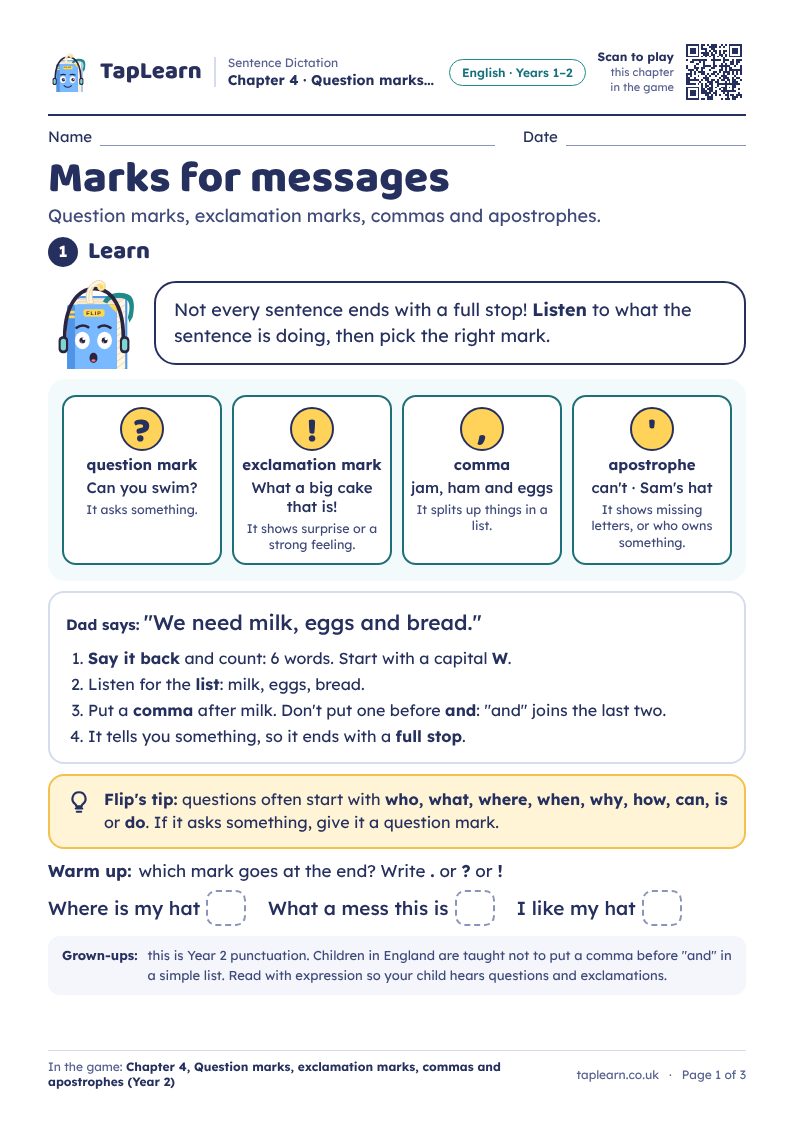
Marks for Messages is a printable question marks and commas worksheet for Years 1 and 2 (ages 5 to 7) that teaches the Year 2 punctuation of question marks, exclamation marks, commas in lists and apostrophes. It covers the Year 2 English statement to write from memory simple sentences dictated by the teacher, including the sounds, common exception words and punctuation taught so far.
What it practises: Pick the right end mark for questions and exclamations, add commas between items in a list, squash words like do not into don't, and use them all when writing dictated sentences.
This worksheet is for members
Membership opens every chapter of every game and every worksheet, for all your children.
See the plansAlready a member? Log in to print it.
Start with the free one: Say it, count it (chapter 1).
Print it on A4, in colour or black and white. Do it after the chapter, or before it to see what your child already knows.
What's on the worksheet
Your child uses question marks, exclamation marks, commas in lists and apostrophes when writing dictated sentences. Includes a what's-in-the-bag list activity and an answers sheet.
- Page 1 · Learn
- The four marks with examples, a worked example writing We need milk, eggs and bread with list commas, Flip's tip on question words, and an end-mark warm-up.
- Page 2 · Try it together
- What's in the bag?: take three kitchen things out of a bag one at a time, say and write them as a list sentence with commas, then write a question about the bag.
- Page 3 · Practise
- Write end marks, add list commas, match short forms like can't, use apostrophes to show who owns something, write dictated sentences, and a challenge about an end mark.
- Answers sheet
- Every answer, mix-ups like a comma before and, and a shopping list sentence idea.
3 A4 pages and an answers sheet · about 25 minutes
Using it at home
- Read with expression so your child hears the difference between questions and exclamations.
- In England, children are taught not to put a comma before "and" in a simple list. Lay a pencil between the things each time your child says "comma".
- Make a shopping list sentence together and let your child say "comma" in the right places.
Watch out for
- Using a full stop instead of ? or !
- Read it back with expression and ask "Is it asking, telling or showing a strong feeling?"
- Missing list commas, or adding one before and.
- Lay things out on the table and say "comma" between each one.
- Leaving out apostrophes, like cant for can't.
- The apostrophe sits where letters were left out: do not becomes don't.
Questions from the worksheet
- Write the right mark at the end: . or ? or ! — What a huge whale it is
- Add the commas to each list: I can see a cat a dog and a hen.
- Draw lines to match the short forms: cannot, do not, I am, it is.
- Leo wrote: Can we go to the park. Is the end mark right? What should it be, and how do you know?
The answers are on the answers sheet, for grown-ups.
National curriculum in England
This worksheet practises this statement from the Year 2 english programme of study:
- Write from memory simple sentences dictated by the teacher that include words using the GPCs (grapheme-phoneme correspondences), common exception words and punctuation taught so far
In the classroom
- Play what's in the bag as a class, with children writing the list sentence on mini-whiteboards.
- Use Practise A as a show-me check: children hold up a full stop, question mark or exclamation mark card.
Questions and answers
What punctuation do children learn in Year 2?
Year 2 children learn question marks, exclamation marks, commas in lists and apostrophes, as well as capital letters and full stops.
Do you put a comma before 'and' in a list?
Children in England are taught not to: milk, eggs and bread. And joins the last two things.
What does an apostrophe do?
An apostrophe shows where letters are missing, as in can't, or who owns something, as in Sam's hat.
 TapLearn